T-Pot
T-Pot is a free, self-hosted honeypot platform for running more than 20 honeypots across multiple architectures.
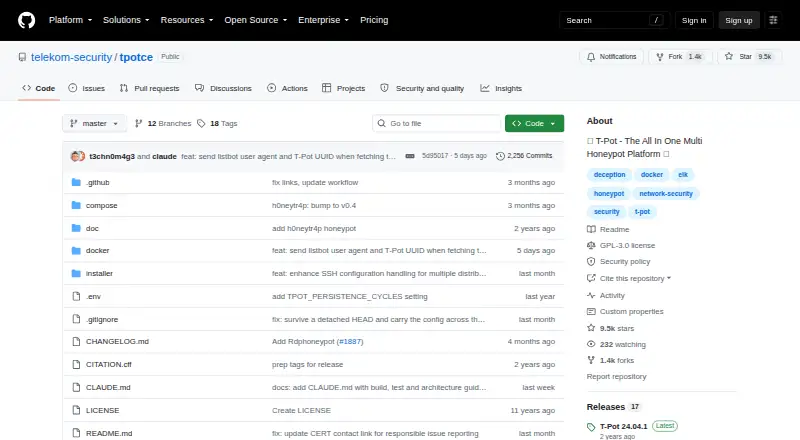
What T-Pot is
T-Pot is a free, self-hosted honeypot platform for running more than 20 honeypots across multiple architectures. It supports standalone and distributed deployments, including hive and sensor installations. For event analysis, Elasticsearch stores events, Logstash ingests and sends them, and Kibana presents dashboards. Network monitoring tools include Fatt, P0f, and Suricata; other included tools include an animated attack map, CyberChef, Elasticvue, and Spiderfoot. The project documents Linux distributions for installation; macOS and Windows use Docker Desktop with a limited feature set. Recommended hardware is 16 GB RAM and a 256 GB SSD for a hive, or 8 GB RAM and a 128 GB SSD for a sensor. Data is submitted to Sicherheitstacho by default, though this can be disabled through configuration. Log persistence defaults to 30 cycles and Elasticsearch indices to 30 days, with both settings adjustable. The project cautions that compromise cannot be ruled out and says honeypots should not contain sensitive data. It is provided as-is without a support commitment.
Good
- Free and self-hosted.
- Includes more than 20 honeypots.
- Supports standalone and distributed deployments.
- Combines event dashboards and network monitoring tools.
Watch out
- macOS and Windows have a limited feature set.
- Recommended hive setup requires 16 GB RAM and a 256 GB SSD.
- Data sharing is enabled by default.
- No support commitment.
Who it suits
T-Pot suits users able to deploy and manage a self-hosted honeypot environment. Its documented hardware recommendations and security cautions matter when choosing a hive or sensor setup.
Verdict
T-Pot brings honeypots, event analysis, and monitoring tools into a self-hosted platform. Review its hardware needs, default data sharing, and security cautions before deploying it.
Plans and prices
From T-Pot's own pricing page, checked 4 Oct 2026.
| Plan | Price | What it gives you |
|---|---|---|
| T-Pot | Free | open source · self-hosted · hardware and network requirements apply |
The facts
Each one read from T-Pot's own pages, with the date it was checked.
What it does
- Analysis stack
- It uses Elasticsearch to store events, Logstash to ingest and send them, and Kibana to display dashboards.checked 4 Oct 2026
- Data sharing
- By default, data is submitted to Sicherheitstacho, and the project says this can be disabled by removing the ewsposter section from the configuration.checked 4 Oct 2026
- Deployment
- T-Pot supports standalone and distributed deployments, including hive and sensor installation types.checked 4 Oct 2026
- Hardware requirements
- The project recommends 16 GB RAM and a 256 GB SSD for a hive, or 8 GB RAM and a 128 GB SSD for a sensor.checked 4 Oct 2026
- LLM honeypots
- The Beelzebub and Galah honeypots require Ollama, while ChatGPT support is described as untested with T-Pot.checked 4 Oct 2026
- Network monitoring
- Included network security monitoring tools include Fatt, P0f, and Suricata.checked 4 Oct 2026
- Operating systems
- The project documents supported Linux distributions and says macOS and Windows use Docker Desktop with a limited feature set.checked 4 Oct 2026
- Purpose
- T-Pot is an all-in-one, optionally distributed honeypot platform supporting multiple architectures and more than 20 honeypots.checked 4 Oct 2026
- Retention
- Log persistence defaults to 30 cycles and the default Elasticsearch index policy keeps indices for 30 days; both can be adjusted.checked 4 Oct 2026
- Security considerations
- The project warns that compromise cannot be ruled out and says honeypots should not contain sensitive data.checked 4 Oct 2026
- Support
- T-Pot is provided as-is without a support commitment; users can report issues and ask general questions through GitHub Issues and Discussions.checked 4 Oct 2026
- Visualization and tools
- Included tools include an animated attack map, CyberChef, Elasticvue, and Spiderfoot.checked 4 Oct 2026
- Vulnerability reporting
- The security policy asks reporters to identify the affected component, provide reproduction details, and check whether the issue is known upstream.checked 4 Oct 2026
The full review of T-Pot
T-Pot is a self-hosted honeypot platform for security practitioners who can provision and isolate dedicated infrastructure. Its breadth of decoys and integrated analysis tools make it a strong fit for a lab or distributed monitoring setup, but the hardware demands and security caveats rule it out as a casual install.
Overview
T-Pot combines more than 20 honeypots in a multi-layer platform, with standalone and distributed deployment options. Distributed installations can use hive and sensor types, which suits teams separating collection from central analysis; a standalone deployment fits a single system. In either case, users operate the infrastructure themselves, and the project provides no support commitment.
Recommended hardware is 16 GB RAM and a 256 GB SSD for a hive, or 8 GB RAM and a 128 GB SSD for a sensor. Those requirements are substantial for a home lab and should shape the decision before deployment. T-Pot submits data to Sicherheitstacho by default; users can disable this by removing the ewsposter section from the configuration.
The project cautions that compromise cannot be ruled out and says honeypots should not contain sensitive data. That makes isolation a core deployment requirement, not a minor operational preference. Log persistence defaults to 30 cycles and Elasticsearch indices to 30 days; both settings can be adjusted.
Key features
T-Pot uses Elasticsearch to store events, Logstash to ingest and send them, and Kibana dashboards to present them. This gives operators an integrated path from captured activity to review, rather than a collection of decoys without a shared analysis layer.
Network security monitoring tools include Fatt, P0f, and Suricata. An animated attack map, CyberChef, Elasticvue, and Spiderfoot add visualization and analysis utilities. The combination is broad, but it also means T-Pot is best suited to users prepared to manage a substantial security stack.
Beelzebub and Galah honeypots require Ollama. ChatGPT support is described as untested with T-Pot, so users should not choose the platform on the assumption that this integration is ready for dependable use.
Pricing
T-Pot is free: the T-Pot plan costs nothing and is open-source and self-hosted. There is no free trial because the software is free to run. The price does not include the hardware or network capacity required to operate it, and there is no hosted plan or support commitment described.
Platforms
T-Pot supports documented Linux distributions. macOS and Windows deployments use Docker Desktop and have a limited feature set, so Linux is the more appropriate choice for users seeking the project's full deployment options. Self-hosting is the operating model across platforms.
Who it's for
T-Pot is for security teams and technically capable users who want multiple honeypots, event analysis, and monitoring tools in one self-managed platform. Its hive-and-sensor options make it particularly relevant to users planning distributed collection. It is a poor fit for anyone without dedicated resources, unwilling to maintain infrastructure, or unable to isolate a system that could be compromised.
Pros and cons
- Pros: More than 20 honeypots, an Elasticsearch-Logstash-Kibana analysis stack, and network monitoring tools are brought together in one platform.
- Pros: Standalone and distributed hive-and-sensor deployments support different collection architectures.
- Pros: The software is free and open source, with adjustable log persistence and index retention.
- Cons: Recommended RAM and SSD requirements are high for a small lab or spare machine.
- Cons: Data sharing is enabled by default, and disabling it requires a configuration change.
- Cons: The project warns that compromise is possible, advises against storing sensitive data in honeypots, and offers no support commitment.
- Cons: macOS and Windows use a limited-feature Docker Desktop setup.
Alternatives
Honeypot Software is the broader category for comparing options. Choose Canarytokens if free tokens deployed through canarytokens.org better suit the job than running T-Pot's self-hosted multi-honeypot stack. OpenCanary is a free, open-source self-hosted option for users seeking an alternative on Linux or macOS.
Honeytrap is another free, self-managed Linux honeypot option. Honeyd may suit users who want a free, GPL-licensed option for Linux or Windows. Beelzebub is a free self-hosted core framework with a trial, and may suit users looking specifically for that framework rather than T-Pot's broader bundle.
Cowrie is a free, BSD-licensed SSH and Telnet honeypot for users focused on those protocols. Endlessh is a free standalone C SSH tarpit, with a default maximum of 4096 clients. MedPot is a free open-source repository that requires Go 1.17 or newer.
Verdict
Choose T-Pot if you want a broad, free honeypot platform with integrated event analysis and monitoring, and have the hardware and operational discipline to isolate and maintain it. Its main advantage is how much it consolidates; look elsewhere if you need a hosted, supported service, a lightweight deployment, or a system that does not carry an explicit compromise risk.
Alternatives to T-Pot
- 1

Canarytokens
Free planAndroidiOSWebSelf-hosted6.6Free plan - 2
OpenCanary
Free planLinuxmacOSSelf-hosted6.5Free plan - 3
Honeytrap
Free planLinuxSelf-hosted6.2Free plan - 4
KFSensor
Windows6.2From $120 a year - 5

Thinkst Canary
WebAPILinuxmacOS6.2From $7,500 a year - 6
Honeyd
Free planLinuxSelf-hostedWindows6.0Free plan