OpenBLD
OpenBLD provides protective DNS intended to block malware, phishing, tracking, and other unwanted domains.
What OpenBLD is
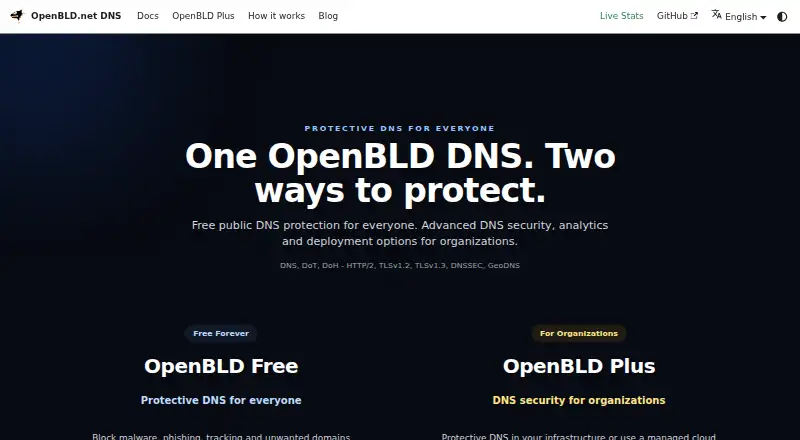
OpenBLD provides protective DNS intended to block malware, phishing, tracking, and other unwanted domains. It supports classic DNS, DNS-over-HTTPS, and DNS-over-TLS. The free service can be configured on phones, browsers, desktops, and routers without installing an agent or other software. Its adaptive ADA profile is intended for most users, while the stricter RIC profile may affect some services. OpenBLD Free is presented for personal use, home networks, and small offices; it is free forever and allows about 100,000 DNS queries per day, subject to a limit of 100 requests per second per IP. OpenBLD Plus is designed for companies, security teams, and managed service providers. It adds organization-specific policies, centralized DNS analytics, security events, and corporate DNS integrations, with Managed Cloud, Dedicated DNS, or On-Premise deployment options. On-Premise keeps DNS traffic, events, and analytics within customer infrastructure. OpenBLD says logs may be enabled for troubleshooting and are not transferred to third parties or used for advertising. The service states that it does not cover YouTube and has no SLA for OpenBLD DNS.
Good
- Supports DNS, DoH, and DoT.
- Free setup requires no agent installation.
- Plus offers on-premise deployment.
- Free plan allows about 100,000 DNS queries daily.
Watch out
- Public DNS is limited to 100 requests per second per IP.
- OpenBLD does not cover YouTube.
- OpenBLD DNS has no SLA.
- The stricter RIC profile may affect some services.
Who it suits
OpenBLD Free is intended for personal use, home networks, and small offices. Plus is aimed at companies, security teams, and MSP or MSSP providers needing centralized policies or deployment choices.
Verdict
OpenBLD offers a no-agent free option and organizational features with multiple deployment choices on Plus. Consider its request limits, lack of DNS SLA, and YouTube coverage exception when assessing fit.
Plans and prices
From OpenBLD's own pricing page, checked 15 Oct 2026.
| Plan | Price | What it gives you |
|---|---|---|
| OpenBLD Free | Free | ~100k DNS queries/day · private, home-network and small-office use · no registration · Free forever |
| OpenBLD Plus | $15 a month | Personal or enterprise support · no limits on redundant requests · incident analysis · Monthly donation of $15+ |
| OpenBLD Plus enterprise deployments | Priced on request | Custom policies · analytics · integrations · professional support · SLA options · Contact for pilot, managed cloud, dedicated DNS or on-premise pricing |
The facts
Each one read from OpenBLD's own pages, with the date it was checked.
What it does
- ADA behavior
- ADA is designed for everyday browsing and allows common Google, Microsoft, Yandex and social-media services.checked 15 Oct 2026
- Audience
- OpenBLD Free is presented for personal use, home networks, and small offices; Plus is designed for companies, security teams, and MSP or MSSP providers.checked 8 Oct 2026
- Chrome extension details
- The Chrome listing shows version 1.1, a 92.02 KiB size and an update date of January 29, 2024.checked 15 Oct 2026
- Corporate integrations
- Documented Plus deployment scenarios include Active Directory DNS, internal zones, upstream resolvers, split DNS, VPN users and dnsdist infrastructure.checked 15 Oct 2026
- Coverage exception
- OpenBLD states that it does not cover YouTube.checked 8 Oct 2026
- Coverage limitation
- The documentation explicitly says OpenBLD does not cover YouTube resources.checked 15 Oct 2026
- Data handling
- The service says logs may be enabled for troubleshooting, are not transferred to third parties or used for advertising, and are anonymized where possible.checked 15 Oct 2026
- Deployment and data control
- Plus is available as Managed Cloud, Dedicated DNS, or On-Premise; On-Premise lets DNS traffic, events, and analytics remain within customer infrastructure.checked 8 Oct 2026
- Deployment choices
- OpenBLD Plus is offered as managed cloud, on-premise or dedicated DNS deployment.checked 15 Oct 2026
- Desktop and router use
- OpenBLD can be configured in browsers, operating systems, home or office routers and mobile devices without an agent.checked 15 Oct 2026
- Documentation and support
- Documentation covers introduction, setup categories, operating modes, Plus deployments, contacts and a dated technical blog; support is offered through Telegram and email.checked 15 Oct 2026
- Filtering modes
- The service offers Adaptive ADA, stricter RIC and OpenBLD Plus modes.checked 15 Oct 2026
- Independent domain fact
- IPAddress.com records the openbld.net domain registration date as May 2, 2023 and identifies GitHub.com as the server header.checked 15 Oct 2026
- Independent infrastructure description
- IPAddress.com describes OpenBLD as a free Anycast and GeoDNS DNS service focused on blocking ads, tracking, telemetry and malicious domains.checked 15 Oct 2026
- Integrations
- Plus integration options may include Active Directory DNS, ClickHouse, VictoriaLogs, Grafana, Prometheus-compatible monitoring, syslog, and SIEM systems.checked 8 Oct 2026
- Licence
- The public GitHub repository for the OpenBLD website is marked CC0-1.0; the service's internal zBLD components are described as internal technology rather than separately licensed source code.checked 15 Oct 2026
- Limit: ECS support
- The Spanish review says OpenBLD does not support EDNS Client Subnet, which can prevent CDNs from selecting the nearest server to the user.checked 15 Oct 2026
- Limit: geographic coverage
- The Spanish review reports that OpenBLD had no point of presence in Spain at the time of its April 2025 test.checked 15 Oct 2026
- Mobile setup
- Android devices use Private DNS configuration, while Apple devices use an installable DNS profile.checked 15 Oct 2026
Where it runs
- Browser extension
- OpenBLD lists an extension for Chrome, Edge, Brave, Vivaldi and Opera, and setup of DNS is required before using it.checked 15 Oct 2026
The company
- Company size
- LinkedIn lists OpenBLD.net as a nonprofit with one employee and headquarters in Almaty, Kazakhstan.checked 15 Oct 2026
- Founded
- 2019checked 28 Sep 2026
- Founded year
- The official chronology says the public OpenBLD.net DNS service launched in 2019 after beginning as Open BLD Sys-Admin DNS Service.checked 15 Oct 2026
- Maker identity
- LinkedIn identifies Yevgeniy Goncharov as the employee associated with OpenBLD.net, while the project blog names him as maintainer.checked 15 Oct 2026
The full review of OpenBLD
OpenBLD is a protective DNS service for blocking malware, phishing, tracking, and other unwanted domains across devices and networks. It fits individuals, households, small offices, and organizations that want DNS-level controls without installing an agent on every Free-plan device. Its strongest case is flexible deployment and organizational control; public-use limits, the lack of a standard DNS SLA, and no YouTube coverage make it a less universal choice.
Overview
OpenBLD has operated since 2019 and uses DNS filtering rather than device-by-device security software. Classic DNS, DNS-over-HTTPS (DoH), and DNS-over-TLS (DoT) are supported, allowing deployment choices across phones, browsers, computers, routers, and managed environments. Free is positioned for personal use, home networks, and small offices, while Plus targets companies, security teams, and managed service providers.
Key features
The ADA profile is designed for typical users and is the better starting point when compatibility matters. RIC applies stricter filtering, which can block more questionable destinations but may also affect services that depend on them. Custom blocklists and advanced activity reports let users tune protection and inspect activity rather than relying only on a fixed filter.
OpenBLD Free needs no agent or additional software. Configuration can be performed directly on phones, browsers, desktops, and routers, which is useful for mixed-device households and small offices. The extension supports Chrome, Edge, Brave, Vivaldi, and Opera, but the underlying service must be configured first. Mobile support covers Android 9 and later and iOS 14 and later.
Public DNS use is capped at 100 requests per second per IP. AXFR and ANY requests are not accepted, and requests from virtual servers or cloud environments may be blocked automatically. These rules are material for hosted infrastructure and high-volume deployments. OpenBLD also states that YouTube is not covered, so it should not be selected where that service is a required filtering target.
Plus adds organization-specific policies, centralized DNS analytics, security events, and corporate DNS integrations. Possible integrations include Active Directory DNS, ClickHouse, VictoriaLogs, Grafana, Prometheus-compatible monitoring, syslog, and SIEM systems. Managed Cloud, Dedicated DNS, and On-Premise deployment cover different control requirements; On-Premise keeps DNS traffic, events, and analytics inside the customer’s infrastructure. Logs may be enabled for troubleshooting, are not transferred to third parties for advertising, and are anonymized whenever possible.
Pricing
| Plan | Price and terms | What you get |
|---|---|---|
| OpenBLD Free | free, free forever | About 100,000 DNS queries per day, private use, and 100 requests per second per IP |
| OpenBLD Plus | Custom pricing; contact OpenBLD for requirements and pricing. Paid plans start from $15/mo. | Managed Cloud, Dedicated DNS, or On-Premise, professional support, and SLA options |
Free is the sensible choice for personal networks and small offices that can stay within its daily and per-IP limits. Plus is for organizations that need centralized policy, analytics, integrations, support, or control over where DNS data is processed. The free tier gives up enterprise deployment and support, while Plus requires a requirements-based quote; the published starting price does not replace that quote.
Platforms
OpenBLD supports Android, iOS, Linux, macOS, Windows, the web, browser extensions, and self-hosted deployments. Router configuration broadens Free’s coverage beyond individually managed devices. Android 9+ and iOS 14+ are supported, and the extension covers Chrome, Edge, Brave, Vivaldi, and Opera after service setup.
Who it's for
Choose Free for household protection, personal devices, or a small office seeking DNS filtering without an installed agent. Choose Plus when a security or IT team needs organization-specific rules, centralized reporting, corporate integrations, professional support, or an On-Premise data boundary. Public-facing cloud workloads and services requiring an SLA should assess the request restrictions and service commitment carefully.
Pros and cons
Pros
- No-agent Free setup: DNS can be configured directly on phones, computers, browsers, and routers.
- Multiple encrypted transports: DoH and DoT supplement classic DNS for varied deployment needs.
- Organizational depth on Plus: Policies, analytics, security events, integrations, and three deployment models support managed environments.
- Data-control option: On-Premise keeps traffic and analytics within customer infrastructure.
Cons
- Public-use ceiling: 100 requests per second per IP and roughly 100,000 daily queries constrain heavier use.
- Cloud and special-request restrictions: Virtual-server traffic may be blocked, and AXFR and ANY are unavailable.
- No YouTube coverage: It is unsuitable when YouTube must be included in filtering.
- No standard DNS SLA: The documentation gives the base DNS service no SLA; SLA options are associated with Plus.
- Support split: Professional support is a Plus benefit, while general and technical questions go through Telegram.
Alternatives
AdGuard DNS is the better comparison for readers who want a freemium service with a free trial and an open-source project. FilterDNS suits readers seeking a free service with no trial. NextDNS is worth considering for a free tier offering 300,000 queries per month, unlimited devices, and unlimited configurations. OpenDNS Home fits users who want a free resolver, including a preconfigured Family Shield option. DNS for Family is another free, family-focused choice with fair-use limits. NxFilter is an alternative with freeware licensing and a paid $7.00-per-month Jahaslist plan. UnveilDNS offers a free Community plan with unlimited devices and requests. Cloudflare Gateway is a better fit for readers who prefer a free business tier for up to 50 users and standard log retention.
For broader category browsing, see Internet Filtering Software.
Verdict
OpenBLD is a strong choice for users and organizations that want DNS protection, no-agent Free deployment, and a path to centralized policies and on-premise control. Select Free for modest personal or small-office networks; select Plus when integrations, professional support, deployment choice, and SLA options justify custom pricing. Look elsewhere if you need YouTube coverage, unrestricted cloud-server use, or a standard SLA on the DNS service.
Alternatives to OpenBLD
- 1

AdGuard DNS
Free planOpen sourceAndroidiOSWebAPI8.6From $29.88 a year - 2

NextDNS
Free planOpen sourceAndroidiOSWebAPI8.6From £1.79 a month - 3

Cloudflare Gateway
Free planAndroidiOSWebAPI8.3$7 usage-based - 4

Control D
Open sourceAndroidiOSWebAPI8.1From $2 a month - 5
DNSFilter
AndroidiOSWebAPI7.8From $1 a month - 6
NxFilter
Free planAndroidWebAPILinux7.6From $60 a year