
NextDNS
NextDNS is a DNS service for blocking security threats, ads, and trackers and for supervising children's internet access across devices and networks.
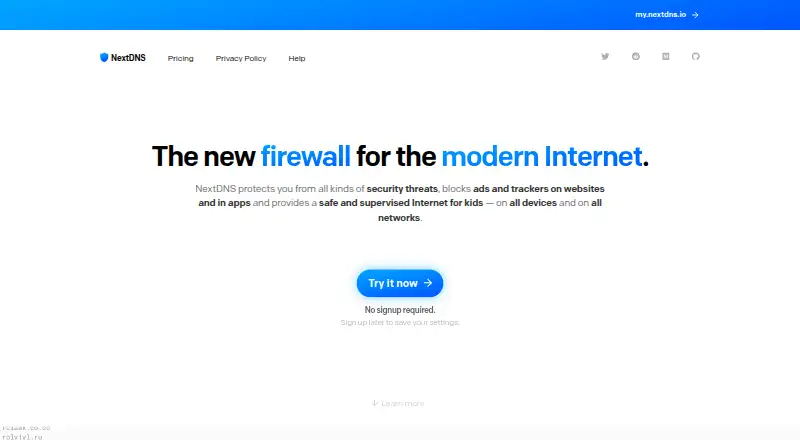
What NextDNS is
NextDNS is a DNS service for blocking security threats, ads, and trackers and for supervising children's internet access across devices and networks. Its protections include malware and phishing, cryptojacking, DNS rebinding, deceptive lookalike domains, domain generation algorithms, and newly registered domains. Parental controls include category filters, SafeSearch, YouTube Restricted Mode, blocked sites, apps and games, and scheduled Recreation Time. DNS-over-HTTPS and DNS-over-TLS provide encrypted DNS connections; IPv4 linked-IP setup is unencrypted. Users can disable logging or choose retention from one hour to two years and select storage in the United States, European Union, United Kingdom, or Switzerland. The free plan includes 300,000 queries per month; after that limit, queries continue to be answered as a non-blocking DNS service. Pro costs £1.79 a month, Business £17.90 a month for every 50 employees, and Education £17.90 a month for every 250 students. Free and Pro list community support; Business and Education list email support.
Good
- Blocks listed security threats, ads, and trackers.
- Includes category filters and scheduled Recreation Time.
- Supports encrypted DNS through DoH and DoT.
- Users can disable logging or choose retention and location.
Watch out
- Free plan includes 300,000 queries per month.
- IPv4 linked-IP setup is unencrypted.
- After the free quota, service becomes non-blocking DNS.
Who it suits
NextDNS suits people seeking threat, ad, and tracker blocking across devices, as well as households wanting internet controls for children. Its logging choices may also suit users who want to configure retention or turn logging off.
Verdict
NextDNS combines DNS-based protection and filtering with parental controls and adjustable logging. The free plan has a monthly query cap, while paid plans list unlimited queries.
Plans and prices
From NextDNS's own pricing page, checked 15 Oct 2026.
| Plan | Price | What it gives you |
|---|---|---|
| Free | Free | 300,000 queries/month · unlimited devices · unlimited configurations · all features · community support · £0/month |
| Pro | £1.79 a month | unlimited queries · unlimited devices · unlimited configurations · all features · community support · personal and close family use · £1.79/month or £17.90/year |
| Business | £17.90 a month | unlimited queries · unlimited devices · unlimited configurations · all features · email support · per 50 employees · £17.90/month or £179/year |
| Education | £17.90 a month | unlimited queries · unlimited devices · unlimited configurations · all features · email support · per 250 students · £17.90/month or £179/year |
The facts
Each one read from NextDNS's own pages, with the date it was checked.
What it does
- Additional controls
- Features include unlimited configurations, custom allowlists and denylists, customizable block pages, DNS rewrites, DNSSEC validation, and experimental Handshake support.checked 30 Sep 2026
- Analytics and logs
- Analytics include real-time logs, Tracker Insights, configurable retention from one hour to two years, and a choice of United States, European Union, United Kingdom or Switzerland storage.checked 15 Oct 2026
- API authentication
- API calls use an X-Api-Key header and the endpoint is api.nextdns.io.checked 15 Oct 2026
- API capabilities
- The API supports profile creation and updates, nested settings and lists, analytics, time-series data, log filtering, server-sent log streaming, log downloads and log deletion.checked 15 Oct 2026
- API status
- The public API documentation labels the API beta and warns that breaking changes may occur without notice.checked 15 Oct 2026
- CLI and self-hosting
- NextDNS publishes an open-source CLI that acts as a DNS53-to-DoH proxy for routers and Unix-like systems and can also use other DoH providers.checked 15 Oct 2026
- CLI licence
- The public NextDNS CLI repository is licensed under MIT.checked 15 Oct 2026
- Configuration features
- Accounts support unlimited configurations, unlimited custom allowlists and denylists, customizable block pages, DNS rewrites, DNSSEC validation and experimental Handshake naming.checked 15 Oct 2026
- Data privacy controls
- The privacy policy says users can choose what is logged, for how long and in which jurisdiction, and can view, export, or delete their data.checked 30 Sep 2026
- Documentation and support
- The Help Center lists 25 getting-started articles, four privacy or blocklist articles, eight how-to guides, four troubleshooting articles, 3,317 discussions, 1,123 ideas and 3,147 bug reports.checked 15 Oct 2026
- Encrypted DNS
- NextDNS supports DNS-over-HTTPS and DNS-over-TLS and says setup works across home, cellular, work and public Wi-Fi networks.checked 15 Oct 2026
- Independent review limits
- TechRadar says setup can be difficult, support is limited and speeds can occasionally suffer; Android Authority notes the 300,000-query free limit can be excessive for a single phone.checked 15 Oct 2026
- Independent review praise
- TechRadar praises NextDNS for strong security, effective ad blocking, customization and reasonable pricing, while Android Authority describes it as a convenient set-and-forget DNS service with detailed analytics.checked 15 Oct 2026
- Limit: G2 reviewers
- G2 reviewers report confusing initial setup, occasional sites or services that require disabling NextDNS, and some ads or trackers still getting through.checked 15 Oct 2026
- Limit: Trustpilot list management
- A Trustpilot reviewer says NextDNS lacks convenient alphabetic sorting and upload or download tools for allowlists and denylists compared with Control D.checked 15 Oct 2026
- Limit: Trustpilot support and updates
- Trustpilot complaints repeatedly mention unanswered support requests and a perception that product development has slowed or stopped.checked 15 Oct 2026
- Network scale
- The homepage reports 132 server locations, about 100 billion queries per month and 15 billion blocked queries per month.checked 15 Oct 2026
- Parental controls
- Controls can block categories such as pornography, violence and piracy, enforce SafeSearch and YouTube Restricted Mode, block named apps or games, and schedule access through Recreation Time.checked 15 Oct 2026
Where it runs
- Apple setup
- The Apple setup page generates a configuration profile for iOS, iPadOS, macOS, and tvOS devices.checked 30 Sep 2026
- Limit: iOS app
- iOS reviewers describe the app as dated, sometimes report Wi-Fi, app or website failures, and say a VPN can take priority over NextDNS DNS.checked 15 Oct 2026
- Limit: Mac app
- Mac reviewers report missing network or SSID detection, a dated client and cases where the menu-bar app appeared not to work.checked 15 Oct 2026
The company
- Company profile
- LinkedIn describes NextDNS as a privately held Wilmington, Delaware technology company founded in 2019 with 11–50 employees.checked 15 Oct 2026
- Maker and founding
- NextDNS Inc. was founded in May 2019 in Delaware by Romain Cointepas and Olivier Poitrey.checked 15 Oct 2026
Money
- Free tier limit
- The free plan includes 300,000 queries per month; after the quota is exceeded, NextDNS says it continues answering queries as a classic non-blocking DNS service.checked 30 Sep 2026
The full review of NextDNS
Overview
NextDNS is a DNS service that filters threats, ads, and trackers while giving users control over children’s internet access. It suits households that want one set of controls across devices and networks, as well as organizations that need managed filtering. Its strongest advantage is the breadth of its controls; the key trade-off is that the free plan stops filtering after its monthly query allowance is used.
Key features
Security and privacy filtering
NextDNS blocks malware and phishing alongside less familiar risks such as DNS rebinding, IDN homographs, typosquatting, domain generation algorithms, and newly registered domains. Ad and tracker blocking includes operating-system-level trackers and third-party trackers disguised as first-party. That breadth makes it useful for people who want filtering beyond ordinary ad blocking, though the service works at the DNS level rather than describing a broader device-security suite.
Family controls and configuration
Parents can block content categories, individual websites, apps, and games, enable SafeSearch and YouTube Restricted Mode, and schedule Recreation Time. Custom allowlists and denylists, customizable block pages, DNS rewrites, DNSSEC validation, and experimental Handshake support add flexibility for people who want more control over how DNS requests are handled. Unlimited configurations make it possible to maintain separate setups without a configuration-count ceiling.
Encrypted DNS and privacy controls
DNS-over-HTTPS and DNS-over-TLS encrypt DNS traffic. Router and device setup options broaden where the service can be applied, but IPv4 linked-IP setup is unencrypted, so users who require encrypted DNS should choose DoH or DoT instead. Apple users can generate a configuration profile for iOS, iPadOS, macOS, and tvOS.
Users can disable logging or choose a retention period from one hour to two years and storage in the United States, European Union, United Kingdom, or Switzerland. They can view, export, or delete their data. NextDNS says it discards DNS request and response data after replying, and logs data only when a user requests it or a feature requires it.
Pricing
NextDNS uses a freemium model, with no free trial. Every plan includes unlimited devices, unlimited configurations, and all features; the differences are query limits, intended use, and support.
- Free — free: 300,000 queries per month and community support. This is a broad way to try the full feature set across unlimited devices, but it is not dependable for continued filtering once usage passes the monthly cap: afterward, NextDNS answers queries as a classic, non-blocking DNS service.
- Pro — £1.79 a month: billed at £1.79/month or £17.90/year, with 17% savings on annual billing. It removes the query cap and is intended for personal and close family use. Community support remains the support option.
- Business — £17.90 a month: billed at £17.90/month or £179/year, with 17% savings on annual billing, for every 50 employees. It has unlimited queries and email support, making it the business-focused tier for small and medium businesses.
- Education — £17.90 a month: billed at £17.90/month or £179/year, with 17% savings on annual billing, for every 250 students. It includes unlimited queries and email support for schools and universities.
Pro is the clearest fit for a household that outgrows the free quota. Business and Education retain the same listed core features but price access by employee or student cohort, rather than by an individual account.
Platforms
NextDNS supports Windows, macOS, Linux, iOS, Android, web, API, extensions, and self-hosted use. It also supports router setup, including a CLI that can run on some routers. Apple configuration profiles cover iOS, iPadOS, macOS, and tvOS.
Who it's for
Choose NextDNS if you want security filtering, tracker blocking, and parental controls in one configurable DNS service, especially across several devices or networks. Families can tailor controls by category, site, app, schedule, and search settings; privacy-focused users can adjust both logging and data location. It is a weaker fit if you need the free service to keep blocking at high query volumes, or if you want encryption but plan to use IPv4 linked-IP setup.
Pros and cons
- Pro: Broad threat coverage. Filtering spans familiar malware and phishing as well as DNS rebinding, typosquatting, and other listed DNS-related threats.
- Pro: Detailed family controls. Category and individual-item blocking combine with SafeSearch, YouTube Restricted Mode, and scheduled Recreation Time.
- Pro: Adjustable logging. Users can turn logs off or choose retention and storage jurisdiction, and can view, export, or delete their data.
- Con: Free filtering has a hard practical limit. After 300,000 monthly queries, DNS replies continue without blocking, which can undermine the protection users chose the service for.
- Con: One setup path is unencrypted. IPv4 linked-IP setup does not encrypt traffic; encrypted DNS requires DoH or DoT.
Alternatives
AdGuard DNS is worth considering if open-source code that anyone can inspect matters to you; it also has a free plan and free trial.
Quad9 is a simpler free alternative, with no contract or sign-up process.
Technitium DNS Server suits people who specifically want a free, open-source, self-hosted DNS server.
AdGuard is another freemium option.
CleanBrowsing is an alternative with a free plan and a paid Basic tier at $8.99 a month, with limits of up to 25 devices or 3.75 million requests per month.
Control D is another freemium alternative with a free trial; its SMB plan is $2 a month on endpoint-based pricing.
GoGuardian DNS offers customized pricing for schools and districts.
Infoblox Cloud Network Automation uses token-based licensing with custom pricing.
For broader comparisons, browse DNS Filtering Software and Internet Filtering Software.
Verdict
NextDNS is a strong choice for families and individuals who want configurable DNS-level protection, privacy controls, and parental filtering across devices. Its unlimited paid plans remove the free tier’s most important constraint, while its logging controls let users choose how much activity data to retain. Look elsewhere if you need free filtering without a query ceiling or require encryption through an IPv4 linked-IP setup.
Getting started
- Visit the NextDNS website and choose the Free, Pro, Business, or Education plan.
- Create a configuration and set threat, privacy, or parental controls such as blocklists and schedules.
- Choose whether to log DNS activity, its retention period, and storage jurisdiction.
- Set up NextDNS on a supported device or router; Apple users can generate a configuration profile.
- For encrypted DNS, configure DNS-over-HTTPS or DNS-over-TLS rather than IPv4 linked-IP setup.
Limits worth knowing
The Free plan includes 300,000 queries per month; above that, NextDNS continues answering as a classic non-blocking DNS service. Pro is £1.79 a month; Business is £17.90 a month for every 50 employees, and Education is £17.90 a month for every 250 students.
Questions
Is NextDNS free?
Yes. The Free plan costs nothing and includes 300,000 queries per month, unlimited devices and configurations, all features, and community support.
What happens after the free query allowance?
After 300,000 queries in a month, NextDNS says it continues answering queries as a classic non-blocking DNS service.
How much do the paid plans cost?
Pro costs £1.79 a month, or £17.90 a year. Business costs £17.90 a month per 50 employees, and Education costs £17.90 a month per 250 students; annual billing for each is 179 GBP.
Which platforms does NextDNS support?
Listed platforms include Android, iOS, Linux, macOS, Windows, web, API, extensions, and self-hosted use. Setup guidance also covers routers and Apple configuration profiles for iOS, iPadOS, macOS, and tvOS.
Does NextDNS offer encrypted DNS?
Yes. It supports DNS-over-HTTPS and DNS-over-TLS. IPv4 linked-IP setup is unencrypted.
Can users control DNS logging?
Yes. Users can disable logging or choose retention from one hour to two years and select storage in the United States, European Union, United Kingdom, or Switzerland.
Alternatives to NextDNS
- 1

AdGuard DNS
Free planOpen sourceAndroidiOSWebAPI8.6From $29.88 a year - 2

Cloudflare Gateway
Free planAndroidiOSWebAPI8.3$7 usage-based - 3

Control D
Open sourceAndroidiOSWebAPI8.1From $2 a month - 4
OpenBLD
Free planAndroidiOSWebAPI7.9From $15 a month - 5
DNSFilter
AndroidiOSWebAPI7.8From $1 a month - 6
NxFilter
Free planAndroidWebAPILinux7.6From $60 a year