
Infoblox Cloud Network Automation
Infoblox Cloud Network Automation centrally automates DDI, DNS, and IPAM provisioning across cloud and virtualized environments.
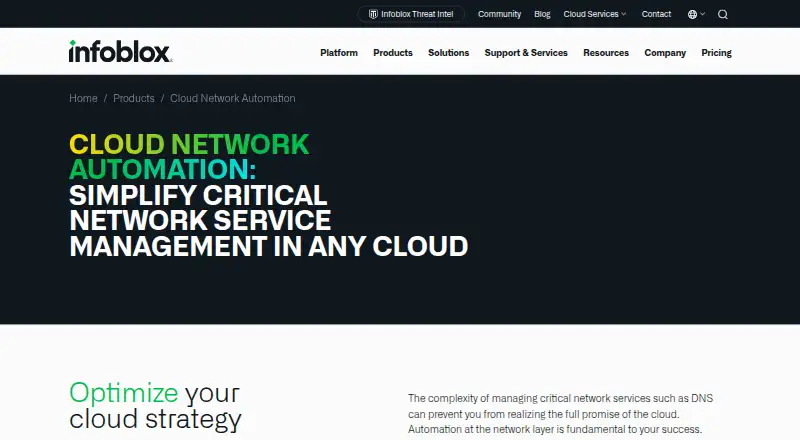
What Infoblox Cloud Network Automation is
Infoblox Cloud Network Automation centrally automates DDI, DNS, and IPAM provisioning across cloud and virtualized environments. A shared control plane provides discovery and visibility into virtual machines and network assets, while cross-cloud reporting covers DNS records, DHCP leases, and IP addresses. Tenant-based management and a central interface help teams oversee cloud and virtualization platforms. Listed integrations include VMware, OpenStack, Ansible, Terraform, Kubernetes, and Docker. APIs manage NIOS objects with role-based access control. Deployment options include virtual appliances for cloud and data-center installations intended to increase scale and reliability; the service also describes local redundant DDI for each cloud instance and location. Cloud provider coverage includes AWS, Microsoft Azure, Google Cloud Platform, and Oracle Cloud. Licensing uses token packs for an agreement term, which can be used across multiple services or capabilities; pricing is on request. Infoblox identifies NetOps and DevOps teams among the intended users. Its Trust Center lists compliance documentation for ISO/IEC 27001, SOC 2, and SOC 3.
Good
- Central control plane discovers virtual machines and network assets
- Audits DNS records, DHCP leases, and IP addresses across clouds
- Integrates with VMware, OpenStack, Ansible, Terraform, Kubernetes, and Docker
- Supports four named cloud providers
- APIs include role-based access control
Watch out
- Pricing is available on request
- No free plan is listed
- Licensing requires token packs for an agreement term
Who it suits
This is aimed at NetOps and DevOps teams managing network services in cloud and virtualized environments. It may suit organizations that need cross-cloud DDI provisioning, auditing, and asset visibility.
Verdict
Cloud Network Automation combines DDI provisioning with discovery and cross-cloud reporting, and lists integrations for several cloud and infrastructure tools. Teams should factor in its term-based token licensing and request pricing details.
Plans and prices
From Infoblox Cloud Network Automation's own pricing page, checked 30 Sep 2026.
| Plan | Price | What it gives you |
|---|---|---|
| Token-based licensing | Priced on request | No public product price listed · token packs are sized to customer requirements · Tokens are purchased as an allowance for use over an agreement term; contact Infoblox for pricing. |
The facts
Each one read from Infoblox Cloud Network Automation's own pages, with the date it was checked.
What it does
- APIs and access control
- Infoblox says its APIs manage NIOS objects with role-based access control (RBAC).checked 30 Sep 2026
- Auditing
- The product supports cross-cloud auditing and reporting for DNS records, DHCP leases, and IP addresses.checked 30 Sep 2026
- Availability
- Infoblox says it can deliver local redundant DDI services for each cloud instance and location.checked 30 Sep 2026
- Deployment
- The product supports virtual appliance options for cloud deployments and deployment in data centers to increase scale and reliability.checked 30 Sep 2026
- Integrations
- The page lists IPAM integrations with VMware, OpenStack, Ansible, Terraform, Kubernetes, and Docker.checked 30 Sep 2026
- Intended users
- The product page describes the offering for teams managing cloud network services and names NetOps and DevOps among the relevant roles.checked 30 Sep 2026
- Licensing
- Infoblox describes token-based licensing in which customers purchase token packs for a contract term and use them across multiple services or capabilities.checked 30 Sep 2026
- Management
- Its capabilities include tenant-based management, cloud resource visibility, and a centralized management interface across cloud and virtualization platforms.checked 30 Sep 2026
- Purpose
- Cloud Network Automation centrally automates DDI, DNS, and IPAM provisioning in cloud and virtualized environments.checked 30 Sep 2026
- Security and compliance
- Infoblox’s Trust Center lists compliance documentation including ISO/IEC 27001, SOC 2, and SOC 3.checked 30 Sep 2026
- Support
- Infoblox provides a customer support portal and lists technical account management, professional services, and education services.checked 30 Sep 2026
- Visibility
- It provides visibility and discovery into virtual machines and network assets through a single control plane.checked 30 Sep 2026
The company
- Company history
- Infoblox says it was founded in 1999 in Chicago, Illinois, by Stuart Bailey.checked 30 Sep 2026
- Founded
- 1999checked 28 Sep 2026
- Headquarters
- Infoblox lists its global headquarters at 2390 Mission College Boulevard, Suite 501, Santa Clara, California 95054, USA.checked 30 Sep 2026
The full review of Infoblox Cloud Network Automation
Infoblox Cloud Network Automation is built for enterprise teams that need to coordinate DNS, DHCP and IP address management across several cloud and virtual environments. It is a strong fit for NetOps and DevOps groups seeking one operational view across providers, while organizations with modest or single-cloud needs may find its licensing model harder to justify.
Overview
The platform brings DDI provisioning into a centralized control plane and adds discovery of virtual machines and other network assets. Tenant-oriented administration, cloud-resource visibility and cross-environment management are useful when responsibility is split among teams or business units. Coverage spans AWS, Microsoft Azure, Google Cloud Platform and Oracle Cloud, giving multicloud enterprises a broad operating scope.
Infoblox supports virtual appliances for cloud deployments as well as data-center deployment options intended to improve scale and resilience. Local redundant DDI services can be delivered for each cloud instance and location, which suits distributed architectures that cannot depend on a single central service. Hybrid deployment is supported across API, Linux, self-hosted, web and Windows environments.
Key features
Provisioning and integrations
Automation covers DNS, DHCP and IPAM provisioning from one management interface. Integrations with VMware, OpenStack, Ansible, Terraform, Kubernetes and Docker connect address management with virtualization, infrastructure-as-code and container workflows. That breadth is valuable for teams standardizing network changes across varied tooling, though it also positions the product as an enterprise coordination layer rather than a lightweight utility.
Visibility, auditing and control
Discovery and inventory functions provide views of virtual machines, devices, layer-2 physical infrastructure and layer-3 logical networks. Topology mapping, scheduled discovery, asset and device inventories, vendor monitoring and continuous attack-surface score refresh support ongoing oversight. Cross-cloud auditing reports on DNS records, DHCP leases and IP addresses, helping organizations trace changes and review service usage.
APIs manage NIOS objects with role-based access control, while configuration management, workflow orchestration, network testing, zero-touch deployment and access-policy provisioning support repeatable operations. Custom domain policies, activity reports, encrypted DNS through DoH and roaming protection extend the policy and reporting side of the platform. Enterprise network scope and full attack-surface coverage indicate a product aimed at broad infrastructure governance.
Pricing
Infoblox uses token-based licensing rather than a public per-user price. Customers buy token packs as an allowance for use during an agreement term, with packs sized to their requirements and usable across multiple services or capabilities. Pricing is custom, so buyers should model expected consumption and clarify renewal and term commitments before selecting it. There is no free plan.
Platforms
The hybrid deployment model supports API, Linux, self-hosted, web and Windows access. Cloud-provider coverage includes AWS, Microsoft Azure, Google Cloud Platform and Oracle Cloud. Virtual appliances can run in cloud environments, while data-center deployment options address organizations that need local infrastructure and additional resilience.
Who it's for
NetOps and DevOps teams managing enterprise cloud network services are the clearest audience. It makes sense for organizations operating multiple providers, virtualization platforms and locations, especially where centralized auditing, tenant separation and infrastructure-as-code integration matter. Smaller teams, single-cloud deployments or buyers requiring transparent entry pricing should look closely at the token commitment before proceeding.
Pros and cons
- Pro: Centralized DNS, DHCP and IPAM automation reduces the need to coordinate separate provisioning systems across clouds.
- Pro: Multicloud discovery, topology, inventory and cross-cloud auditing provide a broad operational picture.
- Pro: VMware, OpenStack, Ansible, Terraform, Kubernetes and Docker integrations fit mixed infrastructure and automation pipelines.
- Pro: Local redundant DDI services and hybrid deployment options support distributed and resilience-focused architectures.
- Con: Token packs billed for an agreement term make budgeting and capacity planning less straightforward than simple subscription pricing.
- Con: Custom pricing and no free plan make it difficult for smaller organizations to evaluate without a sales process.
Alternatives
Cloudflare Access is a freemium, multi-platform option with a free plan for under 50 users, better suited to teams prioritizing access control and a low-commitment starting point.
Tailscale offers a free Personal plan for up to six users and unlimited user devices, making it a simpler choice for smaller private-network deployments.
ZeroTier provides freemium networking with a Personal plan covering 10 devices and one network, useful when lightweight virtual networking is the priority.
F5 BIG-IP APM is a paid access-management product with perpetual-license options for virtual, hardware or hybrid environments.
Cilium is free, open source and Linux-focused, appropriate when a team wants a kernel-based networking platform rather than a commercial DDI suite.
BlueCat Horizon is a paid DDI orchestration alternative licensed by unique active IP.
NetBox offers freemium network documentation through hosted and self-hosted options.
OpenStack Neutron is a free networking service for OpenStack environments.
For broader category comparisons, see Cloud Network Management Software, Network Provisioning Software, Network Documentation Software, Network Configuration Management Software, Security Ratings Software and DHCP Management Software.
Verdict
Choose Infoblox Cloud Network Automation when an enterprise needs centralized, multicloud DDI automation with discovery, auditing, policy control and integrations spanning infrastructure and container tools. Its main reason to look elsewhere is the term-based token model with custom pricing: organizations that need a small, predictable or freely testable deployment will find simpler alternatives easier to assess.
Alternatives to Infoblox Cloud Network Automation
- 1

Tailscale
Free planOpen sourceAndroidiOSWebAPI8.7From $1 a month - 2

ZeroTier
Free planAndroidiOSWebAPI8.2From $18 a month - 3

NetBox
Free planOpen sourceWebAPILinuxSelf-hosted7.6Free plan - 4
Cloudflare WAN (formerly Magic WAN)
Free planWeb6.4$7 usage-based - 5
Cisco Catalyst Center
WebAPILinuxmacOS6.2 - 6
BlueCat Horizon
WebAPILinuxWindows6.1