ZeroTier
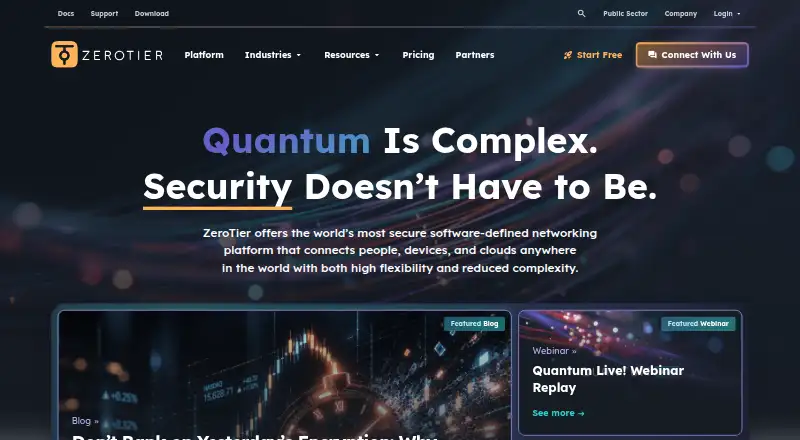
ZeroTier is a software-defined networking platform for connecting people, devices, and cloud environments through secure virtual networks.
What ZeroTier is
ZeroTier is a software-defined networking platform for connecting people, devices, and cloud environments through secure virtual networks. Its network overlays can span public clouds, private data centers, on-premises systems, remote devices, and edge systems. Security features include cryptographic device identity, end-to-end traffic encryption, peer-to-peer connections when possible, and centrally defined policies enforced globally. Capabilities include cloud-to-cloud networking, global device fleets, identity-based access control, Layer 2 and Layer 3 networking, and programmable management. The platform supports hybrid deployment and lists coverage for major cloud providers including AWS, Azure, Google Compute Engine, and Oracle Cloud Infrastructure. Documentation includes API guides and tutorials for Docker, code-server, Terraform, webhooks, and Prometheus/Grafana monitoring. Personal is for non-commercial use and covers 10 devices, one network, and one network admin. Essential costs $18 a month and includes 10 devices, with additional devices at $2.00 each. Scale costs $179 a month and includes 100 devices, with additional devices at $1.80 each. Enterprise and Quantum use custom pricing. Quantum is described for post-quantum networking and air-gapped deployments.
Good
- Supports Layer 2 and Layer 3 networking.
- Uses end-to-end traffic encryption and cryptographic identities.
- Offers hybrid deployment and multicloud support.
- Includes API access on the Essential plan.
- Infrastructure-as-code support is listed.
Watch out
- Personal plan is for non-commercial use only.
- Personal includes just 10 devices.
- Network monitoring is listed as unavailable.
- Essential costs $18 a month.
Who it suits
ZeroTier suits organizations connecting devices and cloud or on-premises environments through virtual networks. Its Personal plan is specifically limited to non-commercial use.
Verdict
ZeroTier combines virtual networking across cloud, on-premises, and remote environments with policy controls and encrypted traffic. Plan limits and paid costs matter when choosing it for larger or commercial deployments.
Plans and prices
From ZeroTier's own pricing page, checked 15 Oct 2026.
| Plan | Price | What it gives you |
|---|---|---|
| Essential | $18 a month | Commercial license · 10 included devices · $2.00 per additional device · 10 networks · 5 admins · ticketed support with SLA · API and AI-agent access · OIDC SSO · 30-day audit logs · Per Month |
| Scale | $179 a month | Commercial license · 100 included devices · $1.80 per additional device · unlimited networks · 10 admins · custom flow rules · ticketed support with SLA · Per Month |
| Quantum | Priced on request | Separate post-quantum platform · CNSA 2.0/FIPS 203 mandate support · sovereign and air-gapped environments · Commercial Billing Available |
| Personal | Free | Personal non-commercial use · 10 devices · 1 network · 1 network admin · CLI, UI and webhooks · community support |
| Enterprise | Priced on request | 500+ devices · unlimited networks and admins · self-hosted and air-gapped deployment · HSM and embedded processor support · 90-day audit logs · priority support with enhanced SLA · Commercial Billing Available |
The facts
Each one read from ZeroTier's own pages, with the date it was checked.
Where it runs
- Air-gapped use
- The maker says ZeroTier Quantum can be deployed fully in air-gapped environments, with policy enforced locally and endpoints exclusively generating and holding keys.checked 30 Sep 2026
What it does
- API surface
- The agent and Central expose APIs for querying networks and peers and for managing network configuration and membership.checked 15 Oct 2026
- Central API authentication
- New Central uses service-account API tokens for automated workflows and team access, and this requires the Essential plan or higher.checked 15 Oct 2026
- Compatibility
- Supported platforms include Linux, macOS, Windows, iOS/iPadOS, Android and FreeBSD, with ARM, x86, MIPS and s390x architectures.checked 15 Oct 2026
- Compliance
- ZeroTier states that it is SOC 2 Type II certified and directs customers to its Trust Center for compliance reports.checked 15 Oct 2026
- Developer integrations
- Official developer documentation covers Docker, code-server, Terraform, sockets, webhooks and Prometheus/Grafana observability.checked 15 Oct 2026
- Documentation depth
- The documentation includes getting-started guides, platform notes, API references, troubleshooting, security, SLA, glossary and developer-tool tutorials.checked 15 Oct 2026
- End-to-end encryption
- ZeroTier states that traffic uses asymmetric encryption and private keys remain on the device.checked 15 Oct 2026
- Features
- Capabilities include cloud-to-cloud networking, global device fleets, identity-based access control, Layer 2 and Layer 3 networking, and programmable network management.checked 30 Sep 2026
- Funding investors
- Crunchbase lists Series A funding and names Anorak Ventures, Battery Ventures and Bonfire Ventures among the investors.checked 15 Oct 2026
- Identity access control
- Each network member is identified and authenticated cryptographically, and ZeroTier supports identity-based access control and local policy enforcement.checked 15 Oct 2026
- Integrations
- The maker’s documentation includes API guides and tutorials for Docker, code-server, Terraform, webhooks, and Prometheus/Grafana monitoring.checked 30 Sep 2026
- Licence
- The public ZeroTierOne repository uses MPL-2.0 for most core code but separately identifies non-free source-available portions, so the complete product is not uniformly open source.checked 15 Oct 2026
- Limit: advanced routing documentation
- Capterra reviewers report that routing between ZeroTier and physical LANs can be complicated and that official documentation does not cover every issue.checked 15 Oct 2026
- Limit: interface and learning curve
- G2 and Capterra reviewers mention a dated or confusing dashboard, limited UI polish and a learning curve for advanced networking.checked 15 Oct 2026
- Limit: mobile functionality
- Google Play reviewers request always-on VPN, simultaneous multiple-network connections and better recovery after switching between Wi-Fi and cellular networks.checked 15 Oct 2026
- Limit: reliability and support complaints
- Trustpilot reviewers report intermittent connectivity, difficult uninstallation, delayed bug fixes, expensive forced plans and slow or unclear paid support responses.checked 15 Oct 2026
- Multi-cloud networking
- ZeroTier supports networks spanning public clouds, private data centers, on-premises environments, self-hosted networks, air-gapped networks and edge systems.checked 15 Oct 2026
- Networking
- Networks operate as secure virtual overlays spanning public clouds, private data centers, on-premises environments, remote devices, and edge systems.checked 30 Sep 2026
The company
- Company headquarters and size
- LinkedIn lists San Francisco, California headquarters and a company size of 11–50 employees.checked 15 Oct 2026
- Company history
- ZeroTier says its open-source release went live in 2013, after founder Adam Ierymenko began the project as a side project.checked 30 Sep 2026
- Company legal name
- Crunchbase lists the legal name as ZeroTier, Inc.checked 15 Oct 2026
- Founded
- LinkedIn lists 2013 as the founding year, matching the maker’s history of its open-source release in 2013.checked 15 Oct 2026
Money
- Free plan
- Yeschecked 20 Sep 2026
The full review of ZeroTier
ZeroTier is software-defined networking for connecting devices, clouds, and data centers through virtual networks. It suits teams that need centrally managed connectivity across mixed infrastructure, as well as individuals with modest non-commercial needs. Its flexible reach and policy controls are compelling, but device limits and escalating per-device charges deserve attention as deployments grow.
Overview
ZeroTier builds secure virtual overlays across public clouds, private data centers, on-premises systems, remote devices, and edge environments. That makes it a useful fit for organizations managing connectivity across more than one kind of infrastructure, rather than only linking users to a single private network.
Cryptographic device identity, end-to-end encryption, and peer-to-peer connections when possible form the security foundation. Centrally defined policies are enforced globally, giving administrators a consistent way to govern access across distributed networks. The platform supports both Layer 2 and Layer 3 networking, identity-based access control, and programmable network management.
Key features
ZeroTier covers cloud-to-cloud networking and global device fleets, with infrastructure-as-code support and VPN and firewall policy management. It supports DigitalOcean, Amazon Web Services, Google Compute Engine, Microsoft Azure, Oracle Cloud Infrastructure, Alibaba Cloud, IBM Cloud, Vultr, and Equinix Metal. Documentation includes API guides and tutorials for Docker, code-server, Terraform, webhooks, and Prometheus/Grafana monitoring, giving technical teams routes to automate and integrate network operations.
One notable gap is network monitoring: ZeroTier does not include it. Teams needing monitoring should plan to use other tooling rather than treating the networking platform as an all-in-one operations console.
The maker lists SOC 2 Type II, FIPS 140-3, and GDPR among its trust badges. ZeroTier Quantum is a separate high-security offering that implements the CNSA 2.0 algorithm suite, including ML-KEM-1024 and ML-DSA-87; the maker also says it can run air-gapped, with local policy enforcement and endpoints generating and holding keys. Its focus is sovereign and mission-critical environments, and its custom pricing puts it in a different buying conversation from the standard plans.
Pricing
ZeroTier is freemium, with paid plans starting at $18 a month. Personal has no published price and is for non-commercial use; it allows 10 devices, one network, and one network admin. Community support is included. Its strict device and network caps make it suitable for personal setups, not growing commercial deployments.
Essential costs $18 a month, billed per month. It includes 10 devices, with each additional device costing $2.00, plus 10 networks, five admins, API and AI agent access, OIDC SSO, and 30-day audit logs. Community support remains the support option. The plan adds meaningful administration and identity features, but the per-device charge can add up for larger fleets.
Scale costs $179 a month, billed per month. It includes 100 devices, with each additional device at $1.80, unlimited networks, 10 admins, custom flow rules, and ticketed support with an SLA. This is the more capable choice for larger deployments that need custom policy and formal support, though the monthly commitment is substantially higher than Essential.
Enterprise has custom pricing and starts at 500 devices, with unlimited networks and admins and 90-day audit logs. It includes priority support with an enhanced SLA, making it the tier aimed at large organizations with stronger support and audit requirements. Quantum also uses custom pricing and is positioned for post-quantum networking in high-security, sovereign, and mission-critical environments.
Platforms
ZeroTier supports Android, iOS, Linux, macOS, and Windows, alongside API, web, and self-hosted options. That breadth suits mixed-device environments and teams that need to manage networking programmatically or operate their own deployment.
Who it's for
Choose ZeroTier if you need virtual networking across cloud providers, data centers, on-premises infrastructure, and remote devices, with centrally enforced policy and several plan levels. Personal is the constrained option for non-commercial use; Essential suits smaller commercial setups needing API access or SSO; Scale and Enterprise are better aligned with larger device fleets and support requirements. Look elsewhere if built-in network monitoring is a must, or if your deployment would quickly outgrow the lower tiers’ device allowances.
Pros and cons
- Pros: It connects across cloud, on-premises, and remote environments, giving mixed infrastructure a shared virtual-network layer.
- Pros: Device identity, encrypted traffic, and centrally enforced policy give administrators security controls across distributed networks.
- Pros: API access, infrastructure-as-code support, and tutorials for tools such as Terraform and Docker give technical teams practical integration paths.
- Cons: Personal is limited to non-commercial use, 10 devices, one network, and one admin, so it is not a route to a free business deployment.
- Cons: Essential and Scale charge for devices beyond their included allowances, which makes fleet growth a direct cost consideration.
- Cons: Network monitoring is not included, so teams must account for a separate monitoring approach.
Alternatives
Tailscale is worth considering for individuals or small groups who prioritize a free plan with up to six users and unlimited user devices; its listed platforms cover Android, iOS, Linux, macOS, web, and Windows. Alkira is a paid alternative with web access. Infoblox Cloud Network Automation is a paid option with API, Linux, self-hosted, web, and Windows platforms, using token-based licensing. PacketFabric is a paid alternative with API and web access and no free plan. Megaport Cloud Router is another paid API and web option, with no free plan. Equinix Fabric is a paid API and web alternative without a free plan. Cisco Catalyst Center is a paid option with broad platform support and a subscription requirement for managed devices. Cilium is a free, open-source Linux option for users whose needs fit its Linux kernel and architecture requirements.
Browse Cloud Network Management Software or Business VPN Software for more options in those categories.
Verdict
ZeroTier is a strong choice for teams that need secure, policy-managed virtual networking across varied infrastructure and value API-driven administration. Its clearest reason to choose is that breadth paired with centrally enforced controls; its clearest reason to look elsewhere is the cost and device accounting required as a deployment scales, along with the absence of built-in network monitoring. Personal users should stay within its non-commercial limits, while businesses should match the device allowance and support tier to their actual fleet.
Getting started
- Open the ZeroTier website
- Choose Personal, Essential, Scale, Enterprise, or Quantum
- Install the client on supported devices or use the self-hosted option
- Create or join a virtual network
- Apply identity and firewall policies
- Connect cloud, infrastructure-as-code, or monitoring tools through documented integrations
Limits worth knowing
Personal covers 10 devices, one network, and one network administrator, and is for non-commercial use. Essential includes 10 devices with additional devices at $2.00 each; Scale includes 100 with additional devices at $1.80 each. Enterprise supports 500+ devices, while Quantum uses custom pricing.
Questions
Is ZeroTier free?
Yes. ZeroTier has a free Personal plan for non-commercial use.
What does Essential cost?
Essential costs $18 a month and includes 10 devices, 10 networks, 5 administrators, API and AI agent access, OIDC SSO, and 30-day audit logs.
Which systems can run ZeroTier?
ZeroTier supports Android, iOS, Linux, macOS, Windows, web, API access, and self-hosted deployment.
Does ZeroTier support cloud providers?
Yes. Listed providers include DigitalOcean, Amazon Web Services, Google Compute Engine, Microsoft Azure, Oracle Cloud Infrastructure, Alibaba Cloud, IBM Cloud, Vultr, and Equinix Metal.
What is ZeroTier Quantum?
Quantum provides post-quantum networking for high-security, sovereign, and mission-critical environments. It can be deployed fully air-gapped and uses custom pricing.
What support is included?
Personal and Essential include community support. Scale includes ticketed support with an SLA, while Enterprise includes priority support with an enhanced SLA.
Alternatives to ZeroTier
- 1
Tailscale
Free planOpen sourceAndroidiOSWebAPI9.4From $1 a month - 2

Windscribe
Free planOpen sourceAndroidiOSWebExtension9.1From $3 a month - 3

NetBird
Free planAndroidiOSLinuxmacOS9.0From €6 a month - 4
Twingate
Free planAndroidiOSWebAPI8.9From $5 a month - 5

GoodAccess
Free planAndroidiOSWebLinux8.8Free plan - 6

OPNsense
Free planOpen sourceAndroidiOSWebAPI8.8Free plan