
Quad9
Quad9 is a free recursive DNS platform that focuses on security, performance, and privacy.
What Quad9 is
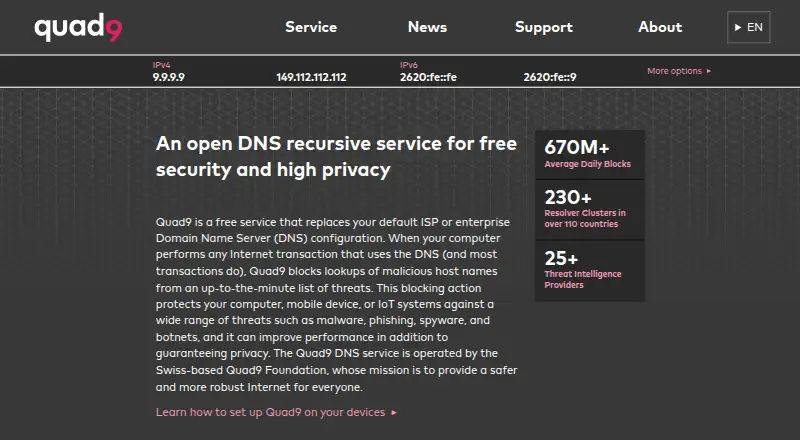
Quad9 is a free recursive DNS platform that focuses on security, performance, and privacy. It blocks DNS requests to domains associated with malware, viruses, adware, phishing, and scams, drawing on information from more than 20 threat intelligence partners. Its resolver services provide DNSSEC validation, and it supports DNS over TLS, DNS over HTTPS, and DNSCrypt. Quad9 says it does not retain end-user IP addresses and is governed by Swiss privacy law. The service focuses on malicious domains rather than content filtering, and it does not offer custom domain policies. Documentation covers setup with Cloudflared, Pi-hole, and open-source routers including pfSense, OPNsense, OpenWrt, MikroTik RouterOS, and IPFire. The support team helps with setup questions and issues. Quad9 reports 99.999% uptime for its global anycast service. The service is free for everyone, with no contract or sign-up process, and is listed for Android, iOS, Linux, macOS, and Windows. Quad9 asks large organisations planning high-volume DNS traffic to contact it first. Its service went online in August 2016, and the organisation launched in 2017.
Good
- Free, with no contract or sign-up
- Blocks domains tied to several types of threats
- Supports three encrypted DNS protocols
- Does not store end-user IP addresses
Watch out
- No content filtering
- No custom domain policies
- Large-scale DNS users are asked to contact Quad9
Who it suits
Quad9 may suit home users and enterprises seeking DNS-based blocking of malicious domains. It is also aimed at users who want encrypted DNS options across the listed platforms.
Verdict
Quad9 is a free DNS option centered on malicious-domain blocking, with multiple encryption choices and broad platform support. It does not filter general content or allow custom domain policies.
Plans and prices
From Quad9's own pricing page, checked 1 Oct 2026.
| Plan | Price | What it gives you |
|---|---|---|
| Quad9 DNS service | Free | free for everyone · no contract · no sign-up process |
The facts
Each one read from Quad9's own pages, with the date it was checked.
What it does
- Audience
- Quad9 is intended for everyone from home users to large-scale enterprises.checked 1 Oct 2026
- DNSSEC
- Quad9 provides DNSSEC validation on its resolver services.checked 1 Oct 2026
- Encryption
- Quad9 supports DNS over TLS, DNS over HTTPS, and DNSCrypt.checked 1 Oct 2026
- Integrations
- Quad9 documentation includes guides for Cloudflared, Pi-hole, and open-source routers including pfSense, OPNsense, OpenWrt, MikroTik RouterOS, and IPFire.checked 1 Oct 2026
- Large-scale use
- ISPs, service providers, and other large organizations are asked to contact Quad9 before sending large-scale DNS traffic.checked 1 Oct 2026
- No content filtering
- Quad9 does not offer content filtering and focuses on blocking malicious domains.checked 1 Oct 2026
- Privacy
- Quad9 does not store end-user IP addresses and is governed by Swiss privacy law.checked 1 Oct 2026
- Reliability
- Quad9 reports 99.999% uptime for its global anycast service.checked 1 Oct 2026
- Service
- Quad9 is a free, recursive, anycast DNS platform providing security, performance, and privacy.checked 1 Oct 2026
- Service history
- Quad9 says its DNS service was brought online in August 2016 and the organization was launched in 2017.checked 1 Oct 2026
- Support
- Quad9 support assists with setup questions and issues through its support team.checked 1 Oct 2026
- Threat blocking
- Quad9 blocks DNS requests for domains associated with malware, viruses, adware, phishing, and scams.checked 1 Oct 2026
- Threat-data partnerships
- Quad9 shares anonymized volumetric information and rough threat geography with threat intelligence partners.checked 1 Oct 2026
- Threat intelligence
- Quad9 combines data from more than 20 threat intelligence partners to identify malicious domains.checked 1 Oct 2026
The company
- Founded
- 2016checked 28 Sep 2026
- Headquarters
- Zürich, Switzerlandchecked 28 Sep 2026
Where it runs
- Platforms
- Setup guides are provided for Mac, Windows, Linux, iOS, and Android, with an Android app available.checked 1 Oct 2026
The full review of Quad9
Quad9 is a no-cost DNS resolver focused on blocking domains tied to online threats. It suits people who want that protection without an account or subscription; its narrow remit makes it a poor choice for managing everyday browsing access.
Overview
Quad9 routes DNS requests through a global anycast network and uses data from more than 20 threat-intelligence partners to identify domains associated with malware, viruses, adware, phishing, and scams. That makes it a focused security layer, not a general web-control service. Its reported 99.999% uptime is reassuring for a service that sits between devices and websites, although large organizations and service providers are asked to contact Quad9 before sending substantial DNS traffic.
Quad9 says it does not store end-user IP addresses and operates under Swiss privacy law. It also shares anonymized volume information and rough threat geography with its intelligence partners, a trade-off worth knowing for users weighing privacy alongside threat detection.
Key features
Threat blocking, not broad filtering
Blocking known malicious destinations can help reduce exposure to phishing and other threats without requiring users to maintain their own blocklists. But Quad9 does not filter by content category or let users create custom domain policies. Choose another tool if you need parental controls, organization-specific site rules, or the ability to allow or block particular domains.
Encrypted and validated DNS
DNS over TLS, DNS over HTTPS, and DNSCrypt give users several options for encrypting DNS queries. Quad9 also validates DNSSEC on its resolver services. Together, these features make it a sensible fit for people who want encrypted DNS and validation without a paid plan, though they do not expand its limited policy controls.
Network integrations and support
Documentation includes setup guides for Cloudflared, Pi-hole, and open-source routers such as pfSense, OPNsense, OpenWrt, MikroTik RouterOS, and IPFire. That breadth is useful to network administrators who want to use Quad9 within an existing setup. Its support team can help with setup questions and issues, while large-scale operators should make contact before sending high volumes of traffic.
Pricing
Quad9 DNS service: free. The service is free for everyone, with no contract and no sign-up process. That removes subscription and account friction, but there is no paid tier that adds category filtering or custom domain policies; those controls are not part of Quad9's offering.
Platforms
Quad9 supports Android, iOS, Linux, macOS, and Windows. Router and software integration guides also give users ways to incorporate it into supported network setups, rather than limiting its use to a single desktop or mobile platform.
Who it's for
Quad9 is best for home users and organizations that want a free resolver to block known malicious domains, with encrypted DNS options and a privacy approach that avoids storing end-user IP addresses. It is less suitable for parents or administrators who need to control access to non-malicious sites, define custom domain rules, or apply content categories. Larger service providers should contact Quad9 before routing large-scale DNS traffic through the service.
Pros and cons
- Pro: Free for everyone with no sign-up or contract, so there is little friction to adopting its malicious-domain protection.
- Pro: Three encryption options and DNSSEC validation serve users who want more than an unencrypted resolver.
- Pro: Quad9 says it does not retain end-user IP addresses and is governed by Swiss privacy law.
- Con: No content filtering or custom domain policies, so it cannot enforce household or organization-specific browsing rules.
- Con: Sharing anonymized volume data and rough threat geography with intelligence partners may not suit users who prefer threat-data sharing to be absent.
- Con: Large-scale DNS users are asked to contact Quad9 first, adding a step for providers and enterprises considering high-volume use.
Alternatives
DNS Filtering Software is the broader category to explore if Quad9's limited policy controls do not meet your needs.
- AdGuard DNS is a free-plan option to consider if open-source code and support across platforms including API and self-hosted setups matter to you.
- Comodo Secure DNS may suit enterprises or MSPs that want a free plan with up to 300,000 DNS requests per month.
- NextDNS is worth considering if you want unlimited devices and configurations within a free plan capped at 300,000 queries per month.
- NxFilter offers a free software option for commercial or non-commercial use, with a separate paid Jahaslist Monthly plan.
- OpenDNS FamilyShield is the more direct alternative when preconfigured adult-content blocking is the priority; it is free and requires no sign-up.
- Technitium DNS Server is a free, open-source, self-hosted DNS server for those who prefer to run their own service.
- AdGuard is another freemium option, with annual personal and family plans as well as a lifetime plan.
- CleanBrowsing offers a paid Basic plan at $8.99 a month, with up to 25 devices or 3.75 million requests per month.
Verdict
Choose Quad9 if you want a free, account-free DNS resolver whose main job is blocking known malicious domains, and you value encrypted DNS, DNSSEC validation, and a policy against storing end-user IP addresses. Look elsewhere if your main need is content filtering or custom domain rules: Quad9's security focus is useful precisely because it is narrow, but that same limit rules it out as a general browsing-control tool.
Alternatives to Quad9
- 1

AdGuard DNS
Free planOpen sourceAndroidiOSWebAPI8.6From $29.88 a year - 2

NextDNS
Free planOpen sourceAndroidiOSWebAPI8.6From £1.79 a month - 3

Cloudflare Gateway
Free planAndroidiOSWebAPI8.3$7 usage-based - 4

Control D
Open sourceAndroidiOSWebAPI8.1From $2 a month - 5

GoodAccess
Free planAndroidiOSWebLinux8.1Free plan - 6
DNSFilter
AndroidiOSWebAPI7.8From $1 a month