
Olo Ordering
Olo Ordering is a web-based ordering platform for restaurants, supporting orders through websites and branded apps, including delivery orders.
What Olo Ordering is
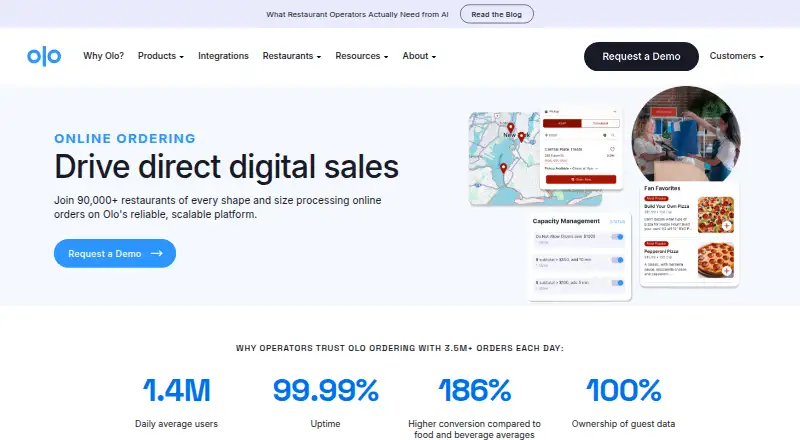
Olo Ordering is a web-based ordering platform for restaurants, supporting orders through websites and branded apps, including delivery orders. Its customizable white-label ordering engine can be paired with custom front-end integration. Restaurants can manage menus for digital channels from a centralized system, with reporting and menu management available through one dashboard. The platform also offers AI-powered personalized suggestions, cross-sells, and local favorites, along with passwordless sign-in and checkout.
Order throttling and customizable capacity rules give restaurants controls over order flow. Olo says restaurants retain ownership of guest data and lists more than 400 integration partners. The company reports serving more than 90,000 restaurants, processing more than 3.5 million orders each day, and having 1.4 million average daily users. Its page also reports 99.99% uptime and 186% higher conversion compared with food and beverage averages. Pricing is on request; the provided pricing page returns a Page Not Found message.
Good
- Supports ordering through websites and branded apps.
- Centralizes menu management across digital channels.
- Includes order throttling and customizable capacity rules.
- Restaurants retain ownership of guest data.
- Lists more than 400 integration partners.
Watch out
- Pricing is available on request.
- The provided pricing page returns a Page Not Found message.
- Listed platform is web.
Who it suits
Olo Ordering suits restaurants seeking website and app ordering, centralized menu management, and controls over order capacity. It may also interest operators who want a customizable branded front end and integrations with other systems.
Verdict
Olo Ordering combines digital ordering with menu tools, reporting, and order-flow controls. Restaurants should confirm pricing and platform fit directly with Olo.
The facts
Each one read from Olo Ordering's own pages, with the date it was checked.
What it does
- AI personalization
- AI-powered personalized suggestions, smart cross-sells, and local favorites are available.checked 27 Sep 2026
- API
- Olo lists an API and webhook library, and says API access can support a full end-to-end eCommerce experience.checked 9 Oct 2026
- Branded storefront
- The platform offers a free custom-branded storefront and supports a white-label website and app experience.checked 9 Oct 2026
- Centralized reporting
- Olo provides centralized reporting and menu management through a single dashboard.checked 27 Sep 2026
- Commercial terms
- Olo invites prospective customers to request a demo; the Ordering page does not state a price or trial terms.checked 8 Oct 2026
- Conversion lift
- The page reports 186% higher conversion compared to food and beverage averages.checked 27 Sep 2026
- Customization
- Brands can use Olo Serve, its customizable white-label ordering engine, or integrate a custom front-end UI.checked 8 Oct 2026
- Daily orders
- The page says Olo processes more than 3.5 million orders each day.checked 27 Sep 2026
- Daily users
- The page reports 1.4 million daily average users.checked 27 Sep 2026
- Delivery orders
- Yeschecked 22 Sep 2026
- Developer tools
- The Ordering page lists an API and webhook library.checked 8 Oct 2026
- Guest data
- Olo says brands retain full ownership of guest data collected through Ordering.checked 9 Oct 2026
- Integration partners
- Olo says it has more than 400 integration partners.checked 27 Sep 2026
- Integrations
- Olo says it has more than 400 integration partners for restaurant technology.checked 9 Oct 2026
- Intended customers
- Olo describes Ordering as suitable for single brands, growing regional chains, and nationwide enterprises.checked 8 Oct 2026
- Management tools
- From the Dashboard, brands can manage menus, track sales, run reports, and set permissions.checked 9 Oct 2026
- Menu management
- Restaurants can manage menus for all digital channels from a centralized system.checked 27 Sep 2026
- Operations
- Olo lists order throttling, customizable capacity rules, centralized menu management, and virtual brand support.checked 8 Oct 2026
- Order controls
- The platform includes order throttling and customizable capacity rules.checked 27 Sep 2026
Where it runs
- Branded mobile app
- Yeschecked 22 Sep 2026
- Company platform
- Olo describes itself as an open SaaS platform powering restaurant digital transformation.checked 27 Sep 2026
The company
- Founded
- 2005checked 23 Sep 2026
- Guest data ownership
- Restaurants retain full ownership of their guest data.checked 27 Sep 2026
- Headquarters
- New York, New York, United Stateschecked 23 Sep 2026
The full review of Olo Ordering
Olo Ordering is a restaurant-focused platform for taking direct orders through branded websites and apps. It is strongest for single brands, regional groups, and enterprises that need POS connectivity, centralized operations, and control of guest data. The principal drawback is commercial uncertainty: buyers must request pricing and confirm API and rollout terms before committing.
Overview
Customers can order for pickup, delivery, curbside service, and other handoff options through a restaurant’s website or app. Olo says more than 90,000 restaurants use its platform, with over 3.5 million orders processed each day and 1.4 million daily average users. That operating scale is relevant to high-volume brands, although it does not remove the need to assess implementation and support requirements for a particular operation.
Olo reports 99.99% uptime and 186% higher conversion than food-and-beverage averages. These are useful company-reported benchmarks, not a promise of the same outcome for every restaurant. Brands retain full ownership of guest data, supporting direct customer relationships. Olo describes security procedures intended to protect personal information while acknowledging that no complete-security guarantee is possible.
Key features
Branded ordering and integrations
Olo Serve provides a customizable white-label ordering engine, while a restaurant can also connect its own front-end interface. Website and app ordering can connect with restaurant POS and payment systems through more than 400 integration partners. An API and webhook library gives development teams a route to deeper integrations; API credentials are handled through a customer success manager and developer questions are directed to Olo’s Developer Portal.
Menus, reporting, and operational control
A centralized system manages menus across digital channels and combines menu management with reporting in one dashboard. That is valuable for multi-location teams that need consistent changes and consolidated oversight. Order throttling and customizable capacity rules help limit incoming demand when kitchens or stores are at capacity, while virtual-brand support extends the operational scope beyond a single menu.
Personalization and checkout
AI-powered suggestions, smart cross-sells, and local favorites tailor the ordering experience and are intended to increase average order value. Passwordless sign-in and checkout can remove account-password friction, which suits repeat digital customers. A free custom-branded storefront is included as an additional benefit.
Pricing
Olo uses paid, quote-based pricing. Restaurants must request a demo and pricing directly from Olo; the ordering page does not publish a subscription amount, free plan, trial period, renewal term, seat allowance, or order quota. A provided pricing page returns a Page Not Found message, so buyers should obtain the full commercial proposal, integration costs, and any usage terms before budgeting.
Platforms
Olo Ordering supports Android, iOS, web, and API access. The combination covers customer-facing apps and websites as well as system-to-system connections, making it more suitable for brands with an existing digital or development operation than for buyers seeking a standalone, self-serve storefront.
Who it's for
Olo is aimed at single brands, growing regional chains, and nationwide enterprises. It fits restaurants that want branded direct ordering, delivery and pickup workflows, POS integration, centralized menu and reporting controls, and ownership of guest data. It is less suitable for a small operator that needs a published price, an immediate free tier, or a short self-service setup without a sales and integration process.
Pros and cons
Pros
- Direct ownership of guest data: Restaurants keep the customer information generated by ordering, supporting their own relationship and revenue programs.
- Broad operational controls: Centralized menus, reporting, throttling, and capacity rules address the needs of busy or multi-location operations.
- Flexible front ends: Olo Serve and custom front-end integration allow brands to balance speed with a tailored customer experience.
- Extensive connectivity: More than 400 integration partners, POS and payment connections, APIs, and webhooks support complex restaurant stacks.
Cons
- No published price or trial: Buyers cannot compare costs or test the service from the public pricing information.
- Integration planning is required: API credentials and custom connections involve customer-success and developer channels rather than a purely self-serve workflow.
- Reported performance is not guaranteed: Uptime and conversion figures are Olo’s benchmarks, so restaurants still need their own commercial and operational validation.
Alternatives
For a broader starting point, compare Restaurant Online Ordering Software and Food Ordering Software.
- CloudWaitress is the better fit when a freemium product and a published $39-per-store monthly Standard plan are preferable.
- Clover Online Ordering suits restaurants seeking no setup or subscription fees for takeout, curbside pickup, or dine-in, with possible delivery fees.
- Lunchbox is worth considering for one or two locations with free plans and zero sign-up and commission fees on its SMB plan.
- HungerRush offers a qualifying one-location, one-terminal Starter plan from $0 per month.
- GloriaFood is a low-cost option with unlimited orders and locations on its free service plan and no commission per order.
- storekit offers a free plan with one location and one ordering channel, subject to a 12-month commitment.
- Lightspeed Restaurant is the alternative for a paid POS-centered package with a $69-per-month Starter plan and no free plan or trial.
- Flipdish provides a published $149-per-month Website plan for a branded website, online ordering, and menu management.
Verdict
Choose Olo Ordering if your restaurant brand needs a scalable direct-ordering layer, deep system integrations, centralized controls, and ownership of guest data. Look elsewhere if transparent pricing, a free tier, or immediate self-service adoption matters more than enterprise customization.
Alternatives to Olo Ordering
- 1

Lunchbox
Free planAndroidiOSWebAPI8.2From $300 a month - 2
Popmenu Online Ordering
AndroidiOSWeb7.5From $159 a month - 3

UrbanPiper
AndroidiOSWebmacOS7.2From £79 a month - 4
Slerp
AndroidiOSWeb6.9From £125 a month - 5
TableMind
AndroidiOSWeb6.7From zł199 a month - 6

Otter
AndroidiOSWeb6.6From $79 a month