
storekit
Storekit is an ordering platform for restaurants and hospitality venues, covering pickup, delivery, catering, kiosks, QR order and pay, add-to-bill, and pay-…
What storekit is
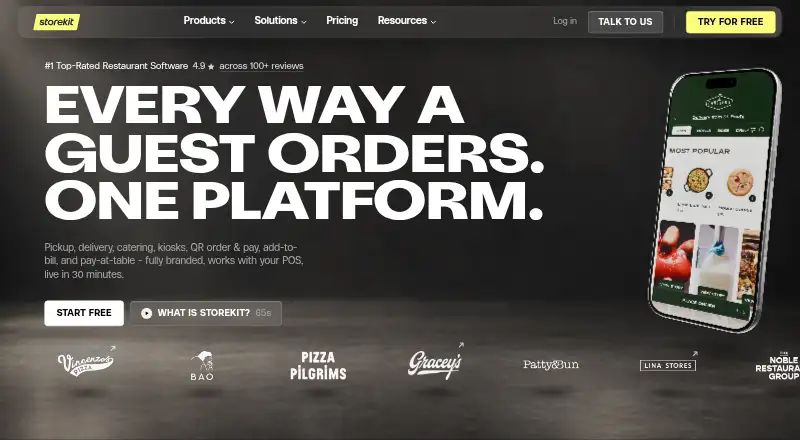
Storekit is an ordering platform for restaurants and hospitality venues, covering pickup, delivery, catering, kiosks, QR order and pay, add-to-bill, and pay-at-table. Customers can order through a browser-based website without downloading an app or creating a login. Operators can build a branded storefront on their own domain and customize its colours, fonts, layout, and sections. Storekit lists more than 100 POS, payment, loyalty, and CRM integrations. Restaurants can use their own riders or dispatch through delivery partners, and App Studio can produce a native app for submission to Apple’s App Store and Google Play under the restaurant’s brand. All plans use zero commission on orders with a flat per-order rate. The free plan lists one location and one ordering channel; Storekit+ is £99 a month with a 12-month commitment, or £149 a month on a rolling plan. Direct REST API access is in early access, is not publicly available, and is granted case by case; webhooks can be enabled as a subscription feature. The company is based in London and was built in 2020.
Good
- Customers can order without an app or login.
- Supports pickup, delivery, catering, and QR ordering.
- Lists more than 100 integrations.
- Offers branded storefronts and native app creation.
- All plans use zero commission on orders.
Watch out
- Free plan is limited to one location and channel.
- Direct REST API access is early access and case by case.
- No free trial is listed.
Who it suits
It suits restaurants and hospitality venues, from independents to groups and enterprise estates, that want direct ordering channels. It may fit operators seeking branded web ordering, delivery options, or a restaurant-branded native app.
Verdict
Storekit combines browser ordering with restaurant branding, delivery options, and a range of ordering formats. Check the location and channel limits, commitment terms, and restricted API access against your needs.
Plans and prices
From storekit's own pricing page, checked 22 Sep 2026.
| Plan | Price | What it gives you |
|---|---|---|
| Storekit | Free | 1 location · 1 ordering channel · Billed monthly with a 12-month commitment |
| Storekit+ | £99 a month | 5 locations · 1 ordering channel · Billed monthly with a 12-month commitment |
| Storekit++ | £199 a month | 10 locations · Unlimited ordering channels · Billed monthly with a 12-month commitment |
| Storekit (rolling) | Free | 1 location · 1 ordering channel · Rolling plan; cancel anytime |
| Storekit+ (rolling) | £149 a month | 5 locations · 1 ordering channel · Rolling plan; cancel anytime |
| Storekit++ (rolling) | £399 a month | 10 locations · Unlimited ordering channels · Rolling plan; cancel anytime |
| Basic | Free | pickup and delivery · Uber Direct and Shipday delivery · kitchen display · unlimited menu items and modifiers · rolling monthly, cancel any time |
| Grow | £99 a month | catering · cross-location reporting · selected EPOS and loyalty integrations · kiosks as an add-on · rolling monthly, cancel any time |
| Pro | £199 a month | QR order & pay · pay-at-table · digital tabs · guided onboarding · named account manager · rolling monthly, cancel any time |
| Enterprise | Priced on request | central estate control · phased onboarding · custom integrations · native app and kiosks included · SLA support · agreed term |
The facts
Each one read from storekit's own pages, with the date it was checked.
What it does
- API access
- Direct REST API access is in early access, is not publicly available, and is granted case by case; webhooks can be enabled without approval as a subscription feature.checked 28 Sep 2026
- Branding
- The platform provides a branded storefront with the customer’s own branding and domain, plus a store designer for colours, fonts, layout, and sections.checked 28 Sep 2026
- Commission
- Every plan has zero commission on orders and uses a flat per-order rate instead.checked 28 Sep 2026
- Delivery
- Restaurants can use their own riders or dispatch through delivery partners including Deliveroo Express, Uber Direct, Nash, Shipday, and Orkestro.checked 28 Sep 2026
- Delivery orders
- Yeschecked 22 Sep 2026
- Integrations
- Storekit lists more than 100 POS, payment, loyalty, and CRM integrations, including Toast, Square, Lightspeed, Zonal, Klaviyo, and Como.checked 28 Sep 2026
- Launch time
- Storekit says operators can build a store, connect a POS or run standalone, and take a first order in about 30 minutes.checked 28 Sep 2026
- Location limit
- 5checked 22 Sep 2026
- Ordering channels
- website and appchecked 22 Sep 2026
- Product
- Storekit is a restaurant ordering platform covering pickup, delivery, catering, kiosks, QR order and pay, add-to-bill, and pay-at-table.checked 28 Sep 2026
- Security
- Storekit states that data in transit uses TLS 1.2 or higher, stored customer and transaction data uses AES-256, and payment processing is PCI DSS Level 1 compliant.checked 28 Sep 2026
- Support
- Basic includes live chat support; higher plans add guided onboarding, menu build, named account management, or SLA-backed support.checked 28 Sep 2026
- Target users
- The platform is built for restaurants and other hospitality venues, including independents, groups, and enterprise estates.checked 28 Sep 2026
Where it runs
- Branded mobile app
- Yeschecked 22 Sep 2026
- Native apps
- App Studio produces a genuine native app submitted to both the Apple App Store and Google Play under the restaurant’s brand.checked 28 Sep 2026
- No app required
- Customers can order through a website in their browser without downloading an app or creating a login.checked 28 Sep 2026
- POS integration
- Yeschecked 22 Sep 2026
The company
- Founded
- 2020checked 28 Sep 2026
- Headquarters
- London, United Kingdomchecked 28 Sep 2026
- Maker history
- Storekit says it was built in 2020, is based and built in London, and runs direct ordering for more than 1,000 restaurants.checked 28 Sep 2026
Money
- Free plan
- Yeschecked 22 Sep 2026
The full review of storekit
Storekit is an ordering platform for restaurants and other hospitality venues, from independent operators to multi-site groups. It suits businesses that want branded direct ordering across several formats; its zero-commission model is appealing, but location and channel caps and the 12-month commitment on its main plans deserve close attention.
Overview
Storekit combines browser-based ordering with branded web and app storefronts for pickup, delivery, catering, kiosks, QR ordering and payment, add-to-bill, and pay-at-table. Customers can order through a website without downloading an app or creating an account, while restaurants can connect a POS or run the service standalone. Storekit says an operator can set up a store and take a first order in about 30 minutes.
Every plan uses a flat per-order rate rather than commission, which makes the pricing model easier to distinguish from commission-based ordering. The per-order rates are not detailed here, so operators should weigh those charges alongside the subscription before choosing a plan.
Key features
Branded ordering and delivery
Restaurants can use their own branding and domain, and adjust storefront colours, fonts, layout, and sections. That gives venues control over the customer-facing experience without requiring customers to install an app. For those that do want one, App Studio produces a native app submitted to the Apple App Store and Google Play under the restaurant’s brand.
Delivery can use a restaurant’s own riders or partners such as Deliveroo Express, Uber Direct, Nash, Shipday, and Orkestro. Storekit also lists more than 100 integrations across POS, payments, loyalty, and CRM, including Toast, Square, Lightspeed, Zonal, Klaviyo, and Como. The breadth is useful for operators linking ordering to existing systems, though direct REST API access is early access, granted case by case, and not publicly available. Webhooks can be enabled as a subscription feature without approval.
Security and support
Storekit states that data in transit is protected with TLS 1.2 or higher, stored customer and transaction data with AES-256, and payment processing is PCI DSS Level 1 compliant. Basic includes live chat; higher plans add options such as guided onboarding, menu build, named account management, or SLA-backed support.
Pricing
Storekit’s published pricing includes both 12-month-commitment plans billed monthly and rolling monthly plans that can be cancelled anytime. The plan names and inclusions also appear in a separate rolling monthly structure, so compare the specific terms and feature bundle before subscribing.
- Storekit: £0.00 per free, billed monthly with a 12-month commitment; one location and one ordering channel. The rolling Storekit plan is also £0.00 per free, cancel anytime, with the same location and channel limits.
- Storekit+: £99.00 per month, billed monthly with a 12-month commitment; five locations and one ordering channel. The rolling version is £149.00 per month, cancel anytime, with the same caps.
- Storekit++: £199.00 per month, billed monthly with a 12-month commitment; 10 locations and unlimited ordering channels. The rolling version is £399.00 per month, cancel anytime, with the same limits.
- Basic: £0.00 per free on a rolling monthly basis, cancel anytime; pickup and delivery, Uber Direct and Shipday delivery, kitchen display, and unlimited menu items and modifiers. This is the low-cost entry point, but the offer is narrower than the paid bundles.
- Grow: £99.00 per month on a rolling monthly basis, cancel anytime; adds catering, cross-location reporting, selected EPOS and loyalty integrations, and kiosks as an add-on. It fits operators needing multi-location oversight or those ordering formats.
- Pro: £199.00 per month on a rolling monthly basis, cancel anytime; includes QR order and pay, pay-at-table, digital tabs, guided onboarding, and a named account manager. This is the strongest fit for venues adopting table-side ordering and wanting more onboarding support.
- Enterprise: custom pricing, rates, technology, implementation, and support for larger or more tailored deployments.
The published pricing note says paid plans start at £99/mo, but Basic is separately described as a free rolling plan. There is no free trial. Storekit’s plans are capped at five locations except Storekit++ at 10, while ordering channels range from one to unlimited; check which plan structure applies to the features and terms your operation needs.
Platforms
Storekit supports Android, iOS, web, and API. Browser ordering is useful for customers who do not want an app, while the native app option gives restaurants a branded presence in both major app stores.
Who it's for
Storekit is best suited to restaurants and hospitality venues that want direct ordering under their own brand, need more than one ordering format, or plan to connect ordering with POS, delivery, loyalty, or CRM tools. The free entry points offer a way to start with limited locations or channels; multi-site groups should examine the location caps, and teams that require open API access should account for case-by-case REST access.
Pros and cons
- Pros: Browser ordering avoids an app download or customer login, and branded storefronts and native apps let restaurants retain their own identity.
- Pros: Pickup, delivery, catering, kiosks, QR ordering, and table payment cover varied service models; integrations and delivery partners support existing restaurant operations.
- Pros: Zero commission on every plan and free entry options lower the barrier for operators evaluating direct ordering.
- Cons: The main monthly-billed tiers carry a 12-month commitment, while rolling versions cost more at the same location and channel limits.
- Cons: One-channel caps on Storekit and Storekit+ may constrain businesses running multiple ordering channels; even the 10-location Storekit++ tier is not unlimited in locations.
- Cons: Direct REST API access is not generally available, making it a less straightforward choice for teams that depend on self-service API integration.
Alternatives
For a broader comparison, see Restaurant Online Ordering Software.
- Lunchbox is another freemium restaurant ordering option, with free plans covering one to two locations.
- Lightspeed Restaurant is a paid option without a free plan or trial; its Starter plan is $69 a month and includes POS, menu management, floor plans, insights, offline mode, and 24/7 support.
- Flipdish is a paid alternative with a free plan; its Website plan is $149 a month per site for a branded website, online ordering, and menu management.
- Clover Online Ordering offers takeout, curbside pickup, and dine-in ordering with no setup or subscription fees; delivery fees may apply.
- Olo Ordering is another web-based alternative.
- Restolabs is a paid option with a free trial; its Basic plan is $199 a month with a 30-day trial and zero-commission unlimited orders.
- Toast is a paid alternative with single-location plans and a terminal included in its Starter Kit.
- FoodAmigos is a paid alternative covering restaurant websites, online ordering, mobile apps, loyalty, marketing, and premium support.
Verdict
Choose Storekit if your restaurant wants branded direct ordering across web, app, delivery, and in-venue formats, with a zero-commission pricing model and integrations to support existing systems. Look elsewhere if your operation needs broadly available REST API access, more than the plan’s location allowance, or the flexibility to avoid the higher cost of rolling monthly terms.
Alternatives to storekit
- 1

Lunchbox
Free planAndroidiOSWebAPI8.9From $300 a month - 2
GloriaFood
Free planAndroidiOSWebAPI8.9From $9 a month - 3

HungerRush
Free planAndroidiOSWebAPI8.8From $149 a month - 4
CloudWaitress
Free planAndroidiOSWebAPI8.7From $39 a month - 5

Ressto
Free planAndroidiOSWeb8.5From $39 a month - 6
Toast
Free planAndroidiOSWebAPI8.4From $69 a month