Ojuri
Ojuri is a self-hosted fraud detection engine for fintechs, payment gateways, and mobile-money platforms.
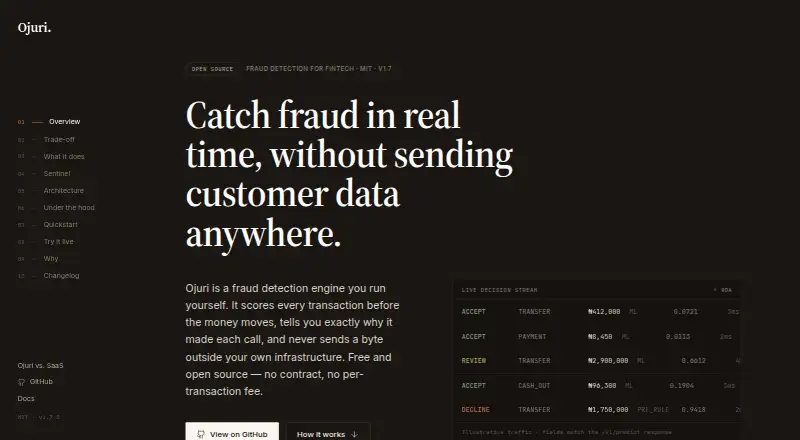
What Ojuri is
Ojuri is a self-hosted fraud detection engine for fintechs, payment gateways, and mobile-money platforms. It scores transactions on the payment authorization path and returns an accept, review, or decline decision. Its real-time agent uses an XGBoost model served through ONNX Runtime, while a separate pattern-analysis agent follows account, device, and payee relationships to identify fraud rings and mule networks. Decisions are logged with reason codes and the data considered by the model. Sentinel provides a review queue, decision stream, model registry, and analyst overrides that can contribute training data. The model-learning agent monitors drift, retrains on verified labels, and checks evaluations before promotion. A separate investigation agent can prepare reports for declined transactions using an optional self-hosted language model. Applications can use the POST /v1/predict API, and a Node SDK supports typed requests, retries, and webhook signature verification. Ojuri runs in the operator’s infrastructure; the free MIT-licensed plan has no per-call fees or rate limits.
Good
- Free MIT-licensed plan with no per-call fees or rate limits
- Scores payments on the authorization path
- Logs decision reason codes and model input data
- Includes analyst review and model-learning tools
- Transaction data stays within the operator’s infrastructure
Watch out
- Quickstart requires Docker and Node 20
- Optional investigation model downloads about 7.6 GB of weights
- Self-hosting is not a compliance certification
Who it suits
Ojuri suits fintechs and payment platforms that need transaction scoring within their own infrastructure. It may also suit teams that want analyst review, model monitoring, and investigation tools alongside live scoring.
Verdict
Ojuri combines live transaction decisions with investigation and model-management workflows, while keeping processing in the operator’s infrastructure. Teams should account for the Docker and Node 20 setup requirements and the optional investigation model’s download size.
Plans and prices
From Ojuri's own pricing page, checked 15 Oct 2026.
| Plan | Price | What it gives you |
|---|---|---|
| Free | Free | Self-hosted deployment · no rate limits · customer-operated infrastructure · No contract or per-transaction fees |
| Ojuri | Free | MIT licensed · no per-call fees · no rate limits |
The facts
Each one read from Ojuri's own pages, with the date it was checked.
What it does
- Analyst dashboard
- Sentinel includes a review queue, decision stream, model registry, and analyst overrides that can become training data.checked 8 Oct 2026
- Analyst workflow
- Sentinel provides a review queue, live decision stream, rule editor, model registry, audit log, investigations, and user administration.checked 15 Oct 2026
- Architecture
- The system uses four agents: real-time detection, pattern analysis, model learning, and fraud investigation.checked 15 Oct 2026
- Audit trail
- Ojuri records each decision and the feature snapshot used at inference before returning the response.checked 15 Oct 2026
- Benchmark result
- The repository reports 34% fraud detection before retraining and 98.8% after one label-driven retraining round, with 1.1% false positives in its simulation.checked 15 Oct 2026
- Compliance
- Ojuri says self-hosting can help with data residency requirements including GDPR, NDPR, and CBN, and explicitly says it is not a compliance certification.checked 8 Oct 2026
- Data handling
- Ojuri says its services run in the operator’s infrastructure and transaction data does not leave that boundary for scoring, training, or investigation.checked 8 Oct 2026
- Data residency
- The maker states that scoring, training, and investigations run inside the customer’s infrastructure without transaction-data egress.checked 15 Oct 2026
- Deployment
- The quickstart uses Docker Compose and requires Docker and Node 20; the investigation model is optional and downloads about 7.6 GB of weights when enabled.checked 8 Oct 2026
- Explainability
- Responses include reason codes, feature contributions, observed values, model version, threshold, and audit ID.checked 15 Oct 2026
- Extensibility
- Custom pre-model and post-model rules can be edited without restarting and normally update within 30 seconds.checked 15 Oct 2026
- Feature extensibility
- The default model exposes 64 features and supports defining additional signals without code changes.checked 15 Oct 2026
- FIA resource limit
- The optional investigation service downloads about 7.6 GB of model weights and needs about 16 GB of free RAM.checked 15 Oct 2026
- Fraud-ring detection
- Pattern analysis identifies shared-device clusters, relationship groups, and emerging transaction rings.checked 15 Oct 2026
- Fraud rings
- The Pattern Analysis Agent tracks account, device, and payee relationships over time to identify fraud rings and mule networks.checked 8 Oct 2026
- Integrations
- The stack uses Kafka, Redis, PostgreSQL, ONNX Runtime, Docker Compose, NGINX, and Prometheus/Grafana components.checked 15 Oct 2026
- Investigations
- The Fraud Investigation Agent creates reports for declined transactions using a self-hosted language model and runs on a separate path from live scoring.checked 8 Oct 2026
- Latest release
- The homepage changelog identifies v1.7.0, dated September 28, 2026, as the current release shown there.checked 15 Oct 2026
- Launch date
- The project’s comparison page identifies v1.0 as released on June 7, 2026.checked 15 Oct 2026
- Learning loop
- Reviewer overrides, chargebacks, and disputes can become labels for later retraining.checked 15 Oct 2026
- License
- The repository is released under the MIT license.checked 15 Oct 2026
- Limit: hosted offering
- The project does not provide a hosted SaaS deployment or per-transaction service; customers operate the infrastructure themselves.checked 15 Oct 2026
- Limit: maturity
- The builder describes Ojuri as version 1 and solo-built, with its shipped model trained on public and synthetic data rather than customer traffic.checked 15 Oct 2026
- Limit: operations
- PAA must run as exactly one instance because it keeps the payment network graph in memory.checked 15 Oct 2026
The full review of Ojuri
Ojuri is a self-hosted fraud engine for teams that need transaction decisions and fraud operations under their own control. It is best suited to fintechs, payment gateways, and mobile-money operators with engineering capacity to run the stack. The zero-cost, MIT-licensed plan is unusually permissive, but infrastructure and model operations remain your responsibility.
Overview
Ojuri returns accept, review, or decline decisions and covers the workflow around those outcomes. It combines live payment scoring, relationship analysis, analyst review, investigations, and model management in an omnichannel system. Services run in the operator’s infrastructure, keeping transaction data inside that boundary for scoring, training, and investigation.
That control is valuable for organizations with strict data-residency requirements, including GDPR, NDPR, or CBN-related requirements. Self-hosting can support those goals, but Ojuri is not a compliance certification. Deployment also requires Docker and Node 20; enabling investigation reports adds an optional model download of about 7.6 GB.
Key features
Live decisions and fraud networks
The Real-Time Detection Agent scores payments on the authorization path with an XGBoost model served through ONNX Runtime. It fits payment flows where an accept, review, or decline result must arrive during authorization. Pattern Analysis follows account, device, and payee relationships over time, helping teams investigate fraud rings and mule networks that single-transaction rules can miss.
Auditability and analyst control
Each decision records reason codes and the data seen by the model, giving investigators a traceable audit trail rather than an unexplained score. Sentinel adds a review queue, decision stream, model registry, and analyst overrides. Overrides can become training data, connecting day-to-day review work with later model improvement.
Learning and investigations
The Model Learning Agent watches for drift, retrains on verified labels, and requires evaluation checks before promoting a model. This is a useful governance pattern for teams that can maintain labeled outcomes; it is more responsibility than a managed service that handles the lifecycle for you. The Fraud Investigation Agent creates reports for declined transactions using a self-hosted language model on a separate path from live scoring, so investigative processing does not have to hold up authorization. The 7.6 GB model download makes that option a consideration for storage and deployment planning.
Integration and controls
Applications can call POST /v1/predict. The Node SDK provides typed requests, retries, and webhook signature verification. API keys, dashboard accounts and roles, signed webhooks, and idempotency keys address common integration and operational risks. Custom rules, machine-learning models, device fingerprinting, and omnichannel support give teams room to combine policy with model signals.
Pricing
Ojuri’s Ojuri plan costs free. It is MIT licensed, has no per-call fees, and imposes no rate limits. The plan includes the product’s custom rules, machine-learning models, device fingerprinting, and omnichannel capabilities. There are no paid tiers to trade features or quotas against, so it suits teams willing to fund hosting, integration, monitoring, and maintenance themselves. Organizations seeking vendor-managed operations or commercial support should look elsewhere.
Platforms
Ojuri is offered as an API, self-hosted deployment, web dashboard, and Windows setup. The documented quickstart uses Docker Compose and requires Docker and Node 20. Windows users have separate setup instructions, while the API and Node SDK serve application integration.
Who it's for
Fintechs, payment gateways, and mobile-money platforms are the clearest fit, especially when transaction data must remain inside an operator-controlled environment. It also suits fraud teams that want analysts, model managers, and investigators working in one system. Smaller teams without Docker, Node, model-lifecycle, or operational expertise may find a hosted alternative more practical.
Pros and cons
Pros
- No usage charges or rate limits: the free MIT-licensed plan avoids per-call costs as transaction volume grows.
- Broad fraud workflow: live scoring, graph-style relationship analysis, review queues, investigations, and model promotion cover more than an API-only detector.
- Traceable decisions: reason codes and recorded input data support audit and analyst review.
- Data boundary: scoring, training, and investigation stay in the operator’s infrastructure.
Cons
- Operational overhead: Docker and Node 20 are required, and self-hosting shifts reliability and maintenance work to your team.
- Investigation storage cost: the optional language model downloads about 7.6 GB of weights.
- Not a certification: self-hosting may help residency requirements but does not itself establish GDPR, NDPR, or CBN compliance.
Alternatives
For a broader category comparison, see Payment Fraud Detection Software.
- FraudLabs Pro is the better fit when a freemium hosted service, Android or iOS access, and a 500-query monthly free tier matter more than unlimited self-hosted use.
- IPQualityScore Fraud Prevention suits teams wanting hosted and self-hosted options with a free plan capped at 1,000 lookups per month and 35 per day, plus a $99 Startup plan.
- Jube is another free, self-hosted open-source option under AGPLv3.
- Stripe Radar is preferable for businesses already using Stripe standard payments and needing included card fraud prevention.
- Ravelin targets organizations seeking a customized paid platform.
- Tazama offers free open-source software, with hosting, implementation, and support requiring resources or a contract.
- Vesta is a paid alternative for teams evaluating a commercial platform.
- DataVisor Fraud Platform is a custom enterprise option with demo-based pricing.
Verdict
Choose Ojuri if you are a fintech or payment operator that wants unrestricted, self-hosted fraud controls, explainable decisions, and an integrated analyst-to-model workflow. Look elsewhere if you want the provider to run the infrastructure, manage model operations, or supply a packaged compliance and support offering.
Alternatives to Ojuri
- 1
Tazama
Free planOpen sourceWebAPILinuxmacOS7.6Free plan - 2
Jube
Free planWebAPILinuxSelf-hosted7.3From $350 a month - 3
SEON
AndroidiOSWebAPI6.8From $699 a month - 4

Marble Case Manager
Free planWebAPISelf-hosted6.6Free plan - 5

NICE Actimize
WebAPI6.2 - 6
Nasdaq Verafin
WebAPI6.1