
Stripe Radar
Stripe Radar is a fraud and abuse protection service for businesses processing payments.
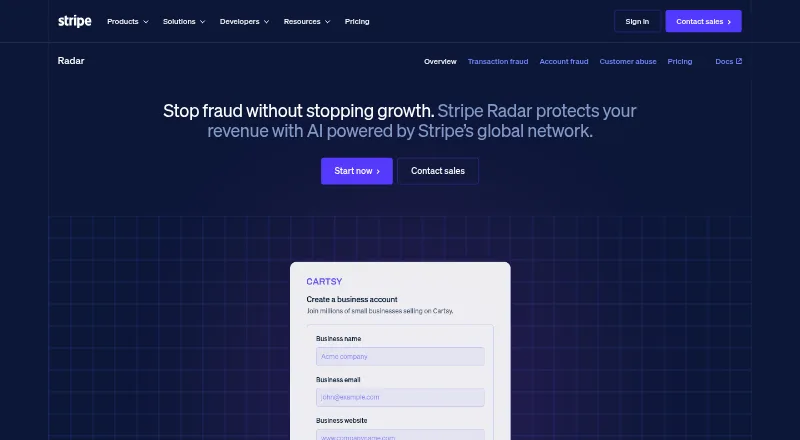
What Stripe Radar is
Stripe Radar is a fraud and abuse protection service for businesses processing payments. It uses AI to block fraudulent payments, flag suspicious accounts, and help prevent customer abuse in real time. Stripe says the AI is trained on more than 70 trillion data points across its network. Radar covers supported payment methods including bank debits, buy now pay later options, crypto, digital wallets, real-time payments, and cash vouchers. Businesses already processing through Stripe can use Radar in the background without additional setup. It can also be used with Stripe Connect, and Stripe says Connect accounts onboarded to a platform need no extra integration. For transactions handled through other payment providers, Radar can supply risk signals through APIs. Plus and Pro include risk scores, custom rules, backtesting, manual reviews, risk preferences, adaptive 3D Secure, and advanced fraud analytics; Pro also adds abuse signals and free-trial abuse protection. Users remain responsible for decisions made using Radar data.
Good
- AI fraud prevention works in real time.
- Covers multiple supported payment methods.
- Stripe-processing businesses can use it without additional setup.
- API risk signals can support other payment providers.
Watch out
- Risk scores and custom rules require Plus or Pro.
- Dynamic risk thresholds are limited to Pro.
- Users are responsible for decisions based on Radar data.
Who it suits
Radar suits businesses processing payments that need real-time fraud and abuse protections. Platforms and marketplaces can use it with Stripe Connect, while businesses using other processors can request risk signals through APIs.
Verdict
Radar offers fraud controls across supported payment methods, with deeper risk tools on Plus and Pro. Businesses should account for plan limits and their responsibility for decisions based on its signals.
Plans and prices
From Stripe Radar's own pricing page, checked 15 Oct 2026.
| Plan | Price | What it gives you |
|---|---|---|
| Radar Lite | Free | AI fraud prevention for card payments · card-testing prevention · fraud alerts · Included at no additional charge for businesses on standard payments pricing |
| Radar Standard | $10 a month | AI fraud prevention across payment methods · card-testing prevention · fraud alerts · fraud analytics · default rules · allowlists/blocklists · Starting at $10 per month; or pay as you go |
| Radar Plus | $14 a month | Custom rules and backtesting · risk preferences · advanced analytics · manual reviews · adaptive 3D Secure · Starting at $14 per month; or pay as you go |
| Radar Standard (platforms and marketplaces) | $20 a month | Transaction fraud protection · fraudulent account identification · Starting at $20 per month |
| Radar Pro | $20 a month | Dynamic risk thresholds · bot protection · multi-account, free-trial and account-sharing signals · pay-as-you-go abuse controls · Starting at $20 per month; or pay as you go |
| Radar Standard (platforms) | $20 a month | Transaction fraud prevention · fraudulent-account identification · out-of-the-box protection · Starting at $20 per month; or pay as you go |
| Radar Plus (platforms) | $44 a month | Custom rules and backtesting · reserves · advanced analytics · Starting at $44 per month; or pay as you go |
| Radar Plus (platforms and marketplaces) | $44 a month | Custom rules and backtesting · reserves · advanced analytics · Starting at $44 per month |
| Radar Pro (platforms) | $70 a month | Advanced protection against emerging fraud and customer abuse · multi-account, free-trial and bot abuse defenses · Starting at $70 per month; or pay as you go |
| Radar Pro (platforms and marketplaces) | $70 a month | Multi-account · free trial · bot abuse protection · Starting at $70 per month |
| Enterprise | Priced on request | Tailored recommendations · Radar signals for payments not processed on Stripe · Custom pricing |
| Radar Enterprise | Priced on request | Tailored recommendations · Radar risk signals · protection for payments not processed on Stripe · Custom pricing; contact sales |
The facts
Each one read from Stripe Radar's own pages, with the date it was checked.
What it does
- Adaptive authentication
- Adaptive 3D Secure is included in Radar Plus and Radar Pro.checked 15 Oct 2026
- AI data scale
- Stripe says Radar models use more than 70 trillion data points from its network.checked 15 Oct 2026
- AI training data
- Stripe says Radar's AI is trained on more than 70 trillion data points across its network.checked 29 Sep 2026
- API access
- Radar exposes APIs that let applications ingest fraud signals for payments, business accounts and customers and score them in their own systems.checked 15 Oct 2026
- API resources
- The API includes early-fraud-warning retrieval and listing endpoints plus webhook events for created and updated warnings.checked 15 Oct 2026
- Customer-abuse controls
- Radar Pro adds free-trial, bot, multi-account, account-sharing and pay-as-you-go abuse signals.checked 15 Oct 2026
- Custom rules
- Plus and Pro let teams create and backtest custom rules, manage allowlists and blocklists, and use manual reviews.checked 15 Oct 2026
- Documentation depth
- Stripe publishes product guides, a help topic, API reference endpoints, testing cards, SDK documentation and a developer changelog ecosystem.checked 15 Oct 2026
- Enterprise users
- Stripe describes Radar as built for platforms, marketplaces, and AI companies, and offers tailored recommendations and custom pricing to enterprises.checked 29 Sep 2026
- External processor use
- Radar can provide risk signals through APIs for businesses processing transactions through other payment service providers.checked 29 Sep 2026
- Fraud and abuse protection
- Radar uses AI to block fraudulent payments, flag suspicious accounts, and prevent customer abuse in real time.checked 29 Sep 2026
- Fraud coverage
- The product covers card testing, transaction fraud, bot abuse, multi-account abuse, free-trial abuse, account sharing, disputes, negative balances and payout fraud.checked 15 Oct 2026
- Integrations
- Radar can be used with Stripe Connect, and Stripe says no additional integration is required for Connect accounts onboarded to a platform.checked 29 Sep 2026
- Lifecycle coverage
- Radar is designed to assess sign-up/onboarding, payment and post-purchase stages.checked 15 Oct 2026
- Limit: pricing
- G2 reviewers complain that dispute-related fees and paid features make Radar increasingly expensive.checked 15 Oct 2026
- Limit: support and fees
- Capterra's review summary reports complaints about complex fees, account holds, chargebacks and inconsistent support.checked 15 Oct 2026
- Limit: withheld funds and payouts
- Recent Trustpilot reviewers complain about delayed payouts, unexplained account closures, withheld funds and unexpected fees.checked 15 Oct 2026
The company
- Company founding and headquarters
- LinkedIn lists Stripe as founded in 2010 and headquartered in South San Francisco, California, with San Francisco and Dublin headquarters described in its profile.checked 15 Oct 2026
- Company headquarters
- Stripe says it has dual headquarters in San Francisco and Dublin.checked 29 Sep 2026
- Company legal name
- Crunchbase lists the legal name as Stripe, LLC.checked 15 Oct 2026
- Company size
- LinkedIn lists Stripe's company size as 5,001–10,000 employees.checked 15 Oct 2026
- Founded
- 2010checked 23 Sep 2026
- Headquarters
- San Francisco and Dublinchecked 23 Sep 2026
Where it runs
- Mobile app scope
- The Stripe Dashboard app is free, iPhone-only, requires an account and supports payment monitoring, refunds, invoices, subscriptions and Tap to Pay.checked 15 Oct 2026
The full review of Stripe Radar
Stripe Radar is Stripe’s fraud and abuse protection service, best suited to merchants and platforms that already process payments through Stripe. Its breadth across payment methods is compelling; businesses that need detailed risk controls should budget for a paid tier.
It is a practical choice when fraud screening belongs inside the payment flow, but it is not a substitute for the business’s own judgment about risk decisions.
Overview
Radar uses machine learning to block fraudulent payments, flag suspicious accounts and help prevent customer abuse in real time. Stripe says its AI is trained on more than 70 trillion data points across its network. That makes Radar a strong fit for Stripe-native payment screening, while the scale of the model should not be mistaken for a transfer of responsibility: businesses remain accountable for how they use Radar data and the decisions they make from it.
For businesses already processing payments with Stripe, Radar runs in the background without additional setup. Coverage includes supported bank debits, buy now pay later, crypto, digital wallets, real-time payments and cash vouchers, as well as cards. Stripe Connect can be used without additional integration for accounts onboarded to a platform. Businesses using other payment providers can access Radar risk signals through APIs, though this is distinct from its background protection for Stripe payments.
Key features
Fraud controls vary by tier
Lite focuses on card fraud prevention and card-testing alerts. Standard broadens protection across payment methods and adds analytics, which is the meaningful step up for businesses accepting more than cards. Plus and Pro add risk scores, custom rules and backtesting, manual reviews, risk preferences, adaptive 3D Secure and advanced fraud analytics. These tools give risk teams more ways to tune decisions, but they require a paid plan.
Pro adds dynamic risk thresholds, which Plus does not include, and abuse signals for bots, multiple accounts, account sharing and pay-as-you-go activity, along with free-trial abuse protection. That makes Pro the more relevant tier for businesses facing account or trial abuse, rather than just transaction fraud.
Platforms and external processors
Radar is described as built for platforms, marketplaces and AI companies. Stripe says platforms can use it with Connect without extra integration for accounts onboarded to the platform. For businesses processing through another provider, API risk signals offer a route to Radar data, but the product’s no-setup background operation applies to Stripe payment processing.
Pricing
Radar is freemium. Lite is included at no additional charge for businesses on standard payments pricing, but covers card fraud prevention and card-testing alerts rather than the broader payment-method coverage of Standard.
| Plan | Price | What it includes |
|---|---|---|
| Radar Lite | free | Included with standard payments pricing; AI card fraud prevention and card-testing alerts. |
| Radar Standard | $10 a month | Starting at $10 per month; fraud protection across payment methods and analytics. |
| Radar Plus | $14 a month | Starting at $14 per month; custom rules and backtesting, risk tolerance controls and advanced analytics. |
| Radar Pro | $20 a month | Starting at $20 per month; multi-account, free-trial and bot abuse protection. |
| Radar Standard (platforms and marketplaces) | $20 a month | Starting at $20 per month; transaction fraud protection and fraudulent account identification. |
| Radar Plus (platforms and marketplaces) | $44 a month | Starting at $44 per month; custom rules and backtesting, reserves and advanced analytics. |
| Radar Pro (platforms and marketplaces) | $70 a month | Starting at $70 per month; multi-account, free-trial and bot abuse protection. |
| Radar Enterprise | Custom pricing | Tailored recommendations, Radar risk signals and protection for payments not processed on Stripe; contact sales. |
The paid merchant tiers start at $10 per month, with Plus at $14 and Pro at $20; the platform and marketplace versions start at higher prices. Choose Standard for wider payment coverage and analytics, Plus when rules and risk tuning matter, and Pro when the added abuse signals or dynamic thresholds justify the premium. Enterprise is the fit for tailored recommendations or protection around payments outside Stripe, at custom pricing.
Platforms
Radar supports Android, iOS, web and API. Its API risk signals are particularly relevant to businesses using other payment service providers; Stripe payment users can instead use its background operation.
Who it's for
Radar suits Stripe merchants seeking fraud protection within their existing payment flow, and platforms or marketplaces using Connect. Businesses with mostly card transactions and modest control needs can start with Lite; those accepting varied methods should consider Standard. Teams that need to adjust risk rules or investigate decisions have a reason to move to Plus, while Pro is better suited to businesses confronting bot, multi-account or trial abuse. Businesses using a different processor may value API risk signals, but should weigh that against Radar’s tighter fit with Stripe payments.
Pros and cons
- Broad payment-method coverage: Standard protection spans supported methods beyond cards, useful for merchants with varied payment mixes.
- Low-friction for Stripe users: Radar runs in the background without extra setup for existing Stripe payment processing.
- Useful controls at higher tiers: Plus and Pro add risk scores, custom rules and backtesting; Pro alone adds dynamic thresholds and specific abuse protections.
- Meaningful limits on Lite: The no-additional-charge tier covers cards and card testing, not the broader payment protection of Standard.
- Business remains accountable: Radar signals inform decisions, but the business is responsible for how it uses them.
Alternatives
For a wider category comparison, browse Payment Fraud Detection Software.
- Sift Payment Protection is a paid option with Android, API, iOS and web support; its price is available by contacting the provider.
- DataVisor Fraud Platform is a paid enterprise platform across Android, API, iOS and web, with custom pricing and a demo request.
- Riskified is a paid alternative for API, extension and web, with no price specified.
- FraudLabs Pro is worth considering for a capped free tier: Micro includes 500 queries per month, sales under 25K USD per month, five validation rules, no grouping rules or sub accounts, 50 custom blacklists and Standard Support.
- IPQualityScore Fraud Prevention offers a free tier with 10 custom rules, 1,000 lookups per month, 35 per day and three CSV uploads per day; its listed Startup plan is 99.00 USD.
- Forter Trust Platform is a paid option for Android, iOS and web.
- Kount 360 is a paid alternative with Android, API, iOS and web support; its Shopify app plan is $25 a month recurring, discounted by 80% for the first three months, with up to $0.12 per transaction tiered by monthly transactions.
- Vesta is a paid alternative available for Android, API, iOS and web.
Verdict
Choose Stripe Radar if your business already processes payments through Stripe and wants fraud screening across supported payment methods without adding a separate step to the payment flow. Its strongest case is broad coverage paired with low-friction Stripe operation; look elsewhere if you need a different fit, and account for the paid tiers required for deeper controls and the business’s responsibility for decisions based on Radar data.
Alternatives to Stripe Radar
- 1
FraudLabs Pro
Free planAndroidiOSWebAPI8.0From $29.95 a month - 2
IPQualityScore Fraud Prevention
Free planAndroidiOSWebAPI7.9From $99 a month - 3

Sift Payment Protection
AndroidiOSWebAPI7.6From $0.06 a month - 4
Tazama
Free planOpen sourceWebAPILinuxmacOS7.6Free plan - 5

Adyen
AndroidiOSWebAPI7.5$0.13 one-time - 6
Ojuri
Free planOpen sourceWebAPILinuxSelf-hosted7.5Free plan