
Marble Case Manager
Marble Case Manager is a fraud and anti-money-laundering case management product for organizations that move money.
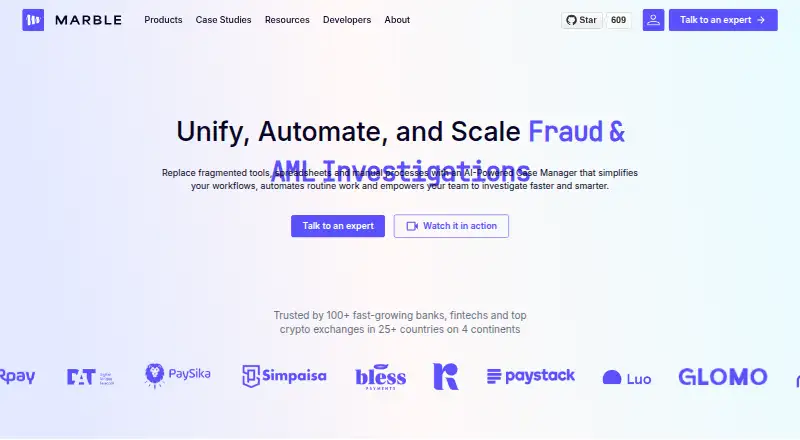
What Marble Case Manager is
Marble Case Manager is a fraud and anti-money-laundering case management product for organizations that move money. It brings internal and third-party customer information, transaction history, alerts, and related activity together in a single case view. Its Virtual Analyst can pre-analyze alerts, flag risks, and draft case summaries and escalation steps designed to be auditable. A suspicious activity report feature uses case information and summaries to help prepare filings. Teams can use role-based access controls to manage permissions and workflows according to their procedures. Marble describes an open data model for bringing together information from core banking and third-party tools, and a REST API for creating and updating objects. Screening data for sanctions, politically exposed persons, and adverse media is documented through OpenSanctions or LexisNexis WorldCompliance. The product includes workflow automation, an audit trail, and reporting dashboards. Deployment is described as hybrid, with plan options that include self-hosted, SaaS, or on-premise deployments. Marble says data is encrypted in transit and at rest with AES 256, and that it is SOC 2 compliant. The maker is based in Paris and was founded in 2023.
Good
- Combines customer data, transaction history, alerts, and activity in one case view.
- Virtual Analyst can flag risks and draft auditable summaries and escalation steps.
- Suspicious activity report feature uses case data and summaries.
- Role-based controls manage access and workflows.
- REST API can create and update objects.
Watch out
- Free plan is self-hosted and includes community support.
- Start is SaaS only.
- Enterprise is the only plan listed with AI automations.
Who it suits
Marble is aimed at banks, fintechs, crypto exchanges, and companies whose core business involves moving money. It may suit investigation teams that need case information, alert analysis, reporting, and workflow controls in one product.
Verdict
Choose Marble Case Manager if your organization investigates fraud or AML activity and wants unified case views, report drafting, and role-based workflow controls. The Free plan is open source and self-hosted; teams seeking SaaS, direct support, or AI automations should review the Start and Enterprise plan details.
Plans and prices
From Marble Case Manager's own pricing page, checked 8 Oct 2026.
| Plan | Price | What it gives you |
|---|---|---|
| Free | Free | Open source · Real-time Decision Engine · Community support · Self-hosted |
| Start | Priced on request | Fraud & AML detection, investigation and reporting · Enterprise-grade governance and security controls · Direct support · SaaS only · On demand |
| Enterprise | Priced on request | Fraud & AML detection, investigation and reporting with AI automations · Enterprise-grade infrastructure, governance and security controls · White glove support with SLA · SaaS or On-Premise · On demand |
The facts
Each one read from Marble Case Manager's own pages, with the date it was checked.
What it does
- Access control
- Role-based access controls let teams manage access and workflows according to internal procedures.checked 8 Oct 2026
- AI investigation
- A built-in Virtual Analyst pre-analyzes alerts, flags risks, and drafts auditable case summaries and escalation steps.checked 8 Oct 2026
- Audit trail
- Case activity, decisions, and workflow changes are tracked, versioned, and timestamped.checked 8 Oct 2026
- Deployment
- The investigation page describes SaaS or on-premise deployment, including multi-tenant self-hosted and multi-instance options.checked 8 Oct 2026
- Integrations
- Marble says its open data model can unify data from core banking and third-party tools, and its REST API can create and update objects.checked 8 Oct 2026
- Intended users
- Marble describes its platform as designed for banks, fintechs, crypto exchanges, and companies moving money as a core business.checked 8 Oct 2026
- Privacy and residency
- Marble says data are stored in mainland EU or self-hosted, and each client's data are kept in separate databases without reuse rights.checked 8 Oct 2026
- Purpose
- Marble Case Manager replaces fragmented tools, spreadsheets, and manual processes with an AI-powered case management product for fraud and AML investigations.checked 8 Oct 2026
- Reporting
- The suspicious activity report feature uses pre-filled case data and summaries to help draft filings.checked 8 Oct 2026
- Reporting dashboards
- Yeschecked 19 Sep 2026
- Screening data providers
- Marble documents sanctions, PEP, and adverse media screening through OpenSanctions or LexisNexis WorldCompliance data.checked 8 Oct 2026
- Security
- Marble says user data is encrypted in transit and at rest with AES 256 and that it is SOC 2 compliant.checked 8 Oct 2026
- Unified case view
- The case manager combines internal and third-party customer data, transaction history, alerts, and related activity in one case view.checked 8 Oct 2026
- Workflow automation
- No-code workflows can use triggers, conditions, and actions to triage cases, route them to teams, and apply escalation rules.checked 8 Oct 2026
The company
- Company
- Marble SAS lists its address as 3 Boulevard de Sebastopol, 75001 Paris, France; a company profile states it was founded in 2023 and is based in Paris.checked 8 Oct 2026
- Headquarters
- Paris, Francechecked 28 Sep 2026
Money
- Free plan
- Yeschecked 19 Sep 2026
The full review of Marble Case Manager
Overview
Marble Case Manager is a fraud and anti-money-laundering investigation platform for organizations that handle financial crime cases. It is best suited to banks, fintechs, crypto exchanges, and other businesses where moving money is central. Its strongest case is a unified investigation workflow; self-hosting is the no-cost route, while SaaS, direct support, and AI automations depend on paid tiers.
Key features
A single case view brings together internal and third-party customer data, transaction history, alerts, and related activity. That can give investigators a more coherent working record than fragmented tools and spreadsheets, though teams will need to connect their data sources to make the view useful. Marble’s open data model is intended to unify core banking and third-party data, and its REST API can create and update objects.
The built-in Virtual Analyst pre-analyzes alerts, flags risks, and drafts case summaries and escalation steps. These outputs are auditable, which makes the AI assistance more relevant to regulated workflows than an opaque recommendation; it is an Enterprise feature, not part of the free plan. A suspicious activity report feature uses case data and summaries to help draft filings, reducing repeated entry across investigation and reporting.
Workflow automation, audit trails, reporting dashboards, and role-based access controls support teams that need to govern case handling according to internal procedures. Screening integrations cover sanctions, politically exposed persons, and adverse media through OpenSanctions or LexisNexis WorldCompliance data. Marble says data is encrypted in transit and at rest using AES 256, is stored in mainland EU or self-hosted, and is kept in separate client databases without reuse rights; it also says it is SOC 2 compliant.
Pricing
Marble uses a freemium model. Free costs nothing and includes the open-source product, a real-time decision engine, community support, and self-hosted deployment. It suits teams able to operate their own hosting and rely on community support; it does not include SaaS, direct support, or the Enterprise AI automations.
Start has custom pricing. It includes fraud and AML detection, investigation, and reporting, plus enterprise-grade governance and security controls and direct support. It is SaaS only, so teams that require self-managed infrastructure should look elsewhere or consider Enterprise. Start is the more appropriate step up for organizations seeking hosted service and direct support without the AI automations named for Enterprise.
Enterprise also has custom pricing. It includes detection, investigation, reporting, AI automations, and enterprise-grade infrastructure, governance, and security controls, with SaaS or on-premise deployment. It is the tier for organizations that need those automations or on-premise operation. No seat counts, quotas, trial, or renewal terms are provided, so buyers should compare those terms directly during procurement.
Platforms
Marble supports web, API, and self-hosted use, with hybrid deployment. Plan choice matters: Free is self-hosted, Start is SaaS only, and Enterprise can be SaaS or on-premise. That gives infrastructure-conscious teams a path to self-management, but on-premise deployment is reserved for Enterprise.
Who it's for
Marble is a focused choice for financial institutions and businesses whose core activity involves moving money and that need fraud or AML case work, reporting, and access controls together. Teams that want the open-source route and can manage hosting can start with Free. Organizations that require a hosted service, direct support, or governed enterprise controls should assess Start; those needing AI automations or on-premise deployment should assess Enterprise. It is less compelling for teams seeking a broad, general-purpose case manager.
Pros and cons
- Pros: A unified case view combines customer, transaction, alert, and related activity, helping investigators work from a shared record.
- Pros: Reporting support draws on case data and summaries, while audit trails and role-based controls address traceability and workflow governance.
- Pros: Free is open source and self-hosted, and Enterprise supports either SaaS or on-premise deployment.
- Cons: Free requires the organization to run the software and offers community support, which may not suit teams without operational capacity.
- Cons: Start is SaaS only, and AI automations are reserved for Enterprise, limiting the choices for teams that need both a particular deployment model and those capabilities.
- Cons: Start and Enterprise use custom pricing, so prospective buyers must obtain a quote to assess cost.
Alternatives
EyesClear is worth considering for financial institutions and regulators seeking a free investigation option: its free plan includes five screening credits with a new account, and it supports web and self-hosted use.
Zenoo is a paid alternative with Android, iOS, API, and web support; choose it if mobile platform coverage is a priority.
Clari5 AML is another paid option, with Linux and web support and licensing based on transaction volumes, modules, and deployment architecture. Its per-transaction, per-user, and enterprise licensing may suit buyers comparing those models.
Eastnets SafeWatch AML is a paid, web-based alternative.
Nasdaq Verafin is a paid financial-crime management option for financial institutions; prospective buyers can request a demo or product information.
NICE Actimize is a paid alternative with API and web platforms; contact the vendor for a demo or expert discussion about custom pricing.
Quantexa AML is a paid alternative supporting API, self-hosted, and web use, with demo requests for pricing discussions.
Temenos Wealth Front Office is another paid option supporting API, self-hosted, and web platforms.
For broader category comparisons, see AML Compliance Software, Fraud Detection Software, and Case Management Software.
Verdict
Choose Marble Case Manager if your organization investigates fraud or AML activity and wants case data, reporting, and workflow controls in one focused system. Its open-source self-hosted Free plan is a credible starting point for teams that can run it themselves; look elsewhere if you need mobile apps or general-purpose case management, and weigh the custom-priced tiers carefully if SaaS, direct support, AI automations, or on-premise deployment are essential.
Getting started
- Visit the Marble investigation website.
- Choose the Free plan for a self-hosted deployment, Start for SaaS, or Enterprise for SaaS or on-premise deployment.
- For the Free plan, use its open-source real-time decision engine and community support.
- For Start or Enterprise, use the plan's listed fraud and AML investigation and reporting capabilities.
Limits worth knowing
The Free plan is self-hosted and includes a real-time decision engine and community support. The listed Start plan is SaaS only, while Enterprise is the listed option with AI automations and on-premise deployment.
Questions
Is there a free plan?
Yes. Free costs nothing and is open source, self-hosted, and includes a real-time decision engine and community support.
Which deployment options are available?
Free is self-hosted, Start is SaaS only, and Enterprise offers SaaS or on-premise deployment. The product is also described as hybrid.
What does the Virtual Analyst do?
It pre-analyzes alerts, flags risks, and drafts auditable case summaries and escalation steps.
What screening data providers are documented?
Marble documents sanctions, PEP, and adverse media screening through OpenSanctions or LexisNexis WorldCompliance data.
Who makes Marble Case Manager?
The maker is Marble Case Manager, based in Paris, France, and founded in 2023.
Alternatives to Marble Case Manager
- 1

NICE Actimize
WebAPI6.2 - 2

Unit21
WebAPI6.2 - 3
Zenoo
AndroidiOSWebAPI6.2 - 4

EyesClear
Free planWebSelf-hosted6.1Free plan - 5
Nasdaq Verafin
WebAPI6.1 - 6
 6.0