Nimbalyst
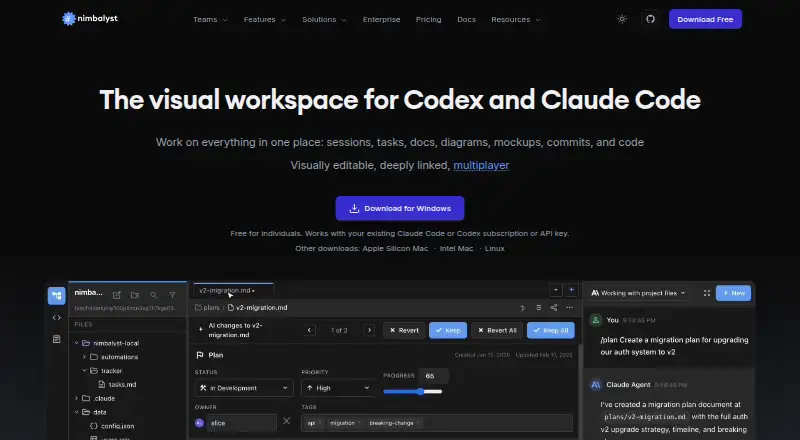
Nimbalyst is a visual workspace for working with Claude Code and Codex on files, sessions and tasks.
What Nimbalyst is
Nimbalyst is a visual workspace for working with Claude Code and Codex on files, sessions and tasks. Its editors cover markdown, code, CSV spreadsheets, mockups, Excalidraw diagrams, data models and Mermaid diagrams. Users can run multiple agent sessions in parallel, search and resume saved sessions, and link sessions to the files they read or write. Developer Mode adds a Monaco code editor, terminal, visual git management, worktrees and pull request review. Teams can edit shared documents, mockups, diagrams, trackers and kanban boards together in real time. Content and metadata are stored as standard files on the local filesystem, and users can choose to sync through GitHub. The desktop and iOS apps are MIT licensed; apps are also available for Linux, macOS and Windows. Android is described as planned for a future release. AI features require a user's own AI subscription or API key, with local models through LM Studio also listed. Individual is free with no feature limits. Teams is listed at $20 a month or $200 a year and is free during Beta.
Good
- Runs multiple agent sessions in parallel.
- Editors include code, CSV, mockups and diagrams.
- Teams supports real-time collaboration on shared work.
- Stores content and metadata as local files.
Watch out
- AI features require your own AI subscription or API key.
- Android is planned, not listed as available.
- Teams pricing is listed as free during Beta.
Who it suits
Nimbalyst suits individuals and teams working with coding agents who want files, sessions and visual tools in one workspace. AI features require users to bring their own AI access or use a local model through LM Studio.
Verdict
Nimbalyst combines agent sessions with editors and team collaboration, while keeping workspace files on the local filesystem by default. Check the AI access requirement and current Teams pricing before choosing a plan.
Plans and prices
From Nimbalyst's own pricing page, checked 29 Sep 2001.
| Plan | Price | What it gives you |
|---|---|---|
| Individual | Free | No feature limits · no trial period · requires your own AI access |
| Teams | $20 a month | Everything in Individual · real-time collaboration · shared docs and trackers · or $200 / user / year. Free during Beta. |
| Teams (annual) | $200 a year | Everything in Individual · real-time collaboration · shared docs and trackers · Free during Beta. |
| Enterprise | Priced on request | Everything in Teams · collaboration server in your cloud or managed by Nimbalyst · data residency and custom editors |
The facts
Each one read from Nimbalyst's own pages, with the date it was checked.
What it does
- Agent sessions
- Users can run multiple agent sessions in parallel, search and resume saved sessions, and link sessions to files they read or write.checked 29 Sep 2001
- AI access requirement
- Users bring their own AI subscription or API key for AI features; the pricing FAQ also lists local models through LM Studio as an option.checked 29 Sep 2001
- Cloud processing
- The trust page says workspace data stays on the device and is processed on Nimbalyst servers only when users opt into cloud features such as sync, share, or Teams.checked 29 Sep 2001
- Code tools
- Developer Mode includes a Monaco code editor, terminal, visual git management, worktrees, and pull request review.checked 29 Sep 2001
- Editors
- The workspace includes visual editors for markdown, code, CSV spreadsheets, mockups, Excalidraw diagrams, data models, and Mermaid diagrams.checked 29 Sep 2001
- Integrations
- Nimbalyst supports Claude Code and Codex, with OpenCode and GitHub Copilot listed as alpha providers, and MCP connections to services such as Linear, GitHub, and Slack.checked 29 Sep 2001
- Intended users
- Nimbalyst describes its audience as teams of people, from one-person teams to larger teams, working with agents.checked 29 Sep 2001
- Mobile
- The iOS app can monitor sessions, review diffs, resume sessions, and send instructions to agents from an iPhone; Android is described as planned for a future release.checked 29 Sep 2001
- Open source
- The desktop and iOS apps are MIT licensed, and the source code is available on GitHub.checked 29 Sep 2001
- Product
- Nimbalyst is an agent-native visual workspace for working with Claude Code and Codex on files, sessions, and tasks in one interface.checked 29 Sep 2001
- Security
- Nimbalyst states it is SOC 2 Type II audited and uses encryption in transit and at rest, access controls, logging, and vendor due diligence.checked 29 Sep 2001
- Storage
- Content and metadata are stored in plain markdown and other standard files on the local filesystem; users can sync through GitHub if they choose.checked 29 Sep 2001
The company
- Team collaboration
- Teams supports real-time multiplayer editing of shared documents, mockups, diagrams, trackers, and kanban boards.checked 29 Sep 2001
The full review of Nimbalyst
Nimbalyst is a workspace for working with Claude Code and Codex alongside project files, tasks and visual editors. It suits people coordinating agent-assisted work across those materials. Its strongest case is bringing sessions and local files together; AI features require a separate subscription or API key.
Overview
Nimbalyst combines parallel agent sessions with a workspace for project materials. Users can search and resume saved sessions and associate them with the files they read or write. That makes it more useful for organizing ongoing agent work than for someone seeking only a diagramming app.
Content and metadata live in plain markdown and other standard files on the local filesystem, and users can choose to sync through GitHub. Nimbalyst says data remains on the device unless users opt into cloud features such as sync, sharing or Teams. The desktop and iOS apps are MIT licensed, with source code on GitHub. Its stated safeguards include SOC 2 Type II auditing, encryption in transit and at rest, access controls, logging and vendor due diligence.
Key features
- Visual editors: Markdown, code, CSV spreadsheets, mockups, Excalidraw diagrams, data models and Mermaid diagrams cover a broad range of project artifacts. Mermaid support and diagram import are included, with Mermaid, Excalidraw and Prisma schema export formats.
- Agent sessions: Running sessions in parallel, then searching and resuming them, helps users keep multiple strands of work organized. Linking sessions to the files they touch gives those interactions useful project context.
- Developer Mode: A Monaco code editor, terminal, visual git management, worktrees and pull request review make this more than a visual planning space for developers who want coding tools alongside agents.
- Providers and connections: Claude Code and Codex are supported. OpenCode and GitHub Copilot are alpha providers, while MCP connections can link services including Linear, GitHub and Slack.
- Team collaboration: Teams enables real-time multiplayer editing for shared documents, mockups, diagrams, trackers and kanban boards. That is a meaningful extension for collaborative work, though it makes the choice of Teams plan and cloud features relevant.
- iPhone companion: The iOS app can monitor sessions, review diffs, resume sessions and send instructions to agents. Android is planned for a future release, so Nimbalyst is not yet a cross-platform mobile choice.
Pricing
Nimbalyst is freemium. The Individual plan costs nothing, has no feature limits and has no trial period. It is a generous starting point for solo users, but it still requires users to bring their own AI subscription or API key; the pricing FAQ also offers local models through LM Studio as an option.
Teams costs $20 a month, billed or $200 / user / year, and adds real-time collaboration and shared docs and trackers to everything in Individual. Teams (annual) costs $200 a year billed and includes the same features. Both Teams plans are Free during Beta. The monthly option suits teams preferring monthly billing; the annual option has a stated yearly price. The per-user terms matter as teams grow, and the Beta offer is not a reason to assume the paid terms will remain free.
Enterprise has custom pricing and includes everything in Teams plus a collaboration server in the customer's cloud or managed by Nimbalyst, data residency and custom editors. It is the relevant tier for organizations needing those deployment and configuration options. No free trial is offered.
Platforms
Nimbalyst supports iOS, Linux, macOS and Windows. The iPhone app handles session monitoring and review tasks, while Android remains planned rather than supported. This platform spread covers major desktop systems, but mobile use currently means iOS.
Who it's for
Nimbalyst is best suited to individuals or teams that work with Claude Code or Codex and want agent sessions connected to files, editors and shared project materials. The local-file approach will appeal to people who want standard files and optional GitHub sync. It is a weaker fit for anyone who needs AI features without bringing separate AI access, needs Android, or wants a focused diagramming tool rather than a broad workspace.
Pros and cons
Pros
- Broad Individual plan: No feature limits at no cost make it possible to use the workspace without first paying Nimbalyst, although AI access is still required separately.
- Local, standard-file storage: Plain markdown and other standard files, with optional GitHub sync, suit users who want project content on their filesystem by default.
- Sessions and artifacts together: Parallel sessions, file links and varied visual editors help keep agent work connected to project materials.
- Real-time shared workspace: Teams collaboration spans documents, mockups, diagrams, trackers and kanban boards rather than just one artifact type.
Cons
- Separate AI access: The free plan does not remove the cost or setup of an AI subscription or API key.
- Paid team seats: Teams is priced per user, making its monthly or annual charge a recurring consideration as collaborators are added.
- No Android app yet: Mobile session control is limited to iOS for now.
- Not a dedicated diagram-only choice: Its breadth is useful for agent workflows, but readers seeking just diagramming may prefer a more focused alternative.
Alternatives
For a directory of diagramming choices, browse AI Diagram Generators.
Creately is a better fit for readers prioritizing canvases and collaborators: its free plan offers unlimited canvases and collaborators, capped at 45 items per canvas.
OpenCharts suits someone looking for a diagramming-oriented free tier with 500K AI credits, one of each project type, one Code Canvas project, 10 GB Drive storage and all export formats.
ArchitectureDiagram.ai is a more targeted option for architecture diagrams; its free plan allows two diagrams per month with watermarked exports.
Archway suits readers seeking AI diagram generations on a free tier, which allows five per month and three diagrams across all seven diagram types, with PNG and SVG export.
Eraser is an alternative for a small number of files and AI diagrams: its free plan includes three files, three AI diagrams, seven-day version history and unlimited guests.
LetDraw is another free option for a small shared diagramming workspace, with three documents, one workspace, five comments per document and three AI prompts.
Mermaid Chart is worth considering when Mermaid diagrams are the main need: its free Basic plan allows three diagrams, limited AI and one team and project.
sysdraw suits a web-only diagramming workflow with a free allowance of 10 scenes, five AI generations per month and PNG export.
Verdict
Choose Nimbalyst if you work with Claude Code or Codex and want agent sessions, project files and collaborative editors in one workspace, with local storage as the default. Its no-feature-limit Individual plan is a strong entry point, but you must bring AI access, and teams should weigh the per-user charge before relying on the Beta offer. Look elsewhere if you need Android or only want a dedicated diagramming app.
Getting started
- Open the Nimbalyst website
- Choose the free Individual plan or a Teams plan
- Install the app on iOS, Linux, macOS, or Windows
- Connect your Claude Code or Codex subscription or API key
- Use LM Studio if you prefer a listed local-model option
- Enable optional GitHub sync, sharing, or Teams cloud features when needed
Limits worth knowing
The Individual plan has no feature limits, but it requires your own AI access. Teams is listed at $20 a month or $200 a year and is free during Beta.
Questions
Is Nimbalyst free?
The Individual plan costs nothing and has no feature limits. Teams costs $20 a month or $200 a year and is free during Beta.
Which platforms are supported?
Nimbalyst has apps for iOS, Linux, macOS, and Windows. Android is described as planned for a future release.
What AI access does it require?
AI features require your own AI subscription or API key. Local models through LM Studio are also listed as an option.
Does it support collaboration?
The Teams plan provides real-time collaboration on shared documents, mockups, diagrams, trackers, and kanban boards.
Is Nimbalyst open source?
The desktop and iOS apps are MIT licensed, and their source code is available on GitHub.
Which integrations are listed?
Claude Code and Codex are supported, with OpenCode and GitHub Copilot listed as alpha providers. MCP connections include services such as Linear, GitHub, and Slack.
Alternatives to Nimbalyst
- 1

Creately
Free planWebAPILinuxmacOS8.0Free plan - 2

Eraser
Free planWebAPIExtensionSelf-hosted7.5From $15 a month - 3
OpenCharts
Free planWebAPImacOSWindows7.4From $9.99 a month - 4
AI Diagram Maker
Free planWebAPIExtension7.2From $10 a month - 5

Archflow
Free planWeb7.2From $5 a month - 6
ArchitectureDiagram.ai
Free planWebAPI6.7From $4.99 a month