mycloud Back Office
mycloud Back Office is a hospitality accounting system for independent properties and hotel chains.
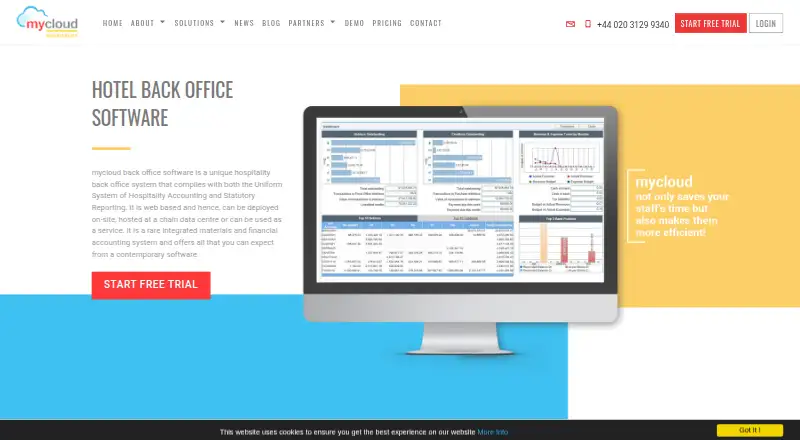
What mycloud Back Office is
mycloud Back Office is a hospitality accounting system for independent properties and hotel chains. Its accounting modules cover sales and debtors, purchases and creditors, petty cash, bank reconciliation, general ledger, and financial reporting. The system also supports multi-property and department reporting. Purchasing tools can create draft orders from reorder policies, recent purchase terms, or supplier quotations, while inventory features cover receiving, stock takes, and consumption tracking. Its F&B Costing module compares actual use with recipe and menu sales expectations and produces variance, menu engineering, and food cost reports. A membership module records members and supports billing by membership type and optional services, with links to PMS, POS, and events and catering modules. The web-based system can be deployed on-site, at a chain data centre, or as a service. It supports scanned transaction documents and electronic report sharing. The maker lists a free trial and pricing from £8/mo; tax-reporting coverage varies by country or region and should be checked.
Good
- Supports multi-property and department reporting
- Includes bank reconciliation and financial reporting
- Tracks stock receiving, takes, and consumption
- Compares food use with recipe and sales expectations
- Offers on-site, hosted, or service deployment
Watch out
- No free plan is listed
- Tax-reporting coverage varies by country or region
- Pricing page does not specify Back Office plan inclusion
Who it suits
It suits independent hospitality businesses and hotel chains needing accounting, purchasing, inventory, and reporting tools. The membership module may also suit properties that bill members for services.
Verdict
mycloud Back Office brings accounting, purchasing, inventory, and food costing into a hospitality-focused system. Check local tax coverage and confirm which pricing plan includes Back Office before choosing it.
The facts
Each one read from mycloud Back Office's own pages, with the date it was checked.
What it does
- Accounting
- Modules include sales and debtors, purchases and creditors, petty cash, bank reconciliation, general ledger, and financial reporting.checked 9 Oct 2026
- Audience
- The product is presented for independent hospitality units and hospitality chains.checked 9 Oct 2026
- Deployment
- The web based system can be deployed on-site, hosted at a chain data centre, or used as a service.checked 9 Oct 2026
- Electronic records
- The maker says supporting documents can be scanned and attached to transactions, while reports and historical records can be handled electronically.checked 9 Oct 2026
- Integrations
- The maker says interfaces exist for some PMS, POS, payroll, and other systems, and that third-party systems can use its standard interfaces.checked 9 Oct 2026
- Interfaces
- The open system has interfaces with some PMS, POS, and payroll systems, and third party systems can use its standard interfaces.checked 9 Oct 2026
- Membership accounting
- The membership accounting module records members, supports billing by membership type and optional services, and integrates with PMS, POS, and events and catering modules.checked 9 Oct 2026
- Multi-property
- The product page describes Back Office as a multi-property system that supports hotel-chain functions.checked 9 Oct 2026
- Multi-property use
- The maker describes Back Office as a multi-property system that supports hospitality chain functions.checked 9 Oct 2026
- Paper reduction
- Transactions can have scanned supporting documents attached, and reports can be viewed on screen or distributed by email.checked 9 Oct 2026
- Pricing
- The pricing page lists Basic at GBP £ 8 per room / month with a 20-room minimum, Standard at GBP £ 12 per room / month with a 20-room minimum, and Premium at GBP £16 per room / month with a 20-room minimum; it does not specify Back Office plan inclusion.checked 9 Oct 2026
- Purchasing
- Regular purchase requirements can be generated from reorder policies, with draft orders based on recent purchase terms or supplier quotations.checked 9 Oct 2026
- Purchasing and inventory
- Purchasing features include reorder-based draft orders, rate contracts, goods receiving, inventory tracking, and stock takes.checked 9 Oct 2026
- Purpose
- mycloud Back Office is a hospitality accounting system that supports the Uniform System of Hospitality Accounting and statutory reporting.checked 9 Oct 2026
- Support
- The product page quotes a customer describing Prologic First's technical services as committed and responsive.checked 9 Oct 2026
- Tax reporting
- VAT and tax reporting is intended to support local statutory requirements, but the maker says coverage varies by country or region and should be checked.checked 9 Oct 2026
The company
- Company
- mycloud is developed by Prologic First, which the maker describes as an independent private company serving the hospitality industry across the UK, Asia, Africa, and the Middle East.checked 9 Oct 2026
- Maker
- The about page says mycloud is developed by Prologic First, an independent private company serving the hospitality industry across the UK, Asia, Africa, and the Middle East.checked 9 Oct 2026
Money
- Food costing
- The F&B Costing module compares actual consumption with expected consumption based on recipes and menu sales, and generates variance, menu engineering, and food cost reports.checked 9 Oct 2026
- Free trial
- The maker offers a free 30-day trial.checked 9 Oct 2026
- Inventory and costing
- Inventory supports receiving, stock takes, and consumption tracking, while F&B Costing compares actual use with recipe and menu sales expectations.checked 9 Oct 2026
The full review of mycloud Back Office
mycloud Back Office is a hospitality-focused accounting and operations system for independent properties and hotel groups. It suits operators that want purchasing, stock control, food costing, and financial reporting connected across one or several properties. Its strongest case is a broad, hospitality-specific back office; regional tax coverage and system compatibility need careful confirmation before committing.
Overview
The system follows the Uniform System of Hospitality Accounting and supports statutory reporting. It can be deployed as a web service, hosted at a chain data centre, or installed on-site, giving groups a choice between managed delivery and greater control over their environment.
Back Office is described as a multi-property platform, so chains can manage property-level activity within a wider hospitality structure. Independent hotels can use the same accounting and operational modules, although some of the chain-oriented scope may be more than a single site requires.
Key features
Accounting and reporting
Core modules cover sales and debtors, purchases and creditors, petty cash, bank reconciliation, the general ledger, and financial reporting. Department reporting adds an operational view of performance, while multi-property accounting supports consolidation across a group. This is a substantial accounting footprint for hospitality operators that do not want separate systems for daily transactions and financial oversight.
Purchasing and inventory
Reorder policies can generate regular purchase requirements, with draft orders based on recent purchase terms or supplier quotations. Rate contracts, goods receiving, inventory tracking, and stock takes extend the workflow through delivery and ongoing control. The practical benefit is a closer link between what a property orders, receives, and holds; that depends on disciplined supplier and stock records.
Food and beverage costing
F&B Costing compares actual consumption with expected use from recipes and menu sales. Variance, menu-engineering, and food-cost reports help managers investigate overspend and assess menu performance. Properties with meaningful food-and-beverage operations gain a more targeted cost-control tool than a general ledger alone provides.
Membership and connected systems
Membership accounting records members and bills by membership type and optional services. It can integrate with PMS, POS, and events and catering modules. Interfaces are also available for some PMS, POS, payroll, and other systems, and third-party products can use standard interfaces. Compatibility therefore matters: the integration promise is useful, but not every existing system is guaranteed to fit.
Electronic records
Scanned supporting documents can be attached to transactions, while reports and historical records can be handled electronically or distributed by email. That can reduce paper handling and make supporting evidence easier to keep with the underlying accounting entry.
Tax coverage
VAT and tax reporting is intended to support local statutory requirements, but coverage varies by country and region. Businesses should verify their jurisdiction before treating this as a complete compliance solution.
Pricing
The pricing model is paid, with pricing noted from £8 per month, and a free trial is offered. The published room-based plans are Basic at GBP £ 8 per room / month, Standard at GBP £ 12 per room / month, and Premium at GBP £16 per room / month. Each has a 20-room minimum, so the entry commitment is at least 20 rooms even for a smaller property.
The pricing page does not state which plan includes Back Office. That makes the room rates useful as a starting point rather than a confirmed Back Office quote. Ask which tier contains the accounting modules, whether the trial covers them, and what terms apply after the trial. A small property should pay particular attention to the 20-room floor; a chain should confirm how charges scale across properties.
Platforms
Back Office is available through web, Android, iOS, Windows, macOS, and Linux environments, with API, extension, and self-hosted options. The deployment choices suit organisations that need browser access, mobile access, integrations, or control over where the system runs.
Who it's for
Independent hotels and hospitality chains are the stated audience. It is especially well suited to groups needing multi-property accounting, department reporting, purchasing controls, inventory and stock-take workflows, and recipe-based food-cost analysis in one hospitality system. It is a less obvious fit for businesses that need guaranteed local tax functionality without regional validation, or that have an ecosystem whose PMS, POS, or payroll products are not covered by the available interfaces.
Pros and cons
Pros
- Broad hospitality accounting: sales, creditors, petty cash, reconciliation, general ledger, and reporting cover the main financial workflow.
- Useful operational controls: reorder-driven purchasing, receiving, stock takes, and consumption tracking connect finance with inventory activity.
- Focused F&B analysis: recipe and menu comparisons produce variance, menu-engineering, and food-cost reports.
- Chain-ready structure: multi-property support and department reporting suit groups managing several hotels.
- Flexible deployment: on-site, chain-hosted, or service delivery is available, with standard interfaces for third-party systems.
Cons
- Back Office pricing is unclear: room-plan rates do not confirm which tier includes this product or its full modules.
- Minimum commitment: every listed plan requires at least 20 rooms, which can outweigh the headline entry price for smaller operations.
- Regional tax uncertainty: VAT and statutory coverage must be checked for the relevant country or region.
- Integration fit is not universal: interfaces exist for some systems, so compatibility with a property’s exact PMS, POS, and payroll stack needs validation.
Alternatives
Choose Docyt instead if you want a freemium accounting option with a free-forever Accountant Copilot plan, bank and card reconciliation, and month-end close automation across Android, iOS, and web.
Hotelary.ai is an alternative for organisations seeking a web-based product with a free HAAVIS tier or a monthly International plan priced at 49.00 USD, plus usage.
Consider Hotel Investor Apps for a paid hospitality application available on Android, iOS, web, and API.
Fairmas is a paid, modular hospitality software option with custom pricing and a demo-led buying process.
Inn-Flow suits buyers who prefer pricing tailored to business needs, with most applications priced by hotel and month.
WinX is a paid hospitality system quoted individually after discovery, typically with a perpetual-licence proposal.
Acumatica Field Service offers paid, custom pricing based on applications, usage, resources, and deployment preferences.
Aptech PVNG is another paid option supporting API, self-hosted, web, and Windows environments.
For a broader shortlist, see Hotel Accounting Software.
Verdict
Choose mycloud Back Office when a hotel or chain needs hospitality-specific accounting tied to purchasing, inventory, food costing, and multi-property reporting. Its main reason to look elsewhere is uncertainty around the exact Back Office plan and regional tax or interface coverage; confirm both before signing up.
Alternatives to mycloud Back Office
- 1

Docyt
Free planAndroidiOSWebAPI8.1Free plan - 2
QuickBooks Time
AndroidiOSWebAPI7.8From $20 a month - 3

Exceed HMS
AndroidiOSWebAPI7.7 - 4
Hotelary.ai
Free planWebAPI7.3Free plan - 5
Xero Expenses
AndroidiOSWeb7.2From $5.40 a month - 6

Acumatica Cloud ERP
AndroidiOSWebAPI6.6