
MinerU
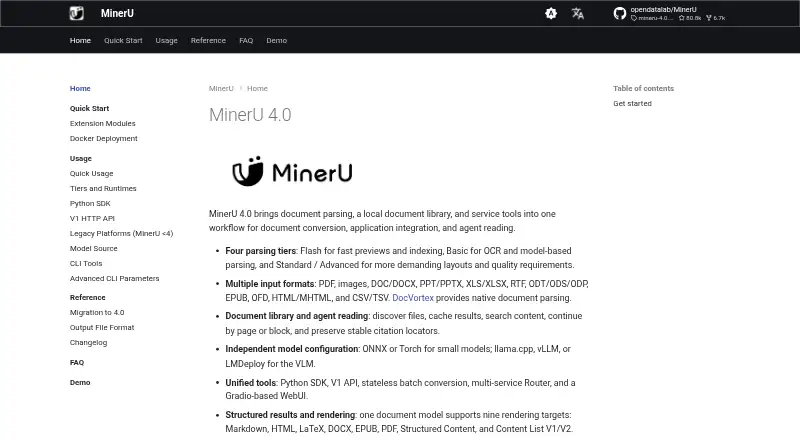
MinerU 4.0 combines document parsing, a local document library, and tools for conversion, application integration, and agent reading.
What MinerU is
MinerU 4.0 combines document parsing, a local document library, and tools for conversion, application integration, and agent reading. It accepts PDFs, images, office documents, ebooks, web formats, and other listed inputs, and can produce Markdown, HTML, LaTeX, DOCX, EPUB, PDF, structured content, and content lists. Four parsing tiers—Flash, Basic, Standard, and Advanced—address different quality and compute needs. The document library can discover files, cache parsing results, search content, continue by page or block, and preserve citation locators. Developers can use a Python SDK, V1 HTTP API, command-line tools, or a Gradio-based WebUI. MinerU also supports the MCP protocol and agent frameworks, with exports to Dify and Notion. Documents are not automatically uploaded to the official service; remote parsing requires explicit configuration. Local WebUI and API server deployments are documented for Linux, macOS, and Windows. The software is free under its project license, which sets commercial-use limits above 100 million monthly active users or USD 20 million monthly revenue.
Good
- Accepts many document and image formats.
- Offers four parsing tiers.
- Can preserve citation locators in its library.
- Provides SDK, API, command-line tools, and WebUI.
- Supports local deployment on Linux, macOS, and Windows.
Watch out
- Higher-throughput local deployments have 16 GB memory recommendations.
- Commercial use has limits under the project license.
- Remote parsing requires explicit configuration.
Who it suits
MinerU suits people and teams converting or searching varied document collections, including developers integrating parsing into applications or agent workflows. Its local deployment options may suit users who want to avoid automatic document uploads.
Verdict
MinerU brings document parsing, library search, and integration tools into one project, with both local and service-oriented options. Review the license conditions if using it commercially at large scale.
Plans and prices
From MinerU's own pricing page, checked 15 Oct 2026.
| Plan | Price | What it gives you |
|---|---|---|
| Free | Free | 5 free pages every day · files up to 10 MB · images up to 5 MB · PDFs up to 5 pages · web access only, no API · $0/ month |
| MinerU open-source software | Free | Commercial license required above 100 million monthly active users or USD 20 million monthly revenue · online services must attribute MinerU · Free to use under the project license |
| Pro · Monthly | $9.90 a month | 1,000 pages every month · files up to 200 MB · images up to 50 MB · PDFs up to 500 pages · API included · USD · one-time payment |
| Pro · Annual | $59.90 a year | 1,000 pages every month · files up to 200 MB · images up to 50 MB · PDFs up to 500 pages · API included · USD · one-time payment |
| On-premise | Priced on request | models and data run inside your network · dedicated support · Talk to us about deployment |
The facts
Each one read from MinerU's own pages, with the date it was checked.
What it does
- Agent integrations
- The official site says MinerU supports the MCP protocol and agent frameworks, and offers export to Dify and Notion.checked 5 Oct 2026
- API network limitation
- The hosted create-task API documentation warns that URLs hosted on GitHub, AWS and other overseas services may time out.checked 15 Oct 2026
- API rate limits
- The hosted service documents 300 submit requests per minute, 1,000 result queries per minute and up to 10,000 files per day, subject to dynamic adjustment.checked 15 Oct 2026
- Changelog license change
- Release 3.1.0 dated April 18, 2026 changed the project from AGPLv3 to the custom Apache-2.0-based MinerU Open Source License.checked 15 Oct 2026
- Cloud lightweight API
- The Agent Lightweight API requires no login but is IP-rate-limited, handles one file up to 10 MB and 20 pages, and returns Markdown only.checked 15 Oct 2026
- Cloud precision API
- The Precision Extract API requires a token, accepts files up to 200 MB and 600 pages, batches up to 200 files, and returns ZIP results with Markdown and JSON plus optional DOCX, HTML or LaTeX.checked 15 Oct 2026
- Developer tooling
- Official tooling includes a Python SDK, V1 HTTP API, stateless batch conversion, multi-service Router and Gradio WebUI.checked 15 Oct 2026
- Docker support
- The documented Docker workflow targets Linux NVIDIA GPUs and Windows WSL2; macOS Docker has no MPS acceleration and non-NVIDIA deployment is pending.checked 15 Oct 2026
- Document library
- Its library discovers and caches files, supports content search and continuation by page or block, and preserves stable citation locators.checked 15 Oct 2026
- Export formats
- The document model supports Markdown, HTML, LaTeX, DOCX, EPUB, PDF, Structured Content and Content List V1/V2 outputs.checked 15 Oct 2026
- Hardware requirements
- The docs recommend at least 16 GB system memory for higher-throughput local deployments and at least 16 GB unified memory for Apple Silicon.checked 5 Oct 2026
- Hosted service
- The official site links to online use and describes an official cloud service, but the opened pages did not state its pricing.checked 5 Oct 2026
- Input formats
- Supported inputs include PDF, images, DOC/DOCX, PPT/PPTX, XLS/XLSX, RTF, OpenDocument, EPUB, OFD, HTML/MHTML and CSV/TSV.checked 15 Oct 2026
- Installation
- The base package is installed with mineru>=4.0,<5 and includes the WebUI, ONNX runtime and llama.cpp VLM.checked 15 Oct 2026
- Institution founding
- LinkedIn lists Shanghai Artificial Intelligence Laboratory as founded in 2020, headquartered in Shanghai, with 201–500 employees.checked 15 Oct 2026
- Integration
- MinerU provides a Python SDK, V1 HTTP API, command-line tools, and a Gradio-based WebUI.checked 5 Oct 2026
- License
- MinerU uses a custom MinerU Open Source License based on Apache 2.0, with attribution requirements and a separate commercial-license trigger above 100 million monthly active users or 20 million USD monthly revenue.checked 15 Oct 2026
- License terms
- The project license permits commercial use without a separate license unless monthly active users exceed 100 million or monthly revenue exceeds USD 20 million, and requires attribution for third-party online services based on MinerU.checked 5 Oct 2026
- Limit: active defect areas
- The repository bug list includes reports involving Apple MPS OCR falling back to CPU, formula and punctuation errors, figure provenance, table extraction and Arabic recognition/order.checked 15 Oct 2026
- Limit: backend quality gap
- DocuOCR reports the CPU pipeline backend at 86.47 on the same benchmark, about 8.92 points below the VLM result.checked 15 Oct 2026
- Limit: CPU timeout
- A closed GitHub issue reports that pure CPU mode could not finish PDFs over 200 pages before timing out.checked 15 Oct 2026
- Limit: hosted throughput
- DocuOCR says hosted accounts receive 1,000 pages per day at highest priority and lower priority thereafter, with 200 MB and 200-page per-file limits.checked 15 Oct 2026
The company
- Company headquarters and size
- Crunchbase lists OpenDataLab as a private for-profit organization headquartered in Shanghai with 51–100 employees.checked 15 Oct 2026
- Company identity
- OpenDataLab's official site identifies it as the Data Platform Center of Shanghai Artificial Intelligence Laboratory and the maker of MinerU.checked 15 Oct 2026
The full review of MinerU
Overview
MinerU 4.0 is a document-parsing and conversion project with a searchable local library and tools for connecting it to software and AI agents. It is a strong fit for developers and teams building repeatable document workflows; occasional users looking for a simple online converter may find it more involved than they need.
Its advantage is the combination of varied inputs, structured outputs, and local or self-hosted workflows. The trade-offs are meaningful memory needs for higher-throughput local use and license conditions for very large commercial services.
Key features
MinerU handles PDF, images, DOC/DOCX, PPT/PPTX, XLS/XLSX, RTF, ODT/ODS/ODP, EPUB, OFD, HTML/MHTML, and CSV/TSV. Four parsing tiers—Flash, Basic, Standard, and Advanced—address different quality and compute needs. That choice is useful for matching processing to a workload, though selecting an appropriate tier entails balancing output quality against available compute.
PDF conversion targets include Markdown, HTML, LaTeX, DOCX, EPUB, PDF, Structured Content, and Content List V1/V2. OCR and batch conversion are supported, making MinerU more relevant to recurring extraction and document-processing pipelines than to a narrow format swap. Images and other supported documents also have documented export options.
The document library discovers files, caches parse results, searches content, resumes by page or block, and preserves citation locators. Those capabilities suit research and document-heavy workflows where material needs to remain searchable and traceable, rather than one-off conversion.
Integration routes include a Python SDK, V1 HTTP API, command-line tools, and a Gradio-based WebUI. MinerU also supports MCP and agent frameworks, with export to Dify and Notion. This breadth gives developers several ways to connect parsing to applications, but readers who only need occasional conversion may not benefit from the added integration surface.
Documents are not automatically uploaded to the official service; remote parsing requires explicit configuration. Users can run a local WebUI and V1 API server or connect the SDK to a self-hosted API. That is a useful privacy and deployment option, but higher-throughput local deployments call for at least 16 GB of system memory; Apple Silicon users are advised to have at least 16 GB of unified memory.
Pricing
MinerU open-source software: free. It is free to use under the project license. There is no paid seat or usage quota attached to this software plan, so it suits individual users and organizations able to operate their own workflow. The trade-off is that local deployment puts setup and hardware demands on the user. The official site also links to an online cloud service, but its pricing is custom pricing.
The license permits commercial use without a separate license unless monthly active users exceed 100 million or monthly revenue exceeds USD 20 million. Online services based on MinerU must attribute MinerU. Commercial operators should account for both conditions before choosing it as the basis of a service.
Platforms
MinerU supports web, Windows, macOS, Linux, API, and self-hosted use. The current quick start provides installation instructions for Linux, macOS, and Windows environments. For unresolved issues, users can turn to the MinerU Discord or WeChat community.
Who it's for
MinerU is best for developers, researchers, and teams that need structured extraction from varied document types, searchable local collections, or integration with applications and agents. Its local processing and self-hosting options also suit users who want to keep documents off the official service by default. It is a less natural choice for someone seeking a minimal online tool for occasional conversion or who cannot accommodate local memory requirements.
Pros and cons
- Pros: Broad documented input and output support makes it useful for workflows that need structured results across many file types.
- Pros: The local library combines search, cached parses, reading continuity, and citation locators, supporting ongoing work rather than isolated conversions.
- Pros: Local processing, self-hosted services, APIs, and agent integrations offer flexible deployment and connection options.
- Cons: Higher-throughput local deployments call for at least 16 GB of memory, a substantial requirement for some machines.
- Cons: Commercial services must observe the license thresholds and attribution condition, adding considerations for large-scale operators.
Alternatives
PDF Converter Software is the broader category to explore when comparing conversion tools.
Choose HiPDF instead if a freemium web-access tool with OCR and batch processing is a better fit than a locally deployable parsing project. Its Basic plan costs $39.95 a year, billed annually.
PDF Agile is another alternative.
Convertio is another alternative.
Docling is a free, MIT-licensed local library that can work offline after model download; consider it if that narrower setup fits your workflow better.
FoxyUtils Online PDF Tools is another alternative.
ZonePDF is another alternative.
pdflayer is another alternative.
Online2PDF is a free web-based alternative.
Verdict
Choose MinerU if you need a flexible document-processing foundation with structured exports, searchable local files, and options for local, self-hosted, API, or agent-connected use. Its breadth and free software license are compelling for technical, recurring workflows; look elsewhere for a lightweight converter, or plan carefully if your deployment needs substantial local memory or operates at the license thresholds.
Alternatives to MinerU
- 1

Convertio
Free planAndroidiOSWebAPI8.3From $6.99 a month - 2

HiPDF
Free planAndroidiOSWebAPI8.2Free plan - 3
PDF Agile
Free planWebmacOSWindows7.8$39 one-time - 4
HTML2PDF Rocket
Free planAndroidWebAPILinux7.5From $5 a month - 5
FoxyUtils Online PDF Tools
Free planWeb7.0Free plan - 6
PDFxlsx
iOSWebAPImacOS7.0From $490 a year