Matrify
Matrify is a web application for tracking information such as action items, assets, customers, and products.
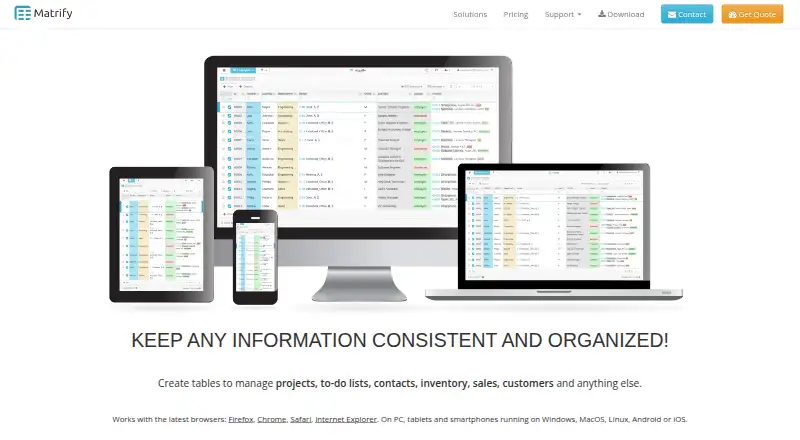
What Matrify is
Matrify is a web application for tracking information such as action items, assets, customers, and products. Users create tables and define columns with types including text, dates, numbers, images, video, and comments. Multi-column search and shareable filters help find records, while links can connect records within a table or across tables. Validation rules and constraints are available, and tables can be shared with permissions for team members or friends.
The product supports CSV import and export, stores its database natively as XML, and provides a RESTful API for reading, writing, deleting, and querying data. Hosting is available as self-hosted server software or cloud hosting on Amazon AWS with a dedicated server per team. The installation guide says SSL/TLS encryption and IP restrictions can be configured, while secure installation remains the user's responsibility. Matrify supports Firefox, Chrome, Safari, and Internet Explorer; server software runs on Linux, Mac, and Windows. The free Standard License allows up to 300 records and three users. Matrify does not support formulas for calculations.
Good
- Supports linked records across tables.
- Tables can have per-user permissions.
- CSV import and export are available.
- RESTful API supports data operations.
- Offers self-hosted and cloud deployment.
Watch out
- Free Standard License is limited to 300 records.
- Formulas for calculations are not supported.
- Secure server installation is the user's responsibility.
Who it suits
Matrify suits individuals, organizations, and corporations that need structured tables, linked records, and permission controls. Its self-hosted option may appeal to teams wanting to manage their own server installation.
Verdict
Matrify offers flexible tables, record links, permissions, and API access, with self-hosted and cloud deployment choices. Its lack of calculation formulas and the free plan's record cap are important constraints to consider.
Plans and prices
From Matrify's own pricing page, checked 8 Oct 2026.
| Plan | Price | What it gives you |
|---|---|---|
| Standard License (1–3 users) | Free | Up to 300 records · up to 3 users |
| Standard License (1–10 users, Starter) — annual | $10 a year | 1–10 users · Annual license; includes maintenance |
| Standard License (1–10 users, Starter) — perpetual | $20, paid once | 1–10 users · Perpetual license; includes one free year of maintenance |
| Standard License (11–15 users) — annual | $500 a year | 11–15 users · Annual license; includes maintenance |
| Standard License (16–25 users) — annual | $1,000 a year | 16–25 users · Annual license; includes maintenance |
| Standard License (11–15 users) — perpetual | $1,000, paid once | 11–15 users · Perpetual license; includes one free year of maintenance |
| Standard License (16–25 users) — perpetual | $2,000, paid once | 16–25 users · Perpetual license; includes one free year of maintenance |
| Standard License (26–50 users) — annual | $2,000 a year | 26–50 users · Annual license; includes maintenance |
| Standard License (26–50 users) — perpetual | $4,000, paid once | 26–50 users · Perpetual license; includes one free year of maintenance |
| Standard License (51–100 users) — annual | $4,000 a year | 51–100 users · Annual license; includes maintenance |
The facts
Each one read from Matrify's own pages, with the date it was checked.
What it does
- API
- Matrify provides a RESTful API to read, write, delete, and query database data.checked 8 Oct 2026
- Audience
- The FAQ says corporations, organizations, and private users can use Matrify to manage information.checked 8 Oct 2026
- Collaboration
- Users can share tables with team members or friends and define what they are permitted to do.checked 8 Oct 2026
- Data links and validation
- Users can link records within or across tables and create validation rules and constraints.checked 8 Oct 2026
- Hosting
- Matrify offers self-hosted server software and cloud hosting on Amazon AWS with a server dedicated to each team.checked 8 Oct 2026
- Import and export
- Matrify supports CSV import and export, and its database is stored natively as an XML file.checked 8 Oct 2026
- Integrations
- The maker describes using the API to automate and integrate Matrify with other tools and processes, without naming specific integrations.checked 8 Oct 2026
- Notable limitation
- Matrify does not support formulas for calculations.checked 8 Oct 2026
- Purpose
- Matrify is a web application for tracking information such as action items, assets, customers, and products.checked 8 Oct 2026
- Search and views
- The product supports multi-column search and creating and sharing filters.checked 8 Oct 2026
- Security configuration
- The server installation guide says SSL/TLS encryption and IP access restrictions can be configured, and warns that secure installation is the user's responsibility.checked 8 Oct 2026
- Support
- The server installation guide directs questions and feedback to [email protected].checked 8 Oct 2026
- Tables and fields
- Users can create tables and define columns with types including text, date, number, image, video, and comment.checked 8 Oct 2026
The company
- Headquarters
- Tallinn, Estoniachecked 28 Sep 2026
Where it runs
- Platform compatibility
- The maker lists Firefox, Chrome, Safari, and Internet Explorer, and says the server runs on Linux, Mac, and Windows.checked 8 Oct 2026
The full review of Matrify
Matrify is a configurable database for organizing records in tables, with linked data, shared access controls, and a choice of cloud or self-hosted deployment. It is best for people and teams who need structured records and API access more than spreadsheet-style calculations. Its flexibility is useful, but the free tier’s 300-record ceiling and lack of formulas put firm boundaries on its reach.
Overview
Users can shape tables around information such as customers, assets, products, or action items, choosing fields for text, dates, numbers, images, video, and comments. Multi-column search and shareable filters make it easier to focus on a slice of a dataset, while record links connect related information within or across tables. Validation rules and constraints add structure; the absence of calculation formulas means Matrify is a poor fit when derived values or spreadsheet-like analysis are central.
Key features
Table sharing includes permission controls, so collaborators can be given different levels of access rather than blanket control. CSV import and export help with data exchange, and the database is stored natively as an XML file. Its RESTful API can read, write, delete, and query database data, which gives technically capable teams a way to build custom automation. The maker describes integrations through the API but names no ready-made connectors, so teams should not choose Matrify expecting a particular plug-and-play integration.
Deployment is a meaningful choice: Matrify can run on a self-hosted server or in cloud hosting on Amazon AWS, with a server dedicated to each team. The server guide says SSL/TLS encryption and IP access restrictions can be configured, while putting responsibility for a secure installation on the user. That makes self-hosting attractive to teams wanting control, but it also brings operational and security duties.
Pricing
The free Standard License costs nothing and allows up to 300 records and 3 users. It is a sensible starting point for a small personal or team database, but the record cap makes it unsuitable for growing collections unless users move to a paid license.
The 1–10 user Starter annual license costs $10 a year and includes maintenance; its perpetual counterpart costs $20, paid once and includes one free year of maintenance. These are the lowest-cost paid options and suit small groups choosing between annual payment and a one-time license purchase. The annual tiers are $500 a year for 11–15 users, $1,000 a year for 16–25 users, $2,000 a year for 26–50 users, and $4,000 a year for 51–100 users; each includes maintenance. Perpetual licenses cost $1,000, paid once for 11–15 users, $2,000, paid once for 16–25 users, and $4,000, paid once for 26–50 users, each including one free year of maintenance. The listed team-size bands make the paid structure more relevant to organizations that know their seat needs; beyond 50 users, only an annual tier is given.
Platforms
Matrify supports Android, iOS, Linux, macOS, web, and Windows, as well as self-hosting and API access. The maker lists Firefox, Chrome, Safari, and Internet Explorer as compatible browsers and says the server runs on Linux, Mac, and Windows.
Who it's for
Corporations, organizations, and private users can use Matrify to manage information. It is strongest for users who want linked tables, configurable fields, controlled collaboration, and either a dedicated cloud server or a server they operate themselves. It is not the right choice for calculation-heavy work, and the free tier’s 300-record cap limits its usefulness as a long-term home for expanding datasets.
Pros and cons
- Pros: Linked records, validation rules, and constraints support more structured data than disconnected lists.
- Pros: Permissions, shareable filters, CSV exchange, and a RESTful API cover collaboration and custom workflows.
- Pros: Cloud and self-hosted deployment give teams a choice of operating model.
- Cons: No calculation formulas, so spreadsheet-oriented analysis requires another tool.
- Cons: The free plan stops at 300 records and 3 users, which can constrain even a useful small database.
- Cons: Self-hosting leaves secure installation to the user, and API-based integrations may require custom work.
Alternatives
Compare no-code database software if you want to weigh Matrify against more options in the category. Choose Lark instead if a free plan for up to 20 users, 100 GB of storage, 18 months of message history, and 1,000 monthly automations better suits a collaborative workspace. Ninox is a stronger alternative when a free allowance of up to 5 users and 5,000 records matters more than Matrify’s deployment choices. For a self-hosted database with no per-seat fee, consider Saltcorn, whose open-source platform is MIT-licensed. Airtable is worth considering for its Team plan’s 50,000 records per base and 100,000 monthly API calls per workspace. Grist is another option for users who want unlimited documents with up to 5,000 records per document on its free plan. Choose Memento Database if unlimited entries on its free plan are a priority. Stackby may suit teams that need a free allowance of 1,500 rows per stack, while Ragic offers 1,000 records per custom sheet and unlimited users on its free plan.
Verdict
Matrify is a good fit for small teams and organizations that need linked records, permissions, API-driven workflows, and a choice of hosting. Its defining advantages are relational structure and deployment flexibility; the main reasons to look elsewhere are the missing formulas and the free plan’s 300-record cap. If calculations or a larger no-cost dataset are essential, another database tool will be a better match.
Getting started
- Visit https://www.matrify.com/en.
- Choose the free Standard License for up to three users and 300 records, or select a paid license.
- Use Matrify on web or one of its listed platforms: Android, iOS, Linux, macOS, or Windows.
- Choose cloud hosting on Amazon AWS or install the server software on Linux, Mac, or Windows.
- Create tables and columns, then import CSV data if needed.
- Configure SSL/TLS encryption and IP access restrictions for a server installation.
Limits worth knowing
The free Standard License is limited to 300 records and up to three users. The $10 a year Starter annual license covers 1–10 users; the $20, paid once perpetual Starter license covers 1–10 users and includes one free year of maintenance.
Questions
Is Matrify free?
Yes. Its free Standard License costs nothing and supports up to 300 records and three users.
What does the paid Starter license cost?
The Starter annual license costs $10 a year and covers 1–10 users, including maintenance. The Starter perpetual license costs $20, paid once, covers 1–10 users, and includes one free year of maintenance.
Which platforms does Matrify support?
Matrify lists Android, API, iOS, Linux, macOS, self-hosted, web, and Windows. It lists Firefox, Chrome, Safari, and Internet Explorer as compatible browsers.
Can Matrify be self-hosted?
Yes. Matrify offers self-hosted server software as well as cloud hosting on Amazon AWS, with a dedicated server for each team.
Does Matrify have an API or named integrations?
It provides a RESTful API to read, write, delete, and query database data. The maker describes using the API to connect other tools and processes but does not name specific integrations.
Does Matrify support formulas?
No. Matrify does not support formulas for calculations.