
Grist
Grist combines spreadsheet analysis with database-style organization for complex data work.
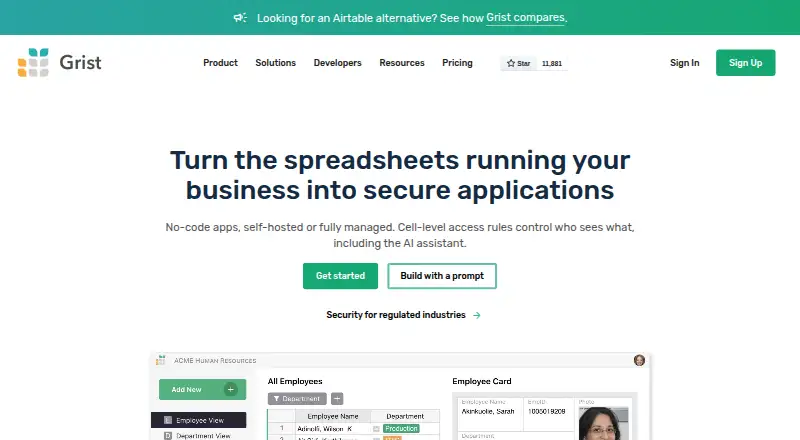
What Grist is
Grist combines spreadsheet analysis with database-style organization for complex data work. Its relational structure lets you manage information as records while working with it through spreadsheet formulas, including Python and Excel-like functions. You can present data in tables, cards, forms, charts, calendars, and custom widgets, and set access rules for who can view or edit particular tables, columns, and records. Grist offers a REST API for reading and changing documents, workspaces, and team sites, along with integrations including Zapier, Integrately, Pabbly Connect, n8n, and Make. It can run as hosted software, as a free open-source Community edition on your own infrastructure, or in a desktop app that works without an internet connection or online account. Documents use SQLite and can be exported as .grist files. Hosted service uses AWS, HTTPS, encrypted storage and backups, and optional MFA; it has not been certified or audited for SOC 2, ISO 27001, HIPAA, or GDPR. The free plan allows up to 5,000 records per document.
Good
- Supports Python and Excel-like formulas.
- Offers tables, charts, calendars, and custom widgets.
- Access rules can target tables, columns, and records.
- Documents can be exported as SQLite-based .grist files.
- Includes self-hosted and offline desktop options.
Watch out
- Free documents are limited to 5,000 records each.
- Hosted service lacks listed SOC 2, ISO 27001, HIPAA, and GDPR certification or auditing.
Who it suits
Grist suits teams that need spreadsheet-style analysis alongside relational data management and fine-grained permissions. Self-hosting and the offline desktop app may suit users who want to run it on their own infrastructure or work without an online account.
Verdict
Grist brings database structure and spreadsheet analysis together, with flexible views, APIs, and deployment options. Check the record limit, pricing, and hosted compliance status against your needs.
Plans and prices
From Grist's own pricing page, checked 30 Sep 2026.
| Plan | Price | What it gives you |
|---|---|---|
| Free | Free | Unlimited documents · Up to 5,000 records/document · 30-day snapshot history · 100 lifetime AI credits |
| Community edition | Free | Free and open source · Hosted on your own server · Community support |
| Grist Community edition | Free | Free and open-source · Self-hosted · Community support · Custom domain · Custom branding |
| Grist | $30 a month | Advanced admin controls · MCP server · AI Assistant · Automations · Custom SSO · Audit log streaming · Multiple team sites · Email notifications · monthly |
| Pro | $96 a year | Up to 100,000 records/document · 3-year snapshot history · 100 AI credits/month · 30-day trial · $96.00 per user per year (= $8.00 per user/month, billed annually) |
| Business | $288 a year | Minimum 5 users · Up to 150,000 records/document · 5-year snapshot history · Automations · Priority email support · 30-day trial · $288.00 per user per year (= $24.00 per user/month, billed annually) |
| Enterprise | Priced on request | Multi-server support · Pre-release security updates · Priority email support · Training workshop · Minimum 50 users |
The facts
Each one read from Grist's own pages, with the date it was checked.
What it does
- Access control
- Grist provides granular access rules that can control visibility and editing for tables, columns, and records.checked 30 Sep 2026
- AI Assistant
- The AI Assistant can answer questions about data, create or modify records, and help write formulas.checked 30 Sep 2026
- API
- Grist provides a REST API for programmatically reading and modifying documents, workspaces, and team sites.checked 30 Sep 2026
- API access
- Yeschecked 20 Sep 2026
- Compliance status
- The hosted Grist product has not undergone certification or auditing for SOC 2, ISO 27001, HIPAA, or GDPR compliance.checked 30 Sep 2026
- Desktop
- A Grist desktop application based on Grist Community edition is available and does not require internet access or an online account.checked 30 Sep 2026
- Formulas
- Grist supports Python formulas and Excel-like spreadsheet functions.checked 30 Sep 2026
- Hosted security
- Hosted Grist uses AWS infrastructure, encrypted AWS S3 storage, HTTPS, optional MFA, and encrypted backups.checked 30 Sep 2026
- Integrations
- Supported integrator services include Zapier, Integrately, Pabbly Connect, n8n, and Make.checked 30 Sep 2026
- Paid from
- 8checked 20 Sep 2026
- Portability
- Grist documents are SQLite databases and can be exported as complete .grist files.checked 30 Sep 2026
- Product type
- Grist combines spreadsheet and database capabilities for complex data work.checked 30 Sep 2026
- Relational data
- Grist organizes data like a database or app while analyzing and visualizing it like a spreadsheet.checked 30 Sep 2026
- Self-hosting
- Grist can be installed on customer infrastructure using Docker and is available as a free open-source Community edition.checked 30 Sep 2026
- Support
- Grist provides community support through its forum and official Discord channel.checked 30 Sep 2026
- Views
- Grist supports tables, cards, forms, charts, calendars, and custom widgets on pages.checked 30 Sep 2026
The company
- Founded
- 2014checked 23 Sep 2026
- Headquarters
- New York City, United Stateschecked 23 Sep 2026
Money
- Free plan
- Yeschecked 20 Sep 2026
The full review of Grist
Overview
Grist is a spreadsheet and database tool for people whose work depends on structured, connected records as well as flexible analysis. Its strongest case is the combination of relational data, varied views, and deployment choices; its main caveats are a 5,000-record free cap and the hosted product’s lack of major compliance certifications.
Key features
Database structure with spreadsheet flexibility
Grist organizes information like a database or app while retaining spreadsheet-style analysis and visualization. That makes it a better fit than a flat sheet when records need structure, while Excel-like functions and Python formulas offer two approaches to calculations. Python formulas add flexibility, though they may be more than a spreadsheet-only workflow needs.
Tables, cards, forms, charts, calendars, and custom widgets let teams present the same data in different ways. An app interface builder, workflow automation, and granular access rules extend the tool beyond analysis: permissions can govern visibility and editing at the table, column, or record level.
Connections, deployment, and portability
A REST API supports programmatic reading and modification of documents, workspaces, and team sites. Integrations include Zapier, Integrately, Pabbly Connect, n8n, and Make. Grist can run on customer infrastructure through Docker, and its desktop application is based on the Community edition and works without internet or an online account.
Documents are SQLite databases and can be exported as complete .grist files, a useful portability option. The AI Assistant can answer questions about data, create or modify records, and help write formulas. Hosted Grist uses AWS infrastructure, encrypted S3 storage, HTTPS, optional MFA, and encrypted backups. Those protections do not substitute for formal certification: hosted Grist has not undergone SOC 2, ISO 27001, HIPAA, or GDPR compliance certification or auditing.
Pricing
Grist has a free plan and paid hosted plans, plus free self-hosted editions. The pricing note gives paid pricing from $8/user/mo (annual), while the plan prices shown are Free at no cost, Pro at $10 a month billed monthly, and Business at $30 a month billed monthly. The quoted $8 annual starting rate and monthly plan prices use different billing terms, so compare the applicable plan and term before choosing.
- Free: free, unlimited documents, up to 5,000 records per document, 30-day snapshot history, and 100 lifetime AI credits. It is a useful way to start, but the record ceiling can rule it out for larger datasets.
- Pro: $10 a month, billed monthly, with up to 100,000 records per document, three-year snapshot history, 100 AI credits per month, and a 30-day trial. It suits individuals or teams that need substantially more room and longer history than Free.
- Business: $30 a month, billed monthly, with a five-user minimum, up to 150,000 records per document, five-year snapshot history, automations, priority email support, and a 30-day trial. The minimum seat count makes it a team purchase rather than a small step up for one user.
- Enterprise: custom pricing, dedicated servers, and advanced security and governance. It is the option for organizations that need those deployment and control provisions.
- Community edition: free, free and open source, self-hosted, with community support. A separate Grist Community edition offer also includes a custom domain and custom branding. Self-hosting avoids hosted-plan pricing but puts operation on the customer’s own server.
A separate Grist plan is priced at $24 a year, billed annually, and includes advanced admin controls, an MCP server, AI Assistant, automations, custom SSO, audit log streaming, multiple team sites, and email notifications. Community support is available through the forum and official Discord channel.
Platforms
Grist supports web, macOS, Windows, Linux, API access, and self-hosting. The desktop app can operate offline without an online account, while the Community edition provides a self-hosted route.
Who it's for
Grist is best for people who have outgrown flat spreadsheets and need relational organization, multiple ways to view records, or fine-grained permissions without giving up formula-driven analysis. It is less suitable for hosted deployments that require formal compliance certification, or for users whose datasets exceed the free plan’s 5,000-record limit but who do not want a paid plan or self-hosting.
Pros and cons
- Pro: Relational structure, spreadsheet analysis, and multiple view types work together, making it adaptable to complex data tasks.
- Pro: Granular permissions, API access, automation integrations, and self-hosting support operational and deployment flexibility.
- Pro: SQLite-based documents can be exported as complete .grist files, and the desktop app can work offline.
- Con: Free documents top out at 5,000 records, so growing datasets may require a paid plan.
- Con: Business requires at least five users, which may be excessive for an individual or small group.
- Con: Hosted Grist lacks certification or auditing for SOC 2, ISO 27001, HIPAA, and GDPR, limiting its fit for organizations that require those assurances.
Alternatives
For a broader set of spreadsheet choices, compare Spreadsheet apps. Readers focused on AI-assisted spreadsheets can browse AI Spreadsheet Tools, while those prioritizing database-style app building can explore No-Code Database Software.
Quadratic is another freemium option, with a free plan and support across web, desktop, mobile, API, and self-hosted platforms. SheetFactorys offers a free plan with daily caps on formula generations and data cleanings, plus a 50-row limit and one dashboard per month. Ajelix is a freemium web and extension option with paid plans that specify file, workspace, CPU, and memory limits. GPTExcel offers a free tier with up to 90 credits per month and can be tried without a credit card. remio is a freemium choice for Windows, macOS, iOS, and Android. Shortcut has a free plan with 20 weekly credits and a paid tier priced at $100 a month, billed annually. Pelayar AI Spreadsheet Agent offers a free Starter tier with usage allowances across agent chat and other tasks. Rows is another freemium spreadsheet option with a free plan and API platform support.
Verdict
Choose Grist if you need spreadsheet analysis over relational data and value flexible views, permissions, APIs, or the option to self-host. Its portable documents and offline desktop app add useful control, but the free record cap and the hosted product’s compliance status are decisive checks. If formal hosted certification is mandatory, or your work fits comfortably in a simpler flat spreadsheet, look elsewhere.
Getting started
- Open https://www.getgrist.com/ for hosted Grist.
- Choose the Free plan, or select the Pro or Business plan with a 30-day trial.
- For self-hosting, install the Community edition on your infrastructure using Docker.
- Alternatively, use the desktop application without internet access or an online account.
- Use the REST API or a supported integration service to connect programmatic workflows.
Limits worth knowing
The Free plan allows up to 5,000 records per document, 30-day snapshot history, and 100 lifetime AI credits. Pro is listed at $10 a month with up to 100,000 records per document; Business is $30 a month, requires at least 5 users, and allows up to 150,000 records per document.
Questions
Is Grist free?
Yes. The Free plan costs 0.00 USD and allows unlimited documents, up to 5,000 records per document, 30-day snapshot history, and 100 lifetime AI credits. The Community edition is also free and open source.
What are the paid plans and prices?
Pro is $10 a month, billed monthly, and Business is $30 a month, billed monthly. Enterprise has custom pricing.
Is there a free trial?
Yes. Pro and Business each list a 30-day trial.
Which platforms and deployment options are available?
Listed platforms are API, Linux, macOS, self-hosted, web, and Windows. Grist is available hosted, as a self-hosted Community edition, and as a desktop application that does not require internet access or an online account.
Is Grist open source?
Yes. The Community edition is free and open source, and can be hosted on your own server.
What integrations and API access does Grist offer?
It provides a REST API for reading and modifying documents, workspaces, and team sites. Supported integrator services include Zapier, Integrately, Pabbly Connect, n8n, and Make.
Alternatives to Grist
- 1

Quadratic
Free planAndroidiOSWebAPI8.9From $18 a month - 2

Sourcetable
Free planAndroidiOSWebAPI8.7From $29 a month - 3

GPTExcel
Free planWebAPI8.0From $19.90 a month - 4

Bricks
Free planWebAPISelf-hosted8.0From $17.50 a month - 5
SheetFactorys
Free planAndroidiOSWebmacOS8.0From $19 a month - 6

remio
Free planAndroidiOSExtensionmacOS8.0From $13.90 a month