
MailFrame
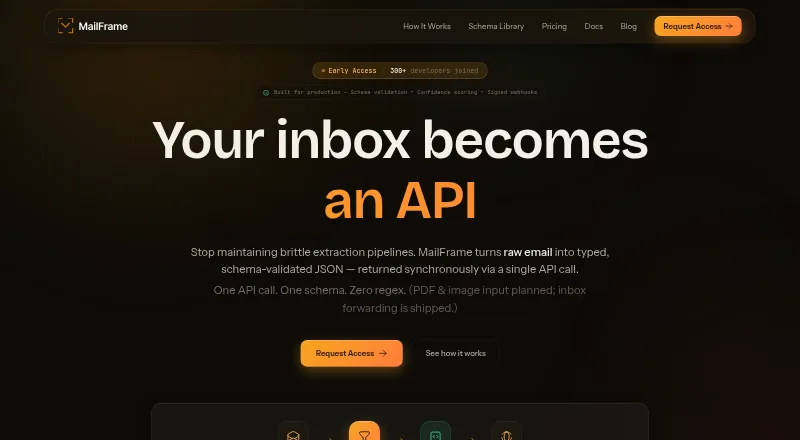
MailFrame is a developer-focused API that converts raw email into typed JSON validated against a schema.
What MailFrame is
MailFrame is a developer-focused API that converts raw email into typed JSON validated against a schema. A request can include raw RFC 822 MIME or plain-text email-like input and a JSON Schema, with validated JSON returned synchronously. Developers can submit an inline schema without registering or select from prebuilt schemas covering receipts and orders from services such as Stripe, Shopify, PayPal, Amazon, Apple App Store, and Google Play, as well as invoices, travel bookings, GitHub notifications, and shipping notices. Signed HMAC-SHA256 webhooks support retries, delivery history, a dead-letter queue, and replay. The current API accepts raw MIME and plain text; PDF and image input are planned, not available now. MailFrame says it retains raw email only as long as needed for delivery and debugging, does not sell or share customer data, and stores API keys hashed. The service is in limited early access with weekly developer onboarding. SOC 2 Type II is on the roadmap, and MailFrame says it is not yet HIPAA-eligible as a Business Associate.
Good
- Returns schema-validated JSON synchronously.
- Inline schemas need no registration step.
- Webhook delivery supports retries, history, dead-lettering, and replay.
- Free plan includes 100 parse operations per month.
Watch out
- PDF and image input are planned, not currently available.
- Limited early access uses weekly developer onboarding.
- SOC 2 Type II is on the roadmap.
- Not yet HIPAA-eligible as a Business Associate.
Who it suits
MailFrame is aimed at app developers integrating inbound document email into their own services. It is relevant when the desired input is raw MIME or plain text and downstream systems can accept webhooks.
Verdict
MailFrame focuses on turning inbound email into structured JSON for developer workflows. Its current input limits and early-access availability matter, especially for teams needing attachments or established compliance status.
Plans and prices
From MailFrame's own pricing page, checked 15 Oct 2026.
| Plan | Price | What it gives you |
|---|---|---|
| Free | Free | 100 parse ops / mo · 1 active schema · Webhook delivery · Community support · No credit card required · $0 /mo |
| Indie | $19 a month | 500 parse ops / mo · 5 active schemas · Signed webhook delivery · Email support · Schema versioning · $0.038 per doc after · $19 /mo |
| Startup | $49 a month | 5,000 parse ops / mo · Unlimited schemas · PDF & image input planned · Confidence scoring · API key scoping · Priority support · $0.0098 per doc after · $49 /mo |
| Scale | $149 a month | 50,000 parse ops / mo · Unlimited schemas · Async parse mode · Cache hits included · Custom webhook rate limits · Uptime target post-GA · $0.003 per doc after · $149 /mo |
| Enterprise | Priced on request | 100k+ parse ops / mo · Custom volume pricing · Dedicated infrastructure · Custom SLAs · SOC 2 on roadmap · Account manager · SSO / SAML · <$0.003 per doc after · Custom /mo |
The facts
Each one read from MailFrame's own pages, with the date it was checked.
What it does
- Accepted input
- The supported input is raw RFC 822 MIME or plain-text email-like content, while PDF and image parsing are planned.checked 15 Oct 2026
- API authentication
- Requests use bearer tokens over HTTPS, with environment-scoped keys that can be created, scoped, rotated, and revoked.checked 15 Oct 2026
- API endpoint
- The primary parser is POST /v1/parse and returns typed JSON synchronously in the same HTTP response.checked 15 Oct 2026
- API error handling
- The API documents 400, 401, 422, 429, and 5xx response meanings and JSON error envelopes.checked 15 Oct 2026
- API examples
- The documentation supplies curl, TypeScript, and Python examples for every documented endpoint.checked 15 Oct 2026
- API key security
- API keys are stored hashed, so the raw key cannot be recovered from MailFrame's records.checked 29 Sep 2026
- Audience
- MailFrame says it is for app developers integrating inbound document email into their own service.checked 29 Sep 2026
- Availability
- MailFrame is in limited early access and says it is onboarding developers in weekly batches.checked 29 Sep 2026
- Chrome data disclosure
- The listing declares handling of personally identifiable information, authentication information, personal communications, and website content.checked 15 Oct 2026
- Chrome developer status
- The Chrome developer is marked as a non-trader and states that disclosed data is not sold or used for unrelated purposes.checked 15 Oct 2026
- Chrome extension features
- The listing describes Gmail summaries, multilingual output, order and invoice extraction with CSV export, calendar links, focus reading, and daily briefs.checked 15 Oct 2026
- Chrome listing identity
- The Chrome listing is a Gmail extension whose developer website and support address use mailframe.org rather than mailframe.ai.checked 15 Oct 2026
- Chrome listing users
- The Chrome listing shows 6 users, version 1.0.1, and an update date of June 11, 2026.checked 15 Oct 2026
- Chrome privacy claim
- The extension says it processes only the active thread on demand, does not scan the mailbox in the background, and does not store email content.checked 15 Oct 2026
- Compliance
- SOC 2 Type II is on the roadmap, and MailFrame says it is not yet HIPAA-eligible as a Business Associate.checked 29 Sep 2026
- Compliance status
- SOC 2 Type II is on the roadmap and MailFrame is not currently HIPAA-eligible as a Business Associate.checked 15 Oct 2026
- Confidence scoring
- The product returns an overall confidence value and low-confidence field information for parses.checked 15 Oct 2026
- Credential protection
- API keys are stored hashed, while webhook secrets are shown once and stored encrypted.checked 15 Oct 2026
- Custom schemas
- Clients may send an inline JSON Schema without registering it first.checked 15 Oct 2026
- Data handling
- MailFrame says it retains raw email content for the minimum time needed to deliver the response and surface debugging, and does not sell or share customer data.checked 29 Sep 2026
- Data retention
- MailFrame says raw email is retained only as long as needed to return the response and support debugging, and customer data is not sold or shared.checked 15 Oct 2026
- Delivery
- MailFrame supports signed HMAC-SHA256 webhook delivery with retries, attempt history, a dead-letter queue, and replay.checked 29 Sep 2026
- Early access
- Access is limited and developers are onboarded in weekly batches.checked 15 Oct 2026
Money
- Chrome plan limits
- The extension listing advertises Free at 30 summaries monthly, Pro at 1,000 summaries monthly, and a Business tier for higher-volume extraction.checked 15 Oct 2026
The full review of MailFrame
Overview
MailFrame is an API that converts email into schema-validated JSON for software developers. It suits teams routing inbound email data into their own applications and services. Its flexible schemas and webhook delivery are useful, but it is not yet a fit for attachment parsing or workloads that require HIPAA eligibility.
Key features
Schema-based parsing
Send raw RFC 822 MIME or plain-text email-like input with a JSON Schema, and MailFrame returns validated JSON synchronously. Inline schemas need no registration, which makes it practical to define the exact output your application expects without managing a separate schema setup step. Prebuilt schemas cover Stripe and Shopify receipts or orders, PayPal, Amazon, Apple App Store and Google Play receipts, GitHub notifications, invoices, travel bookings, and shipping notifications.
Webhook delivery
Signed HMAC-SHA256 webhook delivery includes retries, attempt history, a dead-letter queue, and replay. That gives teams using webhook-compatible downstream systems ways to handle failed deliveries and investigate or replay them. MailFrame is API-first; it is not presented as a general-purpose inbox or document-processing suite.
Input and data handling
The API currently accepts email content, not attachments. PDF and image input are planned, while attachment parsing and OCR extraction are not available; teams whose documents arrive as attachments should look elsewhere for now. MailFrame says it keeps raw email content only as long as needed to deliver a response and surface debugging, and does not sell or share customer data. API keys are stored hashed so their original values cannot be recovered from MailFrame's records.
SOC 2 Type II is on the roadmap, and MailFrame is not yet HIPAA-eligible as a Business Associate. That makes it a poor fit for workflows that require either status today.
Pricing
The Free plan costs $0 /mo and includes 100 parse operations per month, one active schema, webhook delivery, and community support, with no credit card required. It is a useful way to validate an integration, but its single-schema and 100-operation caps constrain ongoing use. MailFrame also describes Free as a way to try the product before upgrading.
Indie costs $19 /mo and raises the allowance to 500 parse operations and five active schemas. It adds signed webhook delivery, email support, and schema versioning; extra documents cost $0.038 per doc after the included quota. This is the clearest step up for a small integration that needs several schemas and support, but the 500-operation cap may be limiting for a busy service.
Startup costs $49 /mo for 5,000 parse operations and unlimited schemas, with API key scoping and priority support. Extra documents cost $0.0098 per doc after the quota. PDF and image input and confidence scoring are marked planned, so they should not be treated as current benefits.
Scale costs $149 /mo for 50,000 parse operations, unlimited schemas, cache hits included, and custom webhook rate limits; extra documents cost $0.003 per doc after the quota. Async / Batch API and an uptime target are planned, with the uptime target described as post-GA, so the plan's present value rests on its higher quota and rate-limit customization rather than those future items.
Enterprise has custom pricing and starts at 100k+ parse operations, with custom volume pricing, dedicated infrastructure, custom SLAs, an account manager, and SSO / SAML. SOC 2 remains on the roadmap, and the stated rate is <$0.003 per doc after the quota. This is the plan for organizations needing a tailored volume and infrastructure arrangement, but it does not resolve the current compliance gap.
Platforms
MailFrame is available via API and web. Its API and webhook workflow is aimed at developers integrating parsing into their own services; there is no attachment or OCR extraction capability at present.
Who it's for
MailFrame is best suited to developers who need to turn inbound email into predictable, application-ready fields and can build around an API and webhooks. The schema options and delivery controls are relevant to teams processing receipts, invoices, notifications, travel bookings, or shipping messages. It is not the right choice for teams needing to extract data from PDFs or images today, or requiring HIPAA eligibility or SOC 2 Type II now. Availability is limited early access, with developers onboarded in weekly batches, which may not suit teams needing immediate, established access.
Pros and cons
Pros
- Flexible output: Inline JSON Schemas and prebuilt options let developers shape parsing around their application without first registering a custom schema.
- Recoverable webhook delivery: Retries, attempt history, dead-letter handling, and replay help teams manage delivery failures.
- Clear entry point: Free includes 100 monthly parse operations without a credit card, so a developer can validate a workflow before paying.
Cons
- Email-only input today: PDF and image parsing are planned, and attachment parsing and OCR are unavailable, excluding attachment-heavy workflows.
- Compliance limitations: SOC 2 Type II is on the roadmap and MailFrame is not HIPAA-eligible as a Business Associate.
- Early-access availability: Weekly-batch onboarding can be a barrier for teams that need to adopt a service immediately.
- Quotas shape the upgrade path: Indie includes 500 operations and five schemas; larger included volumes require Startup or Scale.
Alternatives
For a broader category comparison, see Email Parsing Software. Consider noima if its free one-time allowance of 10 documents with 30 days of retention, or its €12/month Starter plan for 150 documents per month and 60 days of retention, better matches a low-volume document workflow.
Parserr is another option, with a free tier covering 15 emails and 10 documents per month for one inbox, plus unlimited parsing rules and integrations including Zapier and Microsoft Flow. Choose it when those inbox and integration terms suit your workflow better than MailFrame's schema-first API approach.
Parsio Receipt OCR may be worth comparing when its free allowance of 30 credits per month or its receipt-OCR focus fits the job; MailFrame currently does not offer OCR extraction.
Parsli offers 10 free pages on signup, unlimited parsers, API access, and integrations, so consider it if those terms better match your parsing needs.
DigiParser is another alternative for readers comparing parsing tools.
MailParse may suit teams seeking a paid email-parsing tool with a Starter plan at $24 per month, billed $288 yearly, for 100 emails per month and Excel, CSV, or JSON output.
inbound starts at $9/mo for 5,000 emails per month and basic support, making it an alternative for readers prioritizing a stated email allowance over MailFrame's schema-based JSON workflow.
MailParse is another web-based alternative.
Verdict
Choose MailFrame if you are a developer who needs email transformed into validated JSON for your own service and values inline schemas plus recoverable webhook delivery. Look elsewhere if your workflow depends on attachments or OCR, or requires HIPAA eligibility or SOC 2 Type II today; its limited early access is another reason to wait if you need assured availability.
Alternatives to MailFrame
- 1

DigiParser
Free planAndroidiOSWebAPI7.9Free plan - 2

Parseur
Free planWebAPI7.6From $49 a month - 3

Email Parser
WebAPIWindows7.0From $145 a year - 4

CloudMailin
Free planWebAPI6.8From $25 a month - 5

Parsio Receipt OCR
Free planWebAPI6.8From $24 a month - 6

EmailEngine
WebAPILinuxmacOS6.7From $1,450 a year