
inbound
Inbound is an email parsing API for developers building transactional email, inbound webhook processing, and AI-assisted workflows.
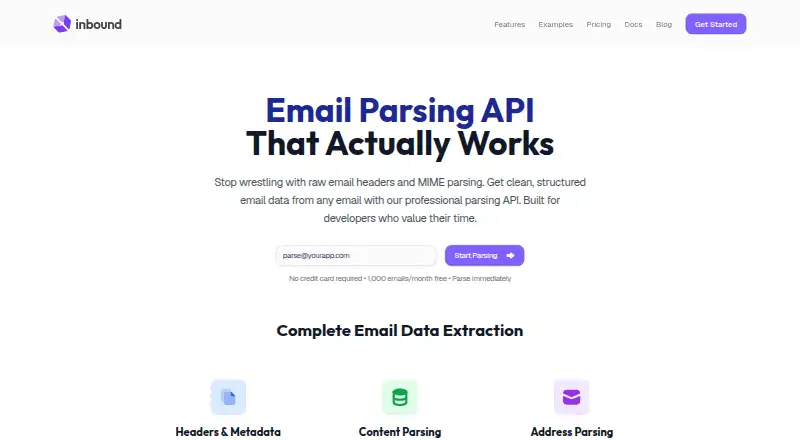
What inbound is
Inbound is an email parsing API for developers building transactional email, inbound webhook processing, and AI-assisted workflows. It converts received email into JSON containing addresses, headers, text and HTML bodies, raw MIME, thread information, and attachment metadata with download links. After parsing, it can deliver email to webhook endpoints, and failed deliveries can be retried through the dashboard or API. Thread identifiers and reply headers keep responses in the existing conversation. Users can send specific addresses to separate endpoints or enable catch-all routing. A TypeScript SDK and REST API support programmatic workflows. Spam detection runs on incoming email, with mailbox options to reject, flag, or accept spam. Listed integration protections include API keys, HMAC signatures, and rate limits. Email data is typically retained for 30 days unless configured otherwise, and users may request deletion. Inbound parses message structure but does not remove quoted reply history or extract business fields from attachments with OCR or AI. Large payloads can also lead to attachment bodies being replaced with a placeholder or parsed headers being emptied.
Good
- Parses email content and attachment metadata into JSON.
- Failed webhook deliveries can be retried.
- Supports address-specific and catch-all routing.
- Includes spam handling options.
Watch out
- Does not remove quoted reply history.
- Does not extract attachment business fields using OCR or AI.
- Large payloads can affect attachment bodies and headers.
Who it suits
Inbound is for developers building email-driven workflows that need parsed message data delivered to webhooks. It may suit teams that need routing, threading, and API-based retries.
Verdict
Inbound provides structured email parsing with routing, webhook delivery, and programmatic retry options. Its parsing limits around quoted history and attachment extraction are important for workflows that need cleaned or interpreted content.
Plans and prices
From inbound's own pricing page, checked 4 Oct 2026.
| Plan | Price | What it gives you |
|---|---|---|
| Default | $9 a month | 5,000 emails/mo · Basic support · $9/mo |
| Pro | $15 a month | 50,000 emails/mo · 50 domains · $15/mo |
| Growth | $39 a month | 100,000 emails/mo · 300 domains · $39/mo |
| Scale | $79 a month | 200,000 emails/mo · unlimited domains · $79/mo |
The facts
Each one read from inbound's own pages, with the date it was checked.
What it does
- Attachment limits
- When a payload exceeds 1 MB, attachment bodies in raw MIME are replaced with a placeholder; if it remains too large, parsed headers are emptied.checked 4 Oct 2026
- Data protection
- The privacy policy says data is encrypted in transit and at rest, with access controls, authentication, security monitoring, and AWS infrastructure.checked 4 Oct 2026
- Email parsing
- Inbound parses received email into JSON containing addresses, headers, text and HTML bodies, raw MIME, thread information, and attachment metadata with download links.checked 4 Oct 2026
- Integrations
- The features page names dub.co for open and click tracking and lists configurable endpoints, routing, and a TypeScript SDK.checked 4 Oct 2026
- Intended users
- Inbound describes itself as an email platform for developers building transactional email, inbound webhook processing, and AI-assisted workflows.checked 4 Oct 2026
- Parsing limits
- Inbound parses message structure but does not remove quoted reply history or extract business fields from attachments using OCR or AI.checked 4 Oct 2026
- Retention
- Email data is typically retained for 30 days unless the user configures different retention settings, and users may request deletion.checked 4 Oct 2026
- Routing
- Users can route specific addresses to separate endpoints or enable catch-all routing for other addresses on the domain.checked 4 Oct 2026
- SDK and API
- Inbound provides a TypeScript SDK and REST API for programmatic email workflows.checked 4 Oct 2026
- Security controls
- The features page lists API keys, HMAC signatures, and rate limits as integration protections.checked 4 Oct 2026
- Spam handling
- Inbound runs incoming email through spam detection, and mailbox settings let users reject, flag, or accept spam.checked 4 Oct 2026
- Support
- The Default plan includes basic support, and the terms say support availability and response times vary by plan.checked 4 Oct 2026
- Threading
- Inbound includes thread identifiers and sets In-Reply-To and References when replying so responses stay in the existing email thread.checked 4 Oct 2026
- Webhook delivery
- Inbound delivers parsed email to webhook endpoints after receipt and parsing, and failed deliveries can be retried from the dashboard or API.checked 4 Oct 2026
Alternatives to inbound
- 1

DigiParser
Free planAndroidiOSWebAPI7.9Free plan - 2

Parseur
Free planWebAPI7.6From $49 a month - 3

MailFrame
Free planWebAPI7.3From $19 a month - 4

Email Parser
WebAPIWindows7.0From $145 a year - 5

CloudMailin
Free planWebAPI6.8From $25 a month - 6

Parsio Receipt OCR
Free planWebAPI6.8From $24 a month