
Lyssna
Lyssna is a remote user research platform for moderated and unmoderated studies, interviews, usability tests, and surveys.
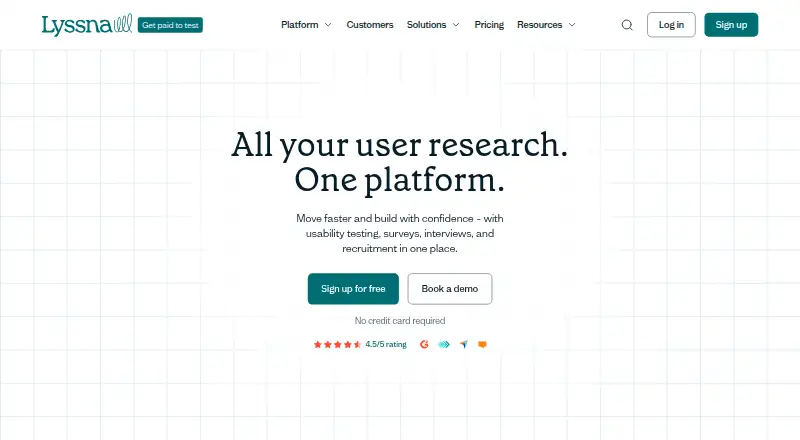
What Lyssna is
Lyssna is a remote user research platform for moderated and unmoderated studies, interviews, usability tests, and surveys. Its methods include card sorting, first-click and five-second tests, live website testing, preference and prototype testing, recordings, tree testing, and interviews. Teams can work with AI or manual summaries, filter by demographics and responses, comment, export CSV files, and share results by link. Lyssna offers on-demand access to more than 690,000 panelists and targeting through more than 395 demographic filters. Listed integrations include Figma, Google Calendar, Google Meet, Microsoft Outlook, Microsoft Teams, and Zoom. The free plan has three seats, unlimited quick studies, and up to 15 self-recruited test and survey responses; signup requires no credit card, and live chat support is included. Growth costs $166 a month billed annually and includes five seats and five in-depth studies per month. Mobile testing is listed as a beta feature.
Good
- Offers moderated and unmoderated research methods.
- Panel access exceeds 690,000 participants.
- Targets audiences with more than 395 demographic filters.
- Free plan includes live chat support.
Watch out
- Free plan limits self-recruited responses to 15.
- Growth limits in-depth studies to five monthly.
- Mobile testing is listed as beta.
Who it suits
Lyssna suits marketers, designers, researchers, and product leaders who need to gather feedback through different study formats. Its free tier can serve small teams exploring research workflows, while Growth supports more self-recruited responses and in-depth studies.
Verdict
Lyssna covers a broad set of remote research methods and provides tools for analyzing and sharing findings. The free tier has a small response allowance, while Growth raises that limit and adds a monthly quota for in-depth studies.
Plans and prices
From Lyssna's own pricing page, checked 30 Sep 2026.
| Plan | Price | What it gives you |
|---|---|---|
| Free | Free | Unlimited quick studies · 3 seats · 15 self-recruited test and survey responses |
| Growth | $166 a month | Unlimited quick studies · 5 in-depth studies per month · 5 seats · Unlimited self-recruited test and survey responses · Billed annually |
| Growth | $199 a month | Unlimited quick studies · 5 in-depth studies per month · 5 seats · Unlimited self-recruited test and survey responses · Billed monthly |
| Enterprise | Priced on request | Unlimited quick studies · Custom in-depth studies · Unlimited seats · Priority support · SSO · SOC2 report |
The facts
Each one read from Lyssna's own pages, with the date it was checked.
What it does
- Analysis
- Lyssna provides AI summaries, manual summaries, filtering by demographics and responses, comments, CSV exports, and share links.checked 30 Sep 2026
- Audience
- Lyssna says it helps teams listen to and understand their audience and serves marketers, designers, researchers, and product leaders.checked 30 Sep 2026
- Integrations
- Listed integrations are Figma, Google Calendar, Google Meet, Microsoft Outlook, Microsoft Teams, and Zoom.checked 30 Sep 2026
- Mission
- Lyssna’s stated mission is to put humans at the heart of solutions to improve the quality of experiences in the world.checked 30 Sep 2026
- Mobile testing
- Mobile testing is listed as a beta feature on Lyssna’s platform navigation.checked 30 Sep 2026
- No card required
- Lyssna states that signing up for its free plan requires no credit card.checked 30 Sep 2026
- Participant panel
- Lyssna offers on-demand access to more than 690,000 panelists and targeting through more than 395 demographic filters.checked 30 Sep 2026
- Research methods
- The platform includes card sorting, first-click testing, five-second testing, live website testing, preference testing, prototype testing, recordings, surveys, tree testing, and user interviews.checked 30 Sep 2026
- Security compliance
- Lyssna’s Trust Center lists SOC 2 Type II and GDPR compliance.checked 30 Sep 2026
- Support
- Live chat support is included on Free, while Enterprise includes priority support and security audit assistance.checked 30 Sep 2026
- What it does
- Lyssna is a remote user research platform for moderated and unmoderated studies, interviews, usability tests, and surveys.checked 30 Sep 2026
The company
- Company history
- Lyssna’s about page says Mateja created fivesecondtest.com in 2008 and that UsabilityHub rebranded to Lyssna in 2023.checked 30 Sep 2026
- Founded
- 2008checked 28 Sep 2026
Money
- Free plan limit
- The Free plan includes 3 seats and lets users view up to 15 self-recruited test and survey responses.checked 30 Sep 2026
- Growth plan limit
- The Growth plan includes 5 in-depth studies per month, 5 seats, and unlimited self-recruited test and survey responses.checked 30 Sep 2026
The full review of Lyssna
Lyssna is a remote research platform for teams that need to gather feedback across interviews, usability studies, and surveys. It best suits marketers, designers, researchers, and product leaders who want several study methods and participant recruitment in one service. Its breadth is compelling, but the free plan’s 15-response cap makes it a starting point rather than a sustained research setup.
Overview
Lyssna supports moderated and unmoderated research, with options for teams to recruit their own participants or draw on an on-demand panel of more than 690,000 people. More than 395 demographic filters help target panelists, which is useful when a study needs a particular audience rather than whoever is readily available.
The platform’s roots go back to fivesecondtest.com, created by Mateja in 2008. UsabilityHub later adopted the Lyssna name in 2023. The company says its purpose is to put people at the center of solutions and improve experiences.
Key features
Study methods
Teams can run card sorting, tree testing, first-click and five-second tests, preference and prototype tests, live website studies, surveys, and user interviews. That variety supports both focused usability checks and broader conversations, rather than steering every research question toward a single format. Mobile testing is in beta, so it should not be treated as a settled capability for teams that depend on mobile studies.
Analysis and collaboration
Lyssna offers AI-generated and manual summaries, filters for demographics and responses, comments, CSV exports, and share links. This combination supports quick synthesis inside the platform as well as exporting data for further work. Integrations include Figma, Google Calendar, Google Meet, Microsoft Outlook, Microsoft Teams, and Zoom.
Trust and support
Lyssna’s Trust Center lists SOC 2 Type II and GDPR compliance. Free includes live chat support; Enterprise adds priority support and security audit assistance. The panel and targeting options are a practical strength for teams that need recruited participants, while self-recruitment remains available for studies using an existing audience.
Pricing
Lyssna uses a freemium model. The Free plan costs nothing, requires no credit card, and includes unlimited quick studies, 3 seats, and access to view up to 15 self-recruited test and survey responses. Live chat is included. It suits evaluation and occasional small studies, but the response ceiling is restrictive for recurring work.
Growth costs $166 a month, billed annually. It includes unlimited quick studies, 5 in-depth studies per month, 5 seats, and unlimited self-recruited test and survey responses. This is the more practical tier for a small team conducting regular research; the annual billing term and monthly quota for in-depth studies are important constraints.
Enterprise has custom pricing and includes unlimited quick studies, custom in-depth studies, unlimited seats, priority support, SSO, and a SOC2 report. It is the fit for organizations needing broader access and enterprise support, though the fixed monthly cost cannot be compared without a quote.
Platforms
Lyssna is available on Android, iOS, and the web. It supports mobile app research, though its mobile testing feature is identified as beta.
Who it's for
Lyssna is a strong option for product and design teams, marketers, and researchers who need a mix of testing methods, participant recruitment, and tools to summarize and share findings. Free works for a small trial or occasional checks. Teams running research routinely are better served by Growth, provided five in-depth studies per month and five seats are sufficient. Organizations that need unlimited seats or enterprise support should consider Enterprise.
Pros and cons
- Broad method coverage: card sorting, interviews, surveys, and several usability tests can support different research questions in one platform.
- Recruitment flexibility: a panel of more than 690,000 people with more than 395 demographic filters complements self-recruited studies.
- Useful analysis options: AI and manual summaries, response filters, comments, CSV exports, and share links accommodate both in-platform review and export.
- Free is sharply capped: three seats are useful for a small group, but viewing only 15 self-recruited responses limits continued use.
- Growth has defined capacity: five seats and five in-depth studies per month may constrain larger or more research-intensive teams, despite unlimited self-recruited responses.
- Mobile testing remains beta: teams relying on mobile testing should account for its beta status.
Alternatives
For a broader comparison, browse UX Research Software or Usability Testing Software.
Maze is another freemium option with a free trial and Android, iOS, web, and API platforms; consider it if you want to compare its trial-based offering, though its free tier has limited features after the trial.
UXArmy may suit a solo researcher seeking a lower-cost paid entry: its Starter plan is $29 a month, while its free plan has one full seat, 15 monthly credits, no recordings, and no participant panel.
Trymata offers a PayGO plan with no subscription requirement, any number of studies, purchased test credits as needed, and results stored for up to six months; it is worth considering when that pay-as-needed model fits better.
Dscout is a paid alternative with customized subscriptions, flexible seats, unlimited concurrent studies, and Slack, Miro, and Figma integrations.
UXtweak has a free plan with all research tools subject to limitations, one active study at a time, 15 responses per month, and 14 days of results access; choose it when those limits meet your needs.
QuestionPunk offers a free Basic plan with 20 responses per month, AI interviews and follow-ups, templates, report export, and community support.
Userfeel offers a free plan with three monthly credits, one admin, bring-your-own-tester support, demographic filters, and screener questions.
HeyMarvin is another freemium option.
Verdict
Choose Lyssna if your team wants varied remote study formats, access to a sizable participant panel, and practical tools for turning responses into shareable findings. Its free tier is a low-friction way to begin, but the 15-response limit makes Growth the sensible choice for regular self-recruited research. Look elsewhere if your team needs more than five in-depth studies monthly, more than five seats at a predictable price, or dependable mobile testing today.
Alternatives to Lyssna
- 1

Userfeel
Free planAndroidiOSWebmacOS8.3From $3,000 a year - 2

Maze
Free planAndroidiOSWebAPI8.1From $99 a month - 3

Ballpark
AndroidiOSWebAPI7.7From $125 a month - 4

PlaybookUX
Free planAndroidiOSWebmacOS7.7From $5,400 a year - 5

UXArmy
Free planAndroidiOSWeb7.6From $29 a month - 6
QuestionPunk
Free planAndroidiOSWebAPI7.4From $29 a month