Locus
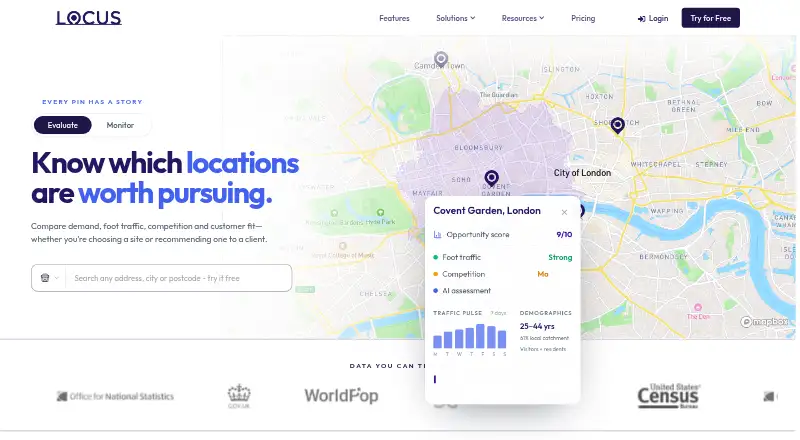
Locus puts demographics, nearby competition, access, demand indicators, and available commercial premises on one map to help evaluate business locations.
What Locus is
Locus puts demographics, nearby competition, access, demand indicators, and available commercial premises on one map to help evaluate business locations. It presents population and foot-traffic patterns alongside competition data and an AI assessment of local opportunity. Reports can set out local context, trade-offs, and evidence for a location decision. Locus Pulse tracks reviews, competitor movement, reputation, and market rank as neighbourhood signals. Ask Locus can navigate the map, adjust catchments, inspect evidence, find commercial premises, and organize options into comparisons, shortlists, or projects. The product describes workflows for commercial real estate advisers, franchise and multi-site retail teams, business owners, and marketing teams. Demographic coverage is deepest in the United Kingdom and United States; other markets may use global population and age estimates alongside regional sources. Plans include free map access, a $15, paid once location report, and Explore at $49 a month. Locus states its recommendations support decisions, not valuations or planning opinions, and do not guarantee business performance.
Good
- Combines demographic and competition signals on a map.
- Creates reports with context and trade-offs.
- Pulse tracks neighbourhood indicators over time.
- Ask Locus supports catchments, comparisons, and shortlists.
- Free map access is available.
Watch out
- Demographic coverage is deepest in the UK and US.
- Recommendations are not valuations or planning opinions.
- Business performance is not guaranteed.
Who it suits
It suits commercial property advisers, multi-site retail and franchise teams, and business owners or marketers assessing potential locations. Users outside the UK and US should note that demographic coverage may be less deep.
Verdict
Locus brings several location signals and research tools together for business-site evaluation. Treat its outputs as decision support, and consider the stated coverage differences when comparing locations.
Plans and prices
From Locus's own pricing page, checked 3 Oct 2026.
| Plan | Price | What it gives you |
|---|---|---|
| Free map access | Free | Browse the map and use measuring tools · Free account adds population, density and gender snapshot |
| One-time location report | $15, paid once | One location · Full location data · AI score and analysis |
| Explore | $49 a month | 5 research runs/month · Direct competitors · Footfall, demand and accessibility signals · AI score and recommendation · PDF export |
| Monitor | $79 a month | Up to 3 monitored businesses · 3 research runs/month · Pulse neighbourhood brief · Ask Locus · Weekly digest emails · Alert notifications |
| Research | $99 a month | 10 research runs/month · White-label reports · Compare up to 5 locations · Projects, shortlists and network map · Heatmaps, travel time and catchments · Competitor sentiment |
| Grow | $199 a month | 20 research runs/month · Locus AI Agent (Beta) · Commercial properties inventory (Beta) · Underserved Areas · Priority support |
The facts
Each one read from Locus's own pages, with the date it was checked.
What it does
- API access
- The terms say API access requires a valid key and is subject to rate limits.checked 3 Oct 2026
- Assistant
- Ask Locus can navigate the map, change catchment settings, inspect available evidence, find commercial premises and help move options into comparisons, shortlists or projects.checked 3 Oct 2026
- Coverage
- The United Kingdom and United States have the deepest demographic coverage, while other markets may use global population and age estimates through WorldPop and supported regional sources.checked 3 Oct 2026
- Data security
- Locus says it implements appropriate technical and organisational measures to protect personal information, but does not guarantee absolute security.checked 3 Oct 2026
- Data sources
- The privacy policy says Locus uses Google Places API for business and competition data and OpenAI technology to analyse aggregated, non-personal location data.checked 3 Oct 2026
- Decision limits
- Locus says its recommendations are decision support, not a valuation, planning opinion or guarantee of business performance.checked 3 Oct 2026
- Location signals
- The product presents population, foot-traffic patterns, competition and an AI assessment of local opportunity.checked 3 Oct 2026
- Monitoring
- Locus Pulse tracks reviews, competitor movement, reputation and market rank as a live read of neighbourhood changes.checked 3 Oct 2026
- Reports
- Locus can create reports that present local context, trade-offs and evidence behind a location decision.checked 3 Oct 2026
- Support
- The contact page directs support and partnership enquiries through its message form and lists an address in Holborn, London.checked 3 Oct 2026
- What it does
- Locus brings demographics, nearby competition, access, demand indicators and available commercial premises into one map to help evaluate business locations.checked 3 Oct 2026
- Who it is for
- Locus describes workflows for commercial real estate advisers, franchise and multi-site retail teams, and business owners or marketing teams.checked 3 Oct 2026
The company
- Company history
- The About page says the founder began seeking a retail business location in 2025 and built an internal prototype after struggling with fragmented research.checked 3 Oct 2026
- Headquarters
- London, United Kingdomchecked 28 Sep 2026
The full review of Locus
Locus is a web-based location intelligence tool for assessing business sites. It is best suited to commercial property advisers and teams planning franchise or multi-site expansion. Its mix of mapping, research and monitoring is useful for comparing locations, but coverage varies by market and its recommendations are not guarantees of business performance.
Overview
Locus brings population, foot-traffic patterns, nearby competition, demand and accessibility signals, and available commercial premises into one map. Reports put local context, trade-offs and supporting evidence together, making the product more useful for weighing candidates than treating an AI score as a decision on its own.
Pulse tracks neighbourhood reviews, competitor movement, reputation and market rank. Ask Locus can adjust catchments, inspect evidence, find commercial premises and help move options into comparisons, shortlists or projects. Together, these features connect site discovery with ongoing monitoring, though access depends on the plan.
Demographic coverage is deepest in the UK and US. Other markets may draw on global population and age estimates through WorldPop and supported regional sources, so cross-market comparisons may have less consistent depth. Locus frames its recommendations as decision support, not a valuation, planning opinion or guarantee of business performance.
Key features
- Location research: Population, footfall, competition, demand and accessibility signals help teams examine the context around a candidate site.
- Reports and comparisons: Reports present evidence and trade-offs; higher plans add multi-location comparisons, shortlists and projects.
- Pulse monitoring: Neighbourhood changes in reviews, competitor activity, reputation and market rank can inform follow-up after a location is selected.
- Ask Locus: Map navigation, catchment changes and evidence inspection can streamline exploration, while property search and organizing options support the move from research to a shortlist.
- Drive-time and territory planning: These capabilities suit teams assessing catchments and planning geographic coverage.
Pricing
Locus has a free map tier, a one-time report and monthly subscriptions. The free option is useful for initial exploration, but it does not include the fuller research workflows of paid plans.
- Free map access — free: Browse the map and use measuring tools; a free account adds population, density and gender snapshots. Best for basic orientation, not repeatable location research.
- One-time location report — $15, paid once: One location with full location data, an AI score and analysis. A low-commitment choice for a single candidate, but it does not provide a monthly research allowance.
- Explore — $49 a month: Five research runs per month, direct competitors, footfall, demand and accessibility signals, AI score and recommendation, and PDF export. It fits teams doing occasional site research and is the entry subscription for recurring analysis.
- Monitor — $79 a month: Up to three monitored businesses, three research runs per month, a Pulse neighbourhood brief, Ask Locus, weekly digest emails and alert notifications. Choose it for ongoing oversight rather than a high volume of new site studies.
- Research — $99 a month: Ten research runs per month, white-label reports, comparisons of up to five locations, projects, shortlists and network map, heatmaps, travel time and catchments, and competitor sentiment. Its higher run allowance and comparison tools suit teams evaluating multiple candidates.
- Grow — $199 a month: Twenty research runs per month, Locus AI Agent (Beta), commercial properties inventory (Beta), Underserved Areas and priority support. The extra capacity and beta features are aimed at heavier research needs.
Platforms
Locus runs on the web. Its terms say API access requires a valid key and is subject to rate limits. The privacy policy says it uses Google Places API for business and competition data and OpenAI technology to analyse aggregated, non-personal location data. Locus says it uses technical and organisational measures to protect personal information, while acknowledging that absolute security cannot be guaranteed.
Who it's for
Commercial real estate advisers can use Locus to assemble local evidence for site evaluations. Franchise and multi-site retail teams can use its location comparisons, catchments and territory planning to structure expansion decisions. Business owners and marketing teams may find it useful when assessing local opportunity or monitoring neighbourhood changes. It is a weaker fit for readers seeking a definitive forecast: the product explicitly treats its recommendations as decision support.
Pros and cons
- Pro: Demographics, footfall, competition, access and premises are brought into one map, reducing the need to assess each signal in isolation.
- Pro: Reports, comparisons and monitoring support both initial site evaluation and continued attention to neighbourhood changes.
- Pro: A free map tier and a $15, paid once report let readers start without a monthly subscription.
- Con: Demographic depth is strongest in the UK and US, which can make comparisons involving other markets less even.
- Con: Monthly research is capped at 3 to 20 runs depending on plan, so teams with heavier workloads need to choose a higher tier.
- Con: Some Grow capabilities, including the AI Agent and commercial property inventory, are in beta, and recommendations do not replace valuation or planning advice.
Alternatives
Consider Mapline if you want to compare another freemium mapping platform with web and API access. Maptive is worth considering if its broad platform support or one-time access model better fits your setup. NIQ is a paid alternative without a free plan. Smappen offers a free web plan with 10 active areas, basic population data, one POI search and up to 100 imported pins, making it a simpler starting point for area mapping. Stadia Maps has a free tier with 200,000 monthly credits and a Starter plan at $20 a month for 1,000,000 credits. Maptitude is a paid option with a free trial and desktop and web offerings. Kalibrate Location Intelligence is a paid alternative whose pricing depends on licensed third-party data, user seats and analytics. eSpatial is another paid option, with a free trial and a Mapping Pro plan requiring at least three users. For more choices, see Location Intelligence Software.
Verdict
Locus is a strong fit for advisers and expansion teams that need mapped location signals, evidence-backed reports and tools to monitor neighbourhood change in one web product. Its tiered plans cover occasional reports through higher-volume research, but buyers should weigh the monthly run limits and uneven coverage beyond the UK and US. Look elsewhere if you need a guaranteed performance forecast or equally deep demographic coverage across markets.
Alternatives to Locus
- 1
Foursquare
Free planAndroidiOSWebAPI8.2From $25 a month - 2
Crowd Connected
Free planAndroidiOSWebAPI7.9Free plan - 3

Maptitude
AndroidiOSWebAPI7.8From $795 a year - 4
Mapbox Studio
Free planAndroidiOSWebAPI7.7Free plan - 5
Maptive
AndroidiOSWebAPI7.2From $110 a month - 6

eSpatial
AndroidiOSWebAPI7.1From $499 a year