KWOK
KWOK simulates Kubernetes nodes, pods, and other API resources, letting users create large cluster environments without running real workloads in simulated p…
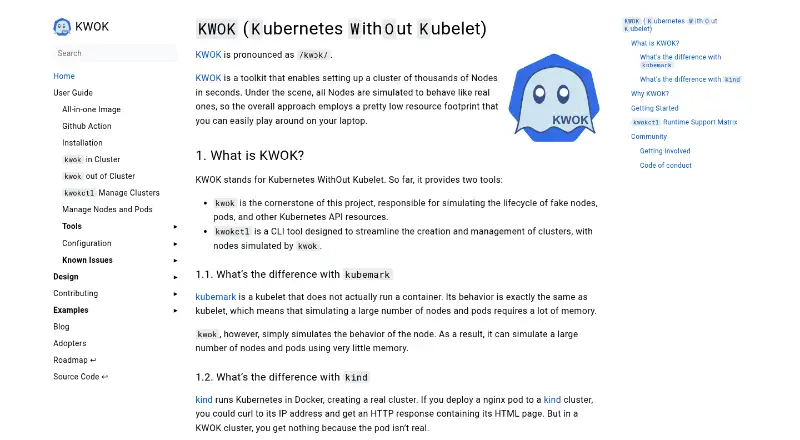
What KWOK is
KWOK simulates Kubernetes nodes, pods, and other API resources, letting users create large cluster environments without running real workloads in simulated pods. The project says it can create 20 nodes or pods per second and reliably maintain 1,000 nodes and 100,000 pods. Its `kwok` tool simulates resource lifecycles, while `kwokctl` creates and manages clusters. Users can configure node types, labels, taints, capacities, conditions, and pod behaviors to explore scenarios and edge cases. KWOK works with Kubernetes API-compliant clients and tools such as kubectl, Helm, and Kui. Documentation gives integration examples for Argo, Istio, Kueue, Linkerd, Prometheus, Metrics Server, and Ray. It supports Linux, macOS, and Windows, with installation options including Homebrew, WinGet, Go, and downloadable binaries. Kubernetes versions can be selected through the kubeVersion configuration option. KWOK is free and Apache-2.0 licensed. Simulated pods do not perform real workload behavior, such as serving an HTTP response.
Good
- Supports Linux, macOS, and Windows.
- Configurable node and pod behaviors.
- Works with kubectl, Helm, and Kui.
- Supports multi-node clusters.
Watch out
- Simulated pods do not run real workloads.
- Pods cannot serve HTTP responses.
- Cloud-provider integrations may delete nodes without provider IDs.
Who it suits
KWOK suits users who need large simulated Kubernetes clusters to exercise API clients, configurations, or integrations. It is not suited to validating actual pod workload behavior.
Verdict
KWOK provides configurable, large-scale Kubernetes simulation across common platforms. Its simulated pods do not execute real workload behavior, so that boundary matters when choosing it.
Plans and prices
From KWOK's own pricing page, checked 8 Oct 2026.
| Plan | Price | What it gives you |
|---|---|---|
| KWOK | Free | Apache-2.0 licensed open-source toolkit · simulates Kubernetes nodes, pods, and clusters |
The facts
Each one read from KWOK's own pages, with the date it was checked.
What it does
- Community support
- Users can reach the maintainers through GitHub issues and discussions or the Kubernetes #kwok and #kwok-dev Slack channels.checked 8 Oct 2026
- Configuration
- Users can configure node types, labels, taints, capacities, conditions, and pod behaviors to test scenarios and edge cases.checked 8 Oct 2026
- Installation
- The project documents installation through Homebrew, WinGet, Go, and downloadable binaries.checked 8 Oct 2026
- Integrations
- The documentation includes integration examples for Argo, Istio, Kueue, Linkerd, Prometheus, Metrics Server, and Ray.checked 8 Oct 2026
- Known issue
- With AWS, GCP, or Azure cloud-provider integrations, nodes may be unexpectedly deleted if they lack provider IDs; the documentation recommends assigning a dummy providerID.checked 8 Oct 2026
- Kubernetes compatibility
- KWOK works with Kubernetes API-compliant tools and clients, including kubectl, Helm, and Kui.checked 8 Oct 2026
- Limitation
- KWOK simulates pods rather than running them, so a pod in a KWOK cluster does not perform real workload behavior such as serving an HTTP response.checked 8 Oct 2026
- Metrics
- KWOK documents enabling Prometheus for a cluster and using Prometheus as a Grafana data source.checked 8 Oct 2026
- Performance
- The project says KWOK can create 20 nodes or pods per second.checked 8 Oct 2026
- Purpose
- KWOK simulates Kubernetes nodes, pods, and other API resources so users can set up clusters of thousands of nodes in seconds.checked 8 Oct 2026
- Scale
- The project says KWOK can reliably maintain 1,000 nodes and 100,000 pods.checked 8 Oct 2026
- Security and license
- The source repository identifies the project as Apache-2.0 licensed and links to a security policy.checked 8 Oct 2026
- Tools
- The project provides `kwok` to simulate resource lifecycles and `kwokctl` to create and manage clusters.checked 8 Oct 2026
Where it runs
- Platforms
- The runtime support matrix covers Linux, macOS (Darwin), and Windows on amd64 and arm64, with support varying by runtime and architecture.checked 8 Oct 2026
Alternatives to KWOK
- 1

vCluster Platform
Free planOpen sourceWebAPILinuxmacOS7.7Free plan - 2

srelens
Free planOpen sourceWebAPIExtensionLinux7.4Free plan - 3
Talos Linux
Free planAPILinuxmacOSSelf-hosted6.8From $1,000 a year - 4
Kunobi
Free planLinuxmacOSWindows6.7From $912 a month - 5
Rancher Desktop
Free planAPILinuxmacOSWindows6.7Free plan - 6
kind
Free planLinuxmacOSSelf-hostedWindows6.6Free plan