Keystone Hub
Keystone Hub is a CRM for higher education institutions managing student leads and supporting recruitment and enrollment.
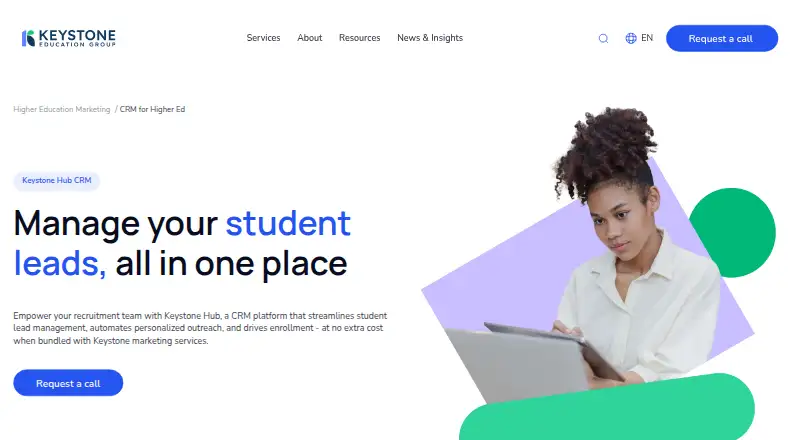
What Keystone Hub is
Keystone Hub is a CRM for higher education institutions managing student leads and supporting recruitment and enrollment. It gathers inquiries from multiple sources into a dashboard, where teams can score and prioritize leads using criteria they customize. Users can automate responses to student inquiries and support personalized outreach. The platform supports over 13 languages and can operate as a standalone CRM or connect with an institution’s existing CRM. Institutions can publish program details on a Keystone profile, including start dates, course content, deadlines, images, and videos. A documented route for sending leads to another CRM uses Zapier or Make webhooks and requires the institution’s own account with one of those services plus a Keystone API key. Keystone’s onboarding team handles setup, including integrations and automated responses. The product is available on the web and through an API. Keystone Hub has no extra cost when bundled with Keystone marketing services; it can also be licensed independently, but that price is not published and interested institutions are directed to request a call.
Good
- Consolidates inquiries from multiple sources
- Scores and prioritizes leads using customized criteria
- Supports over 13 languages
- Can be used alone or integrated with an existing CRM
Watch out
- Independent license price is not published
- Zapier or Make lead connections require the institution's own account and API key
Who it suits
Keystone Hub is designed for higher education institutions focused on student recruitment and enrollment. It suits teams that want a lead dashboard, automated inquiry responses, and options to connect with an existing CRM.
Verdict
Keystone Hub focuses its CRM and outreach tools on higher education recruitment. Institutions can use it at no extra cost when bundled with Keystone marketing services, while independent licensing requires a pricing inquiry.
Plans and prices
From Keystone Hub's own pricing page, checked 14 Oct 2026.
| Plan | Price | What it gives you |
|---|---|---|
| Bundled Keystone Hub | Free | Student lead management · automated outreach · multilingual support · lead qualification · No extra cost when bundled with Keystone marketing services |
| Keystone Hub (bundled) | Free | No extra cost when bundled with Keystone marketing services |
| Keystone Hub (independent license) | Priced on request | Can be licensed independently; price not stated |
| Standalone Keystone Hub license | Priced on request | Standalone CRM · integrations with existing CRM · Contact Keystone; independently licensable |
The facts
Each one read from Keystone Hub's own pages, with the date it was checked.
What it does
- API authentication
- Keystone's Zapier guide requires a customer-specific API key obtained from SmartHub or a customer-success manager.checked 14 Oct 2026
- Automated communication
- Users can configure automatic responses and personalized outreach to student prospects.checked 14 Oct 2026
- Cloud hosting
- Keystone states that all managed data is stored in cloud-based solutions.checked 14 Oct 2026
- CRM integration
- A Keystone Education Group guide documents connecting Keystone leads to another CRM with Zapier or Make webhooks; it says customers need their own Zapier or Make account and a Keystone API key.checked 5 Oct 2026
- Custom webhooks
- The integration guide supports POST requests, custom headers or token authentication, and customer-defined payload formats to CRM endpoints.checked 14 Oct 2026
- Data protection
- The company provides GDPR-oriented data-processing terms and says it uses data-processing agreements with suppliers.checked 14 Oct 2026
- Documentation depth
- The public integration material consists mainly of configuration guides and requires customers to obtain endpoint details from Keystone.checked 14 Oct 2026
- Educations.com integration
- Educations.com leads and performance metrics were integrated into SmartHub alongside leads from other Keystone sites.checked 14 Oct 2026
- Independent adoption
- FeaturedCustomers lists Keystone Academic Solutions as serving 4200 institutions in more than 90 countries and attracting over 6 million student visitors monthly.checked 14 Oct 2026
- Languages
- Keystone Hub supports over 13 languages.checked 5 Oct 2026
- Lead dashboard
- It consolidates student inquiries from various sources in one dashboard.checked 5 Oct 2026
- Lead qualification
- Custom criteria can automatically score and prioritize student leads.checked 14 Oct 2026
- Lead storage
- Student inquiries submitted through listings are stored in the institution's Keystone Hub profile.checked 14 Oct 2026
- Licence
- Customer terms grant a limited, revocable, non-exclusive and non-transferable right to use the service during the contract term.checked 14 Oct 2026
- Limit: implementation dependency
- API and CRM integrations require customer-specific credentials, endpoint information and field mapping, with Keystone support needed for some setup details.checked 14 Oct 2026
- Limit: unpublished pricing
- The product page gives no numeric price and directs prospective customers to request a call; standalone licensing is described without a posted rate.checked 14 Oct 2026
- Multilingual support
- Keystone Hub supports communication in more than 13 languages.checked 14 Oct 2026
- Notable limitation
- The product page does not publish a price for independent licensing; it directs interested users to request a call.checked 5 Oct 2026
- Notable news: Educations.com
- Keystone announced the Educations.com integration in 2024, centralizing its leads and metrics in SmartHub.checked 14 Oct 2026
- Organic visibility
- Published program listings are designed to appear in organic search results and route prospects to the institution profile.checked 14 Oct 2026
The company
- Company founding
- Keystone Academic Solutions AS was founded in 2007, while its parent Keystone Education Group AS was founded in 2020.checked 14 Oct 2026
- Company headquarters and size
- Keystone Education Group says it is headquartered in Oslo and has more than 800 employees across 15 countries.checked 14 Oct 2026
- Company legal identity
- The contracting entity is Keystone Academic Solutions AS, a Norwegian limited-liability company registered at Rolfsbuktveien 4D, 1364 Fornebu, Norway.checked 14 Oct 2026
- Ownership and funding
- Keystone Education Group says it is backed by Viking Venture and Verdane and issued a €100 million bond in 2025.checked 14 Oct 2026
The full review of Keystone Hub
Keystone Hub is a higher-education CRM for institutions turning prospective-student inquiries into enrollments. It is best for recruitment teams that need lead prioritization, multilingual outreach, and program information in one workflow. The strongest fit is an institution already using Keystone marketing services; buyers seeking a standalone system should first resolve the custom-pricing question.
Overview
Keystone Hub is designed around student recruitment rather than general-purpose sales management. It can run as a standalone CRM or connect to an institution’s existing CRM, making it relevant both to teams replacing a fragmented process and to those adding recruitment capabilities around a current system.
Its practical focus is the path from inquiry to enrollment: collecting leads, deciding which prospects need attention, and automating follow-up. That specialization should appeal to higher-education institutions whose admissions and marketing teams need shared visibility into prospective students. It is less compelling for organizations looking for a broadly applicable CRM outside education.
Key features
A single dashboard consolidates student inquiries from multiple sources, reducing the need to track prospects across separate queues. Customized lead-scoring criteria let institutions rank and prioritize inquiries according to their own recruitment rules. This is useful when staff capacity is limited, although the quality of prioritization depends on how thoughtfully those criteria reflect an institution’s process.
Automated responses to student inquiries and broader marketing automation can handle recurring outreach and keep prospects moving between contacts. Support for more than 13 languages strengthens the case for institutions recruiting internationally. These tools are most valuable when an admissions team has repeatable communication journeys; teams relying on highly individual, manual outreach may gain less.
Institutions can publish program profiles containing start dates, course content, deadlines, images, and videos. Keeping this information alongside recruitment activity gives prospects a clearer route from initial interest to program consideration, while giving staff a recruitment-specific destination to maintain.
Keystone’s onboarding team handles setup, including integration and automated responses. For a connection using Zapier or Make webhooks, the institution must supply its own account with one of those services and a Keystone API key. That requirement adds a separate service dependency and account cost, but the supported integration path is clearer than an entirely bespoke connection.
Keystone describes technical and organizational security measures, need-to-know access to personal data, and data-processing agreements with suppliers. Those provisions address important governance concerns for institutions handling applicant information, though each buyer remains responsible for assessing its own compliance requirements.
Pricing
| Plan | Price | Best fit and terms |
|---|---|---|
| Keystone Hub (bundled) | free | No extra cost when bundled with Keystone marketing services; suitable for institutions already buying that service. |
| Keystone Hub (independent license) | Custom pricing | Available as a standalone license, with the price determined through an inquiry. |
The bundled offer is the clear low-risk route for Keystone marketing customers because the CRM carries no additional charge. It is not a generally free product, however: institutions without that bundle must request a quote. Independent buyers should budget for an evaluation and sales conversation before comparing total cost with openly priced alternatives. No seat, usage, renewal, or trial terms are provided, so those points should be confirmed directly.
Platforms
Keystone Hub is available through a web interface and an API. The web access suits admissions and marketing staff, while the API supports integrations and data movement into an institution’s wider technology stack.
Who it's for
This is purpose-built for higher-education institutions focused on student recruitment and enrollment growth, especially teams needing multilingual communication, lead scoring, and centralized inquiry handling. It suits organizations that can use Keystone marketing services or have the resources to assess a custom independent license. It is a weaker choice for buyers demanding transparent standalone pricing or a CRM aimed at industries other than education.
Pros and cons
Pros
- Recruitment-specific workflow: Lead consolidation, scoring, automated responses, and program profiles align directly with student acquisition.
- Flexible deployment: It can stand alone or integrate with an existing CRM.
- International reach: Support for more than 13 languages helps institutions communicate with varied prospect populations.
- Bundled cost advantage: Customers using Keystone marketing services pay no extra charge for the bundled plan.
- Supported onboarding: Keystone’s team handles setup, integration, and automated responses.
Cons
- Opaque independent pricing: Standalone buyers cannot assess cost without requesting a quote.
- Integration dependency: Zapier or Make connections require the institution’s own account and a Keystone API key.
- Bundle-centric value: The strongest price case applies only to institutions already using Keystone marketing services.
Alternatives
For a broader comparison, see Education CRM Software.
OpenEduCat is the better pick for organizations wanting a freemium education platform with Android, iOS, Linux, API, and self-hosted options, plus a 15-day no-card trial.
Neexa Education CRM suits buyers who want a published free tier with 50 credits per month, one agent, three months of chat history, and 30 days of general reporting.
AdmitCue is worth choosing when a web-based admissions tool with a free tier capped at five courses, five scholarships, 1,000 applications, and 5,000 inquiries meets the need.
EduCRM fits small teams seeking a forever-free web plan for up to 10 students with session, scheduling, application, and payment tracking.
Ravenna Admissions is an alternative admissions product with Android, iOS, web, and API access; pricing requires a demo request.
Eduvy CRM offers institution-quoted pricing after catalogue review and includes per-call economics in its product.
Embark is another paid, cross-platform option with solution pricing supplied after contacting the provider.
Ether Enrol may suit institutions comfortable with subscription, implementation, and related fees governed by a school agreement.
Verdict
Choose Keystone Hub if your institution needs a recruitment-focused CRM with lead scoring, automated multilingual outreach, program listings, and a supported path into an existing CRM—especially when Keystone marketing services make it free to add. Look elsewhere if you require transparent independent pricing or want a clearly capped free plan without a sales inquiry. Its specialized workflow is the reason to choose it; its custom standalone cost is the main reason to compare alternatives.
Alternatives to Keystone Hub
- 1

OpenEduCat
Free planAndroidiOSAPILinux7.9Free plan - 2
Kinderpedia Admissions
AndroidiOSWebAPI7.6From €49 a month - 3

Neexa Education CRM
Free planAndroidWebAPIExtension7.6From $199 a month - 4
LeadSquared
AndroidiOSWebAPI7.5 - 5
EduCRM
Free planWebAPI7.3From €49.99 a month - 6
Salesforce Education Cloud
AndroidiOSWebAPI7.1From $87 a month