k3d
k3d is a lightweight wrapper for running k3s, Rancher Lab’s minimal Kubernetes distribution, in Docker.
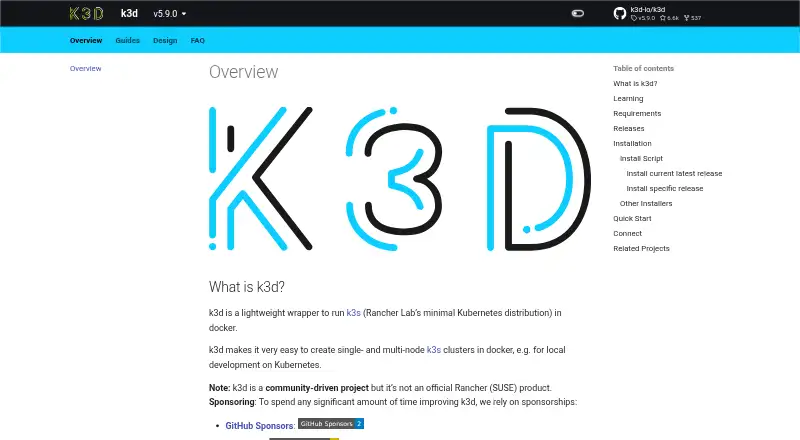
What k3d is
k3d is a lightweight wrapper for running k3s, Rancher Lab’s minimal Kubernetes distribution, in Docker. It creates single-node or multi-node clusters, including for local Kubernetes development, and can support development workflows such as code hot-reloading and a build-deploy-test cycle with Tilt. Docker is required, and kubectl is used to work with the cluster. For k3d v5.x.x, the overview specifies Docker v20.10.5 or later and runc v1.0.0-rc93 or later. The project is community-driven, not an official Rancher (SUSE) product, and its free plan is free, with sponsorships supporting development. k3d runs on Linux, macOS, and Windows, including self-hosted setups. Cluster configuration can include registry authentication and certificates, and services can be exposed through Ingress or NodePort by mapping container ports to the host. Installation options include release binaries, package managers, and Go. The project points users to Rancher community Slack’s #k3d channel for discussion.
Good
- Creates single-node and multi-node k3s clusters.
- Supports development and CI workflows.
- Registry configuration can include authentication and certificates.
- Services can be exposed through Ingress or NodePort.
- Runs on Linux, macOS, and Windows.
Watch out
- Requires Docker and kubectl.
- Not an official Rancher (SUSE) product.
- k3d v5.x.x specifies minimum Docker and runc versions.
Who it suits
k3d suits developers who want local Kubernetes clusters running in Docker, including for development or CI workflows. It is a fit for users comfortable with Docker and kubectl.
Verdict
k3d provides a free way to create k3s clusters in Docker, with options for local development, registry configuration, and service exposure. Keep its Docker requirement and community-driven status in mind.
Plans and prices
From k3d's own pricing page, checked 7 Oct 2026.
| Plan | Price | What it gives you |
|---|---|---|
| Free | Free | Community driven project · sponsorships support development |
The facts
Each one read from k3d's own pages, with the date it was checked.
What it does
- Cluster configuration
- A registries.yaml file can configure registries for a cluster, and the configuration can include registry authentication and certificates.checked 7 Oct 2026
- Cluster creation
- It creates single-node and multi-node k3s clusters in Docker, including for local Kubernetes development.checked 7 Oct 2026
- Community status
- k3d is community-driven and is not an official Rancher (SUSE) product.checked 7 Oct 2026
- Development and CI use
- The overview lists demo use cases including code hot-reloading, a build-deploy-test cycle using Tilt, and running k3d as a service in Drone CI.checked 7 Oct 2026
- Docker version
- The overview says k3d v5.x.x requires at least Docker v20.10.5 with runc at least v1.0.0-rc93 to work properly.checked 7 Oct 2026
- Ingress
- The service guide notes that k3s deploys Traefik as its default ingress controller and demonstrates accessing an Ingress through a mapped host port.checked 7 Oct 2026
- Installation
- The maker lists installation options including GitHub release binaries, Homebrew, AUR, Chocolatey, Scoop, arkade, asdf, and Go.checked 7 Oct 2026
- Kubernetes integrations
- The k3s features guide covers CoreDNS, local-path-provisioner, Traefik, and the Klipper service load balancer in k3d.checked 7 Oct 2026
- Local registries
- The documentation describes creating and using local container image registries, including registries managed by k3d.checked 7 Oct 2026
- Purpose
- k3d is a lightweight wrapper for running k3s, Rancher Lab’s minimal Kubernetes distribution, in Docker.checked 7 Oct 2026
- Related tools
- The overview links to a VS Code extension for handling k3d clusters and a Linux graphical interface called k3x.checked 7 Oct 2026
- Requirements
- Docker is required to use k3d, and kubectl is used to interact with the Kubernetes cluster.checked 7 Oct 2026
- Service exposure
- The service guide documents exposing services through Ingress or NodePort by mapping container ports to the host.checked 7 Oct 2026
- Support
- The overview directs users to the Rancher community Slack and its #k3d channel for discussion.checked 7 Oct 2026
Alternatives to k3d
- 1

vCluster Platform
Free planOpen sourceWebAPILinuxmacOS7.7Free plan - 2

srelens
Free planOpen sourceWebAPIExtensionLinux7.4Free plan - 3
Talos Linux
Free planAPILinuxmacOSSelf-hosted6.8From $1,000 a year - 4
Kunobi
Free planLinuxmacOSWindows6.7From $912 a month - 5
Rancher Desktop
Free planAPILinuxmacOSWindows6.7Free plan - 6
kind
Free planLinuxmacOSSelf-hostedWindows6.6Free plan