JVoiceXML
JVoiceXML is a free, open-source VoiceXML interpreter for Java, described by its project as implementing VoiceXML 2.1.
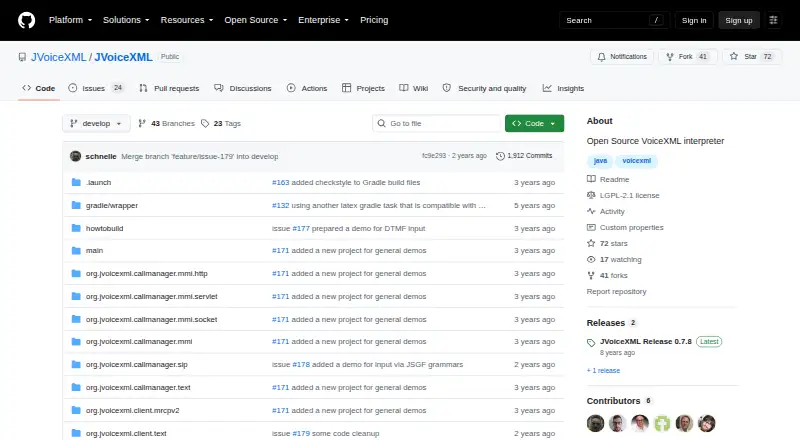
What JVoiceXML is
JVoiceXML is a free, open-source VoiceXML interpreter for Java, described by its project as implementing VoiceXML 2.1. It supports voice dialogs using synthesized speech, digitized audio, spoken input, and DTMF input. Dialog functions also include recording, telephony, and mixed-initiative conversations. An open architecture allows custom extensions, while its demo implementation platforms support Java APIs such as JSAPI and JTAPI. Repository modules include Mary, MRCPv2, JSAPI 2.0, JTAPI, and text implementations. The project names platform independence as a major goal. The GitHub repository identifies the license as LGPL-2.1 and provides release downloads. The latest listed release is version 0.7.8, which added an SRGS grammar processor with SISR support, Microsoft LUIS as a grammar processor, bug fixes, and migration to Gradle. The project is listed for API, Linux, and self-hosted use.
Good
- Free VoiceXML interpreter for Java.
- Implements VoiceXML 2.1.
- Supports spoken and DTMF input.
- Open architecture allows custom extensions.
- Repository includes JSAPI and JTAPI modules.
Watch out
- Latest listed release is version 0.7.8.
- Listed platforms are API, Linux, and self-hosted.
Who it suits
JVoiceXML may suit Java developers building VoiceXML speech dialogs who want an open-source interpreter and custom extension options. Its listed platforms include API, Linux, and self-hosted use.
Verdict
JVoiceXML provides a free Java interpreter for VoiceXML 2.1 dialogs, with speech, DTMF, recording, and telephony capabilities. The latest listed release is 0.7.8.
Plans and prices
From JVoiceXML's own pricing page, checked 3 Oct 2026.
| Plan | Price | What it gives you |
|---|---|---|
| Free | Free | Free VoiceXML interpreter for Java |
| JVoiceXML | Free | Free VoiceXML interpreter for Java |
The facts
Each one read from JVoiceXML's own pages, with the date it was checked.
What it does
- APIs
- Its demo implementation platforms support Java APIs such as JSAPI and JTAPI.checked 4 Oct 2026
- Available modules
- The repository includes modules for Mary, MRCPv2, JSAPI 2.0, JTAPI, and text implementations.checked 3 Oct 2026
- Compatibility goal
- The project states that a major goal is a platform-independent implementation that can be used for free.checked 4 Oct 2026
- Dialogs
- VoiceXML supports audio dialogs using synthesized speech, digitized audio, spoken and DTMF input recognition, spoken input recording, telephony, and mixed initiative conversations.checked 4 Oct 2026
- Distribution
- The repository provides releases and lists downloadable assets for release 0.7.8.checked 4 Oct 2026
- Extensibility
- JVoiceXML has an open architecture for custom extensions.checked 3 Oct 2026
- Extensions
- JVoiceXML has an open architecture for custom extensions.checked 4 Oct 2026
- Java APIs
- Its demo implementation platforms support Java APIs including JSAPI and JTAPI.checked 3 Oct 2026
- Language
- The project describes JVoiceXML as a free VoiceXML interpreter for Java.checked 4 Oct 2026
- Latest release
- The latest listed release is JVoiceXML 0.7.8.checked 4 Oct 2026
- License
- The repository identifies its license as LGPL-2.1.checked 4 Oct 2026
- Maintainer identity
- The GitHub repository is hosted under the JVoiceXML organization.checked 3 Oct 2026
- Purpose
- JVoiceXML is an open source VoiceXML interpreter and an implementation of VoiceXML 2.1.checked 4 Oct 2026
- Release features
- Release 0.7.8 added a more compliant SRGS grammar processor with SISR support, Microsoft LUIS as a grammar processor, bug fixes, and migration to Gradle.checked 4 Oct 2026
- Speech dialogs
- The project describes VoiceXML dialogs supporting synthesized speech, digitized audio, spoken and DTMF input recognition, recording, telephony, and mixed-initiative conversations.checked 3 Oct 2026
- VoiceXML version
- The project describes its implementation as VoiceXML 2.1.checked 3 Oct 2026
Where it runs
- Platform goal
- The project states that a major goal is a platform-independent implementation that can be used for free.checked 3 Oct 2026
The full review of JVoiceXML
JVoiceXML is a Java-based foundation for developers creating VoiceXML voice dialogs and IVR applications. It suits teams that want a self-hosted, extensible interpreter rather than a packaged call-flow service. The main attraction is broad dialog support at no software cost; the main trade-off is that speech and telephony components still need to be selected and integrated.
Overview
JVoiceXML implements VoiceXML 2.1 dialogs covering synthesized speech, digitized audio, spoken-input recognition, DTMF recognition, recording, telephony, and mixed-initiative conversations. That combination supports substantially richer interactions than a keypad-only menu, including callers who switch naturally between speech and touch tones.
Its open architecture is designed for custom extensions, and demo implementation platforms expose Java APIs such as JSAPI and JTAPI. Java teams can therefore align dialog processing with their own application code and surrounding systems. This flexibility is valuable when the integration itself is a product requirement, but it is not the same as receiving a hosted IVR builder with a preassembled visual workflow.
The project states a goal of platform-independent implementation that can be used for free. The repository is hosted by the JVoiceXML organization and uses the LGPL-2.1 license, so teams should include that license in their software-distribution and integration decisions. Release 0.7.8 moved the build to Gradle, added a more compliant SRGS grammar processor with SISR support, added Microsoft LUIS as a grammar processor, and included bug fixes.
Key features
- VoiceXML 2.1 dialog engine: Handles synthesized and recorded audio, speech and DTMF recognition, recording, telephony, and mixed-initiative exchanges. It is a capable base for conversational menus and information lines rather than only one-way announcements.
- Speech and recording: Speech input and call recording are supported, allowing applications to collect spoken responses or retain caller audio where the surrounding implementation provides the necessary services.
- Open extension model: Custom extensions are a first-class architectural goal. This benefits developers who need to adapt the interpreter to a particular back end, but places responsibility for that adaptation on the development team.
- Java integration: JSAPI and JTAPI support in demo implementation platforms gives Java applications established integration points for speech and telephony functions.
- Modular implementations: Repository modules include Mary, MRCPv2, JSAPI 2.0, JTAPI, and text implementations. The selection gives teams options for assembling a stack, while also making component choice part of the project rather than a turnkey purchase.
- Grammar processing: Version 0.7.8 brought improved SRGS processing with SISR support and Microsoft LUIS as a grammar processor, useful for projects that need more capable recognition grammars.
Pricing
JVoiceXML is free software with no free trial because there is no paid tier to trial. The published plans are:
| Plan | Price | Includes |
|---|---|---|
| Free | free | Free VoiceXML interpreter for Java |
| JVoiceXML | free | Free VoiceXML interpreter for Java |
Both entries provide the same stated interpreter at zero cost. There are no published seat, usage, or renewal charges in these plans. The saving is significant for teams able to operate their own Java and telephony stack; organizations wanting a bundled service, vendor-managed infrastructure, or a packaged call-flow editor should budget for another category of product.
Platforms
JVoiceXML is listed for API use, Linux, and self-hosted deployment. That profile fits server-side Java environments and teams responsible for their own runtime. It is not presented as a native Android, iOS, macOS, Windows, or browser application, so mobile or desktop users would need to connect to a separately deployed service.
Who it's for
Choose JVoiceXML when your team is comfortable with Java, needs VoiceXML 2.1 dialog behavior, and wants control over speech, telephony, grammar, and extension components. It is especially appropriate for self-hosted IVR projects that need both spoken and DTMF interaction or recording. It is a weaker fit for a nontechnical buyer seeking an immediately configured phone system, visual campaign tools, or an all-in-one hosted service.
Pros and cons
Pros
- No license fee: The interpreter is free, making experimentation and self-hosted deployment possible without a software subscription.
- Broad dialog coverage: Speech synthesis, audio playback, speech and DTMF recognition, recording, telephony, and mixed initiative cover varied IVR designs.
- Java and extension support: Open extensions plus JSAPI and JTAPI integration provide practical control for Java developers.
- Modular choices: Mary, MRCPv2, JSAPI 2.0, JTAPI, and text modules let teams shape an implementation around their environment.
Cons
- Assembly is part of the job: The module-based architecture requires teams to choose and integrate speech and telephony components.
- Self-hosting focus: API, Linux, and self-hosted deployment favor engineering-led projects over buyers wanting managed infrastructure.
- License obligations: LGPL-2.1 should be reviewed before incorporating and distributing the software.
Alternatives
For a hosted or broader IVR service, compare IVR Software as a category. Momo Business IVR is paid but offers a free plan with pay-as-you-go calling and messaging on Linux, macOS, web, and Windows. Teloz IVR suits users wanting Android, iOS, and web access, with a free plan, trial, calling minutes, SMS segments, a DID, and AI receptionist minutes.
Voicent is a freemium API, self-hosted, web, and Windows option with a free allowance of 100 minutes or texts. CallFire IVR is a paid API and web service with pay-as-you-go and monthly plans. KloudTalk is a paid, trial-based multi-platform phone service, while Agent Voice Response is free self-hosted software for personal and commercial use without per-minute charges.
Genesys Workforce Engagement Management targets organizations willing to pay per named user annually for a broader workforce suite. Avaya Aura Private Cloud is a paid, scalable private-cloud telephony option with per-user pricing.
Verdict
JVoiceXML is a strong choice for Java developers building self-hosted VoiceXML 2.1 dialogs who value control, modular integrations, and a zero software price. Choose it for an extensible interpreter; look elsewhere if you need managed telephony, a visual builder, or a ready-to-run business phone service.
Alternatives to JVoiceXML
- 1
Voicent
Free planAndroidiOSWebAPI8.2From $163 a month - 2
CallFire IVR
Free planAndroidiOSWebAPI8.0From $99 a month - 3
Knowlarity Cloud Contact Center
AndroidiOSWebAPI7.8From ₹16,800 a year - 4

MyOperator
AndroidiOSWebAPI7.8From ₹5,000 a month - 5
Momo Business IVR
Free planWebLinuxmacOSWindows7.4From 25,000 TZS a month - 6
KloudTalk
AndroidiOSWebmacOS7.3From $240 a year