JuicyTraffic
JuicyTraffic helps advertisers identify invalid or suspicious clicks and direct spend toward traffic with a better chance of converting.
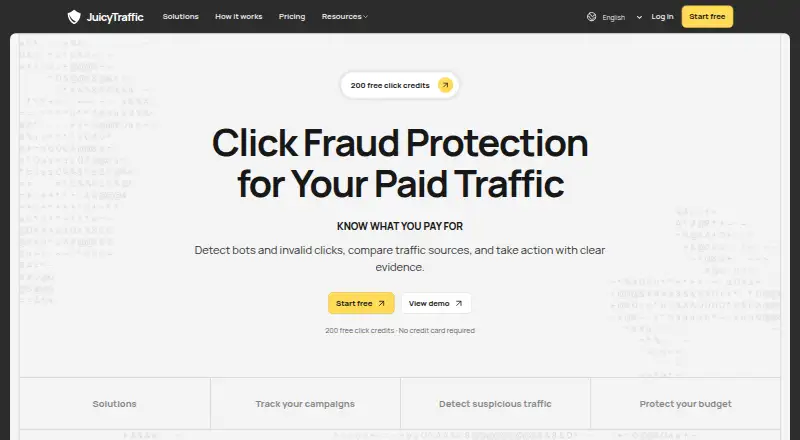
What JuicyTraffic is
JuicyTraffic helps advertisers identify invalid or suspicious clicks and direct spend toward traffic with a better chance of converting. It classifies visits as valid, suspicious, or invalid, and lets users compare quality by source, campaign, and placement. Reports present interaction, automation, network, location, and conversion evidence. Setup involves creating an account, adding a website, and making a campaign link; reporting builds as paid visits arrive. Each unique accepted advertising landing visit consumes one credit regardless of verdict, while follow-up events and retries do not use extra credits. Credits do not expire, and the service says it has no subscription. The free plan provides 200 click credits without requiring a credit card. One-time plans include Mini at $15, paid once, Starter at $49, paid once, Growth at $149, paid once, and Scale at $499, paid once. The service processes technical visit and campaign signals, interaction summaries, IP addresses, and scoped browser identifiers, but its probe does not read page text or form values. Support is available by email during normal business hours; API and developer references are marked as coming soon.
Good
- Traffic is classified as valid, suspicious, or invalid.
- Credits do not expire and there is no subscription.
- Free plan includes 200 credits without a card.
- Reports show several kinds of traffic evidence.
Watch out
- Each unique accepted landing visit uses one credit.
- API and developer references are marked coming soon.
- Email requests are reviewed during normal business hours.
Who it suits
JuicyTraffic suits advertisers who want to assess click quality by source, campaign, and placement. It may fit buyers who prefer non-expiring click credits over a subscription.
Verdict
JuicyTraffic offers a free credit allowance and one-time paid credit bundles, with reports organized around traffic verdicts and evidence. Check how its accepted-visit credit rule fits expected campaign volume.
Plans and prices
From JuicyTraffic's own pricing page, checked 15 Oct 2026.
| Plan | Price | What it gives you |
|---|---|---|
| Free | Free | 200 click credits · no credit card · credits never expire |
| Mini | $15, paid once | 5,000 click credits · $3.00 per 1,000 clicks · Crypto & PayPal accepted · ONE-TIME |
| Starter | $49, paid once | 20,000 click credits · $2.45 per 1,000 clicks · Crypto & PayPal accepted · ONE-TIME |
| Growth | $149, paid once | 100,000 click credits · $1.49 per 1,000 clicks · Crypto & PayPal accepted · ONE-TIME |
| Scale | $499, paid once | 500,000 click credits · $1.00 per 1,000 clicks · Crypto & PayPal accepted · ONE-TIME |
The facts
Each one read from JuicyTraffic's own pages, with the date it was checked.
What it does
- API documentation
- The documentation page labels API and developer references for authentication, endpoints, events, and integrations as coming soon.checked 11 Oct 2026
- API status
- Authentication, endpoints, events, and integration references are marked coming soon.checked 15 Oct 2026
- Bot detection
- The product identifies automated visits and fake traffic that are unlikely to produce customers.checked 15 Oct 2026
- Campaign analysis
- Traffic quality can be compared by source, campaign, and placement.checked 11 Oct 2026
- Campaign attribution
- Traffic quality can be compared by source, campaign, and placement.checked 15 Oct 2026
- Campaign links
- A campaign link connects a paid visit with source, campaign, placement, and optional conversion data.checked 15 Oct 2026
- Conversion tracking
- Campaigns can use URL matching or a meta-tag success condition to record conversions.checked 15 Oct 2026
- Credit charging
- Each unique accepted advertising landing visit consumes one credit regardless of its verdict; follow-up events and retries are free.checked 15 Oct 2026
- Credit usage
- Each unique accepted advertising landing visit uses one credit regardless of its verdict, while follow-up events and retries do not cost extra.checked 11 Oct 2026
- Data collected
- The service processes technical visit and campaign signals, interaction summaries, IP addresses, and scoped browser identifiers; its probe does not read page text or form input values.checked 11 Oct 2026
- Data retention and credentials
- Traffic event records are normally kept for no more than 30 days, and stored integration credentials are protected with access controls and encryption.checked 11 Oct 2026
- Documentation depth
- Documentation is organized into getting started, tracking, analysis, rules and integrations, billing, and troubleshooting sections.checked 15 Oct 2026
- Evidence signals
- Reports use interaction, automation, network, location, and conversion evidence.checked 15 Oct 2026
- Integrations
- The privacy policy says data is shared with a connected ad platform only when a customer asks JuicyTraffic to perform that integration.checked 11 Oct 2026
- Integrations controls
- The documentation provides IP exclusion lists and connected-platform automation controls.checked 15 Oct 2026
- JuicyAds integration context
- JuicyAds describes itself on LinkedIn as a privately held advertising network headquartered in Regina, Saskatchewan.checked 15 Oct 2026
- JuicyAds integration context: awards
- JuicyAds claims more than 20 industry awards in its LinkedIn description.checked 15 Oct 2026
- JuicyAds integration context: clients
- JuicyAds claims more than 105,000 activated clients on its LinkedIn company description.checked 15 Oct 2026
- JuicyAds integration context: formats
- JuicyAds lists banner advertising, native advertising, and popunder traffic among its specialties.checked 15 Oct 2026
- JuicyAds integration context: publishers
- JuicyAds claims a publisher network of about 220,000 sites or publishers.checked 15 Oct 2026
- JuicyAds integration context: scale
- JuicyAds claims billions of monthly impressions across its network.checked 15 Oct 2026
Where it runs
- Browser probe
- The probe is installed in the shared site head or through a tag manager and loads asynchronously.checked 15 Oct 2026
The company
- JuicyAds company profile
- Crunchbase describes JuicyAds as a private internet company focused on banner ads, native advertising, and popunders, with 11–50 employees in Regina, Canada.checked 15 Oct 2026
- JuicyAds integration context: founded
- JuicyAds says it began in 2006 after its founder created it to manage personal traffic and media buys.checked 15 Oct 2026
The full review of JuicyTraffic
JuicyTraffic is a web service for identifying invalid and potentially fraudulent advertising visits. It suits advertisers who want to inspect traffic quality across campaigns and placements without taking on a recurring subscription. Its credit model is straightforward, though every accepted landing visit consumes a credit, including visits judged valid.
Overview
Reports classify traffic as valid, suspicious, or invalid, then let advertisers compare quality by source, campaign, and placement. Evidence spans interaction, automation, network, location, conversion, behavior, and device signals, alongside matched rules and patterns such as repeated invalid clicks and unusual traffic. That gives teams more context than a single pass/fail tally, while leaving the user to interpret the evidence and decide how to act.
Setup follows three steps: create an account, add a website, and create a campaign link. Reports fill in as paid visits arrive. Automatic click blocking is supported, but the API and developer references for authentication, endpoints, events, and integrations are still coming soon, which may matter to teams that need to automate their own workflows.
JuicyTraffic processes technical visit and campaign signals, interaction summaries, IP addresses, and scoped browser identifiers; its probe does not read page text or form input values. Its privacy policy says it does not build cross-site advertising profiles, sell personal information, or set third-party advertising cookies. Traffic event records are normally kept for no more than 30 days. Stored integration credentials have access controls and encryption, and data is shared with an ad platform only when a customer requests that integration.
Key features
The verdict categories and evidence signals make it possible to distinguish suspicious traffic from visits marked invalid, rather than treating every questionable click as equivalent. Comparing results across sources, campaigns, and placements can help advertisers spot where quality differs and direct attention to the weaker segments.
JuicyTraffic names Google Ads, Meta Ads, TikTok Ads, Microsoft Ads, affiliates, Shopify, ExoClick, JuicyAds, TrafficJunky, TrafficStars, and TwinRed among its sources. Its supported ad platforms are ExoClick, JuicyAds, TrafficJunky, TrafficStars, and TwinRed. Automatic blocking is a practical advantage for advertisers who want more than reporting, but the coming-soon API references limit what can be assumed about custom integration workflows.
Each unique accepted advertising landing visit costs one credit regardless of its verdict; follow-up events and retries cost nothing extra. That rule is predictable, but it means valid visits use the same allowance as invalid ones. Purchased credits do not expire, and there is no subscription.
Pricing
The free plan costs nothing and includes 200 click credits, requires no credit card, and has credits that never expire. It is useful for a small initial check, but 200 visits can be quickly exhausted by an active campaign.
Paid bundles are one-time purchases, not recurring plans:
- Mini: $15, paid once for 5,000 click credits, or $3.00 per 1,000 clicks.
- Starter: $49, paid once for 20,000 click credits, or $2.45 per 1,000 clicks.
- Growth: $149, paid once for 100,000 click credits, or $1.49 per 1,000 clicks.
- Scale: $499, paid once for 500,000 click credits, or $1.00 per 1,000 clicks.
Crypto and PayPal are accepted for the paid bundles. Mini suits a limited campaign that outgrows the free allowance; Starter and Growth lower the per-thousand rate for steadily higher volumes, while Scale offers the lowest listed unit cost for large traffic loads. The trade-off is that larger bundles require more money up front, and the credit rule still counts valid accepted landing visits.
Platforms
JuicyTraffic is available on the web. The supported ad-platform connections are ExoClick, JuicyAds, TrafficJunky, TrafficStars, and TwinRed.
Who it's for
JuicyTraffic is a good fit for advertisers who need to compare traffic quality by source or campaign, want verdicts backed by several kinds of evidence, and prefer a one-time credit purchase over a subscription. The non-expiring credits are especially useful when campaign volume is intermittent. It is less compelling for advertisers whose expected valid traffic would consume credits quickly, or teams that depend on documented API workflows today.
Pros and cons
- Pros: Non-expiring credits and no subscription suit uneven campaign schedules.
- Pros: Verdicts, evidence signals, and source-level comparisons provide several ways to investigate traffic quality.
- Pros: Follow-up events and retries do not consume extra credits, and automatic blocking is supported.
- Cons: Every unique accepted landing visit uses a credit, including valid visits, so broad monitoring can draw down a bundle quickly.
- Cons: The free allowance is 200 credits, limiting its usefulness for sustained traffic.
- Cons: API and developer references are coming soon, a constraint for teams planning custom integrations.
Alternatives
Click Fraud Software is the broader category directory for comparing options.
Choose TrafficGuard if a free detection-only solution for ad spend under $2.5K/month or a free trial is a better starting point; its platform support includes API and web. Anura is another API-and-web option, with a 15-day fully functional trial that requires no credit card and includes the same features as a full engagement.
ClickHelm suits readers considering a freemium, self-hosted or web option; its free edition excludes blocking, rules or automatic actions, weekly email reports, and Google charge reconciliation. ClickLens offers a free API-and-web plan with 1,000 sessions per month, one site, basic scoring, seven-day retention, and a session explorer.
ClickPatrol may suit readers who want to begin with a seven-day trial capped at 5,000 clicks and one brand, with no active exclusions. Didva offers a free Watchtower plan for up to 3,000 clicks per month on one site, with seven-day retention and manual IP blocking.
ClickDefender is an alternative with broad platform support, including desktop and mobile operating systems, and a Starter plan at £49 a month. Clixtell is another paid option with a free trial and plans that include call tracking.
Verdict
JuicyTraffic is best for advertisers who want evidence-backed traffic verdicts and flexible, non-expiring credits rather than a recurring bill. Its one-time bundles and campaign comparisons are the strongest reasons to choose it; the main reason to look elsewhere is that accepted valid visits also consume credits, while custom API workflows are not yet documented.
Getting started
- Open https://juicytraffic.com/en.
- Create an account.
- Add a website.
- Create a campaign link.
- Use the Free plan or purchase a one-time credit plan.
Limits worth knowing
The Free plan provides 200 click credits. Each unique accepted advertising landing visit consumes one credit, while follow-up events and retries do not cost extra.
Questions
Is JuicyTraffic free?
Yes. The Free plan includes 200 click credits and does not require a credit card.
How much do paid plans cost?
Mini costs $15.00 USD for 5,000 credits; Starter costs $49.00 USD for 20,000; Growth costs $149.00 USD for 100,000; and Scale costs $499.00 USD for 500,000. Purchases are one-time and credits do not expire.
Which platforms and ad sources does it support?
JuicyTraffic is available on the web. Supported ad platforms are ExoClick, JuicyAds, TrafficJunky, TrafficStars, and TwinRed; named sources also include Google Ads, Meta Ads, TikTok Ads, Microsoft Ads, affiliates, and Shopify.
How are credits used?
One credit is used for each unique accepted advertising landing visit, regardless of its verdict. Follow-up events and retries use no extra credits.
Does it block invalid clicks automatically?
Yes, automatic click blocking is listed as a feature.
How can I contact support?
Product, account, and technical support are available by email. Requests are reviewed during normal business hours.
Alternatives to JuicyTraffic
- 1
ClickPatrol
Free planAndroidiOSWebAPI7.9From €71 a month - 2
ClickHelm
Free planOpen sourceWebSelf-hosted7.7From $29 a month - 3
Didva
Free planOpen sourceWebAPIExtension7.7From $39 a month - 4

ClickCease
AndroidiOSWeb7.0From $69 a month - 5
ClickDefender
AndroidiOSWebAPI6.9From £49 a month - 6
Clixtell
AndroidiOSWeb6.8From $10 a month