
Jitsu
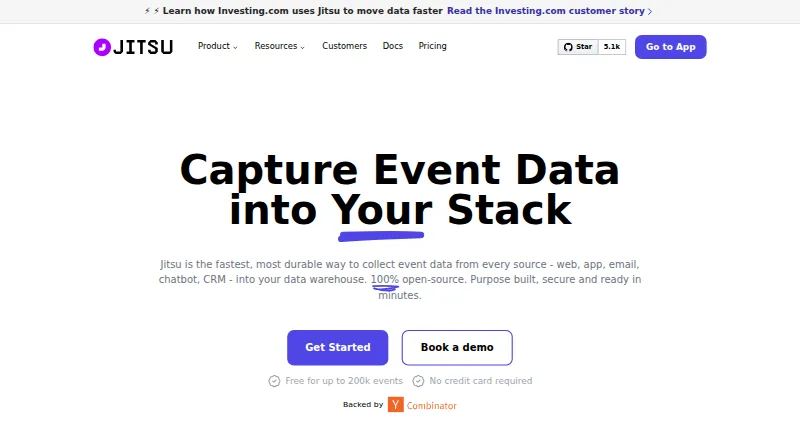
Jitsu collects event data from websites, apps, email, chatbots, and CRMs and routes it to a data warehouse.
What Jitsu is
Jitsu collects event data from websites, apps, email, chatbots, and CRMs and routes it to a data warehouse. It says delivery can take under a second, with optional batching, and buffers data in Kafka during warehouse maintenance for delivery after the warehouse is back online. Jitsu can deduplicate events, create warehouse tables and columns from incoming data, and use JavaScript Functions to filter, transform, or enrich events. Integrations include 609+ sources and 32+ destinations, such as warehouses, object storage, analytics tools, CRMs, and ad platforms. Data can be collected through web snippets, APIs, mobile options, or server-to-server connections. Jitsu is offered as a hosted service or open-source software for on-premise use; feature-complete self-hosting requires Kubernetes. Its free cloud plan includes 200,000 active events per month. Business costs $99 per month and includes 2 million active events monthly, with additional events billed separately. Captured events are free; billing counts active events successfully sent to at least one destination.
Good
- Free plan includes 200,000 active events monthly.
- Supports 609+ sources and 32+ destinations.
- Buffers events during warehouse maintenance.
- Offers hosted and open-source deployment options.
- Encrypts customer data at rest and in transit.
Watch out
- Feature-complete self-hosting requires Kubernetes.
- Business plan costs $99 per month.
- Additional active events cost $40 per million.
Who it suits
Jitsu suits teams that need to collect and route event data into warehouses, with options for hosted or self-hosted deployment. Developers can use its JavaScript event functions and collection methods across web, mobile, and server-side sources.
Verdict
Jitsu combines event collection, routing, and transformation with hosted and self-hosted options. Check the active-event billing rules and Kubernetes requirement if planning a self-hosted deployment.
Plans and prices
From Jitsu's own pricing page, checked 15 Oct 2026.
| Plan | Price | What it gives you |
|---|---|---|
| Free | Free | Unlimited captured events · 200k active events/month · unlimited connectors · one daily active sync · ClickHouse UI/API · unlimited destinations · custom domains · identity stitching · configuration API · $0 |
| Open source | Free | MIT license · self-host on any cloud provider · cloud native · no usage limits · community support · Free. Forever |
| Business | $99 a month | Unlimited captured events · 2M active events/month · $40 per additional 1M events · hourly connector syncs · 5 monthly syncs · $20 per additional monthly active sync · $99 per month |
| Enterprise | Priced on request | Unlimited captured events · custom active-event volume · one-minute connector syncs · unlimited monthly syncs · observability exports · profile builder · custom backup retention · dedicated ingest shard · OIDC SSO · priority support and SLA · Custom; contact us |
The facts
Each one read from Jitsu's own pages, with the date it was checked.
Money
- Billing limits
- Captured events are free; billing counts active events successfully sent to at least one destination, and a function that splits one event into multiple events counts each resulting event.checked 29 Sep 2026
What it does
- CLI and MCP
- Jitsu provides a jitsu-cli for API operations and an MCP server that lets AI agents configure and debug pipelines.checked 15 Oct 2026
- ClickHouse
- Jitsu Cloud includes a configured ClickHouse warehouse with SQL-console and API access.checked 15 Oct 2026
- Compliance
- Jitsu states it is SOC 2 compliant and participates in the EU-US Data Privacy Framework; it offers a DPA and SCC through its security page.checked 29 Sep 2026
- Data durability
- Kafka buffers events while a warehouse is unavailable and delivery resumes after recovery.checked 15 Oct 2026
- Deduplication
- The pipeline can deduplicate repeated event submissions before they reach destinations.checked 15 Oct 2026
- Deduplication and schemas
- Jitsu deduplicates repeated data and can automatically create warehouse tables and columns based on incoming data.checked 29 Sep 2026
- Deployment
- Jitsu is available as a hosted cloud service or as open-source software deployed on on-premise infrastructure; its feature-complete self-hosted deployment requires Kubernetes.checked 29 Sep 2026
- Docker limitation
- Docker Compose is deprecated and omits functions, profile builders and connector syncs.checked 15 Oct 2026
- Documentation
- The documentation includes quickstarts, concepts, API references, SDK guides, destination guides, functions and self-hosting material.checked 15 Oct 2026
- Event backups
- Cloud event backups retain data for up to 7 days on Free and up to 90 days on paid plans; self-hosted deployments do not archive events automatically.checked 15 Oct 2026
- Event delivery
- Jitsu says it delivers data to warehouses in under a second and also supports optional batching.checked 29 Sep 2026
- Event HTTP API
- Backend systems can send events through Jitsu's HTTP API using an X-Write-Key header or basic authentication.checked 15 Oct 2026
- Functions
- JavaScript functions can filter, transform and enrich events and can use storage, logging, HTTP fetch and warehouse APIs.checked 15 Oct 2026
- Funding
- Crunchbase describes Jitsu as a private seed company with two funding rounds and investors including Y Combinator and Costanoa Ventures.checked 15 Oct 2026
- Identity stitching
- Identity stitching links anonymous activity to known users and can update historical records in supported warehouses.checked 15 Oct 2026
- Integrations
- The integrations catalog lists more than 609 connectors and more than 32 destinations.checked 15 Oct 2026
- License
- The public Jitsu repository is released under the MIT license.checked 15 Oct 2026
- Limit: destination coverage
- A Capterra reviewer says the destination catalog was too narrow for one required service and required a webhook workaround.checked 15 Oct 2026
The company
- Company headquarters and size
- LinkedIn lists Jitsu's headquarters in San Francisco and its size as 11–50 employees.checked 15 Oct 2026
- Company legal name
- Crunchbase lists the company legal name as Jitsu Labs, Inc., with Peter Wysinski and Vladimir Klimontovich as founders.checked 15 Oct 2026
- Founded
- The YC directory identifies Jitsu as a Summer 2020 company.checked 15 Oct 2026
- Headquarters
- San Francisco, California, United Stateschecked 23 Sep 2026
Where it runs
- Data collection platforms
- The docs list sending-data options for web snippets, HTTP and Pixel APIs, React Native, iOS, Android, and server-to-server.checked 29 Sep 2026
The full review of Jitsu
Overview
Jitsu is an event-data pipeline for collecting activity from digital services and routing it to warehouses and other destinations. It suits teams that need web, mobile, and server-side events in one flow; the choice is between managed hosting and operating the open-source software yourself.
Its combination of broad integrations, event transformations, and buffering can simplify a multi-source pipeline. The trade-off is that billing depends on successfully delivered active events, while a feature-complete self-hosted deployment requires Kubernetes.
Key features
Collection, delivery, and resilience
Jitsu accepts data through web snippets, HTTP and Pixel APIs, React Native, native iOS and Android, and server-to-server connections. It says delivery to warehouses can take under a second, with batching available when immediate delivery is not needed. That flexibility suits both near-real-time flows and workloads where grouping events is preferable.
When a warehouse is undergoing maintenance, Jitsu buffers events in Kafka for delivery once it returns. It also deduplicates repeated data and can create warehouse tables and columns from incoming events, reducing manual upkeep. These safeguards help keep pipelines moving, though the value depends on having a compatible destination and a flow that fits Jitsu's event-based billing.
Routing and transformation
JavaScript Functions can filter, reshape, or enrich events before they reach a destination. The integrations catalog covers more than 609 sources and 32 destinations, including warehouses, object storage, analytics services, CRMs, and ad platforms. That breadth makes Jitsu a plausible hub for varied event sources; teams with a narrower, single-platform need may not benefit from managing such a pipeline.
Jitsu states that data is encrypted at rest with AES-256 and in transit over TLS. It also says it is SOC 2 compliant, participates in the EU-US Data Privacy Framework, and offers a DPA and SCC. Community support comes with the open-source plan; the pricing page invites questions to the team.
Pricing
Jitsu has a free hosted plan, a free open-source edition, and a paid Business plan from $99 a month. The main pricing distinction is event allowance and sync cadence, not connector count: all hosted tiers include unlimited connectors.
- Open source — free, forever. The MIT-licensed software can be self-hosted on any cloud provider with no usage limits and community support. It suits teams that can operate their own infrastructure. Feature-complete self-hosting requires Kubernetes, so the absence of a usage cap does not remove the operational burden.
- Free — free. Includes 200k active events per month, unlimited captured events, unlimited connectors and destinations, and up to one daily active sync. It can run on Jitsu Cloud, Private Cloud, or On Prem. This is a useful starting point for low-volume pipelines, but the daily sync ceiling is less suited to frequent refreshes.
- Business — $99 a month, billed per month. Includes 2M active events per month, unlimited connectors, syncs as frequent as hourly, and up to five monthly active syncs. Additional events cost $40 per 1M, and each additional monthly active sync costs $20. It fits teams needing more volume and faster refreshes, but those extras can increase the bill.
- Enterprise — custom pricing. Offers a custom active-event allowance, unlimited connectors and monthly active syncs, and syncs as frequent as every minute. It is aimed at pipelines whose volume or cadence exceeds the fixed Business allowance.
Captured events are free; billing counts active events successfully sent to at least one destination. If a function splits one event into several, each resulting event counts. Teams estimating spend should therefore account for delivered output events, not just incoming captures.
Platforms
Jitsu is listed for Android, iOS, Linux, macOS, Windows, web, API, and self-hosted use. Its collection options span web, mobile, and server-side sources, making it suitable for teams that need a common event pipeline across devices and back-end systems.
Who it's for
Jitsu is strongest for product and data teams that need to collect events across multiple surfaces, transform them, and route them to several destinations. The free hosted allowance gives a low-volume project room to start, while Business adds hourly syncs and a larger event quota. Teams without Kubernetes expertise should weigh the hosted plans over feature-complete self-hosting; readers who only need a specialized gateway or customer-data platform may prefer a more focused option.
Pros and cons
- Pro: Collection methods cover web, mobile, and server-to-server events, avoiding separate pipelines for each surface.
- Pro: Kafka buffering, deduplication, and automatic table and column creation address common delivery and schema-maintenance needs.
- Pro: Hosted plans keep connectors unlimited even as event allowances and sync frequency vary.
- Con: The free hosted plan is capped at 200k active events per month and one daily active sync, limiting higher-volume or more frequent workflows.
- Con: Feature-complete self-hosting requires Kubernetes, which adds an infrastructure requirement for teams choosing the no-usage-limit edition.
- Con: Business overages are charged for both extra event volume and additional monthly active syncs, so expanded usage can raise costs beyond the base price.
Alternatives
Consider these alternatives when their pricing or focus better matches your pipeline:
- SnowcatCloud is another freemium option with a free Apache 2.0 self-hosted edition and no licensing fees.
- Stape may suit a Meta CAPI Gateway use case: its Pay as you go plan is $8 a month, billed at $100 yearly, for one Pixel and up to 10 million events per month; additional Pixels cost $8 each.
- RudderStack Customer Data Platform is worth comparing for a free plan with 250K events per month, 16 SDK sources, and 200+ cloud destinations.
- Hightouch is an option for teams whose needs fit its free allowance of two active syncs per month, hourly sync frequency, and 100,000,000 operations per month.
- SetRoasFlow offers a Growth plan at $99 a month with 2M events per month, 10 websites, warehouse export, and priority email support.
- Tracardi offers an open-source version with limited events per second, single tenancy, limited automation, and no event validation.
- Tealium AudienceStream CDP is a paid alternative whose pricing is based on inbound events, with no per-seat fees or charges per integration.
- CustomerLabs CDP is a paid alternative with a Growth plan at $129 a month plus GST, including 500K monthly usage units and unlimited sources and destinations.
- Browse event tracking software for more options in the category.
Verdict
Choose Jitsu if you need a flexible event pipeline that spans web, mobile, and server-side collection, with transformations and warehouse-oriented delivery in one product. Its free options make it approachable at low volume, and Business raises the allowance and cadence without limiting connectors. Look elsewhere if Kubernetes-based self-hosting is impractical or if the active-event and sync charges make your expected usage hard to contain.
Getting started
- Choose Jitsu Cloud, Private Cloud, or On Prem for the Free plan, or use the open-source deployment route.
- Select a collection method such as a web snippet, HTTP or Pixel API, mobile option, or server-to-server.
- Connect a destination from Jitsu's integrations.
- Use the Free plan for up to 200k active events per month, or consider Business at $99 per month.
- For feature-complete self-hosting, deploy on-premise infrastructure with Kubernetes.
Limits worth knowing
The Free plan includes 200k active events per month and up to one daily active sync. Business includes 2M active events per month, up to one-hour syncs, and up to five monthly active syncs; additional events cost $40 per 1M and each extra monthly active sync costs $20. Captured events are free, while billing counts active events successfully sent to at least one destination.
Questions
Is Jitsu free?
Yes. The Free plan is $0 and includes 200k active events per month. The Open source plan is also free, with no usage limits.
What does Business cost?
Business costs $99 a month and includes 2M active events per month. Additional events cost $40 per 1M.
Which platforms and collection methods does Jitsu support?
Listed platforms include Android, iOS, Linux, macOS, Windows, web, API, and self-hosted. Collection options include web snippets, HTTP and Pixel APIs, React Native, iOS, Android, and server-to-server.
Can Jitsu be self-hosted?
Yes. Jitsu offers open-source software for on-premise deployment. A feature-complete self-hosted deployment requires Kubernetes.
What integrations are available?
The integrations page lists 609+ sources and 32+ destinations, including warehouses, object storage, analytics tools, CRMs, and ad platforms.
Who makes Jitsu, and what security measures does it state?
Jitsu lists its headquarters as San Francisco, California, United States. It states that customer data is encrypted at rest with AES-256 and in transit via TLS, and that it is SOC 2 compliant.
Alternatives to Jitsu
- 1

RudderStack Customer Data Platform
Free planOpen sourceAndroidiOSWebAPI8.5From $265 a month - 2

Hightouch
Free planAndroidiOSWebAPI8.2From $350 a month - 3

Stape
Free planAndroidiOSWebAPI8.0From $17 a month - 4

CustomerLabs CDP
AndroidiOSWebAPI6.9From $129 a month - 5
Keen Product Analytics
AndroidiOSWebAPI6.9From $149 a month - 6

SnowcatCloud
Free planAndroidiOSWebAPI6.9Free plan