Interlace
Interlace provides stablecoin infrastructure for businesses using card issuing, accounts, payments, crypto services, and treasury tools.
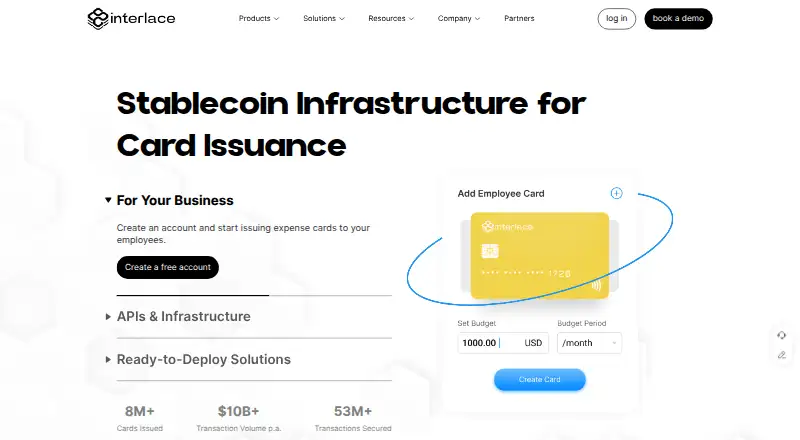
What Interlace is
Interlace provides stablecoin infrastructure for businesses using card issuing, accounts, payments, crypto services, and treasury tools. Its card service offers branded physical and virtual cards with stablecoin settlement, availability in 180+ countries, and controls to set limits, freeze, or cancel cards from an app. Cards can be provisioned to Apple Pay or Google Pay. Interlace Business Accounts support global payments in over 40 currencies and are described as available in over 180 countries or regions, with no minimum balance or deposit requirement. CryptoConnect supports on- and off-ramping, payments, and spending with BTC, ETH, USDC, and USDT. Yield Treasury advertises over 5% on USDC and USDT, with daily yield settlement, no lockup periods, and a $100 starting amount; it says it charges no deposit, redemption, fund transfer, or return fees. APIs are available for embedding cards, accounts, and stablecoin rails in business applications. Pricing is on request. Interlace says it was founded in 2019 and lists PCI DSS Level 1, US and Canadian MSB registrations, and Hong Kong TCSP licensing.
Good
- Offers branded physical and virtual cards.
- Cards include in-app limits, freeze, and cancellation controls.
- Business Accounts support payments in over 40 currencies.
- Yield Treasury has no lockup periods.
- APIs embed cards, accounts, and stablecoin rails.
Watch out
- Pricing is available on request.
- Production API access requires internal approval.
- Production API use requires IP whitelisting.
Who it suits
Interlace identifies crypto exchanges and wallets, fintechs, neobanks, marketplaces, creator businesses, and AI agents as target users. It suits businesses looking to integrate cards, accounts, or stablecoin services through APIs.
Verdict
Interlace combines card issuing, business accounts, crypto services, treasury, and APIs for business use. Pricing is on request, and production API access has an internal approval requirement.
The facts
Each one read from Interlace's own pages, with the date it was checked.
What it does
- Accounts
- Interlace Business Accounts support global payments in over 40 currencies and are described as available in over 180 countries or regions.checked 7 Oct 2026
- API
- Interlace documents APIs for card issuing, banking accounts, crypto infrastructure, payment acquiring, and embedded financial services.checked 7 Oct 2026
- API access
- Production API access requires internal approval, and the guide says IP whitelisting is required in production.checked 7 Oct 2026
- Business accounts
- Interlace Business Accounts support global payments, more than 40 currencies, and availability in over 180 countries and regions; the page says there is no minimum balance or deposit requirement.checked 7 Oct 2026
- Card API features
- The card API offering includes white-label card design, 30+ global BIN options, KYC/KYB and AML monitoring, and digital wallet support.checked 7 Oct 2026
- Card controls
- Cards can be provisioned to Apple Pay or Google Pay, with controls to set limits, freeze, or cancel them from an app.checked 7 Oct 2026
- Card coverage
- Infinity Card says it covers 180+ countries and regions and supports 40+ major currencies.checked 7 Oct 2026
- Cards
- Infinity Card supports corporate expense management, crypto spending, and online and offline payments where Visa and Mastercard are accepted.checked 7 Oct 2026
- Crypto
- CryptoConnect supports on- and off-ramping, payments, spending, and the listed assets BTC, ETH, USDC, and USDT.checked 7 Oct 2026
- Crypto services
- CryptoConnect supports on- and off-ramping, payments, and spending, and lists BTC, ETH, USDC, and USDT as supported assets.checked 7 Oct 2026
- Customers
- Interlace says it serves institutional clients such as wallets, exchanges, and brokers, as well as businesses in cross-border e-commerce, B2B trade, advertising, gaming, and Web3.checked 7 Oct 2026
- Integrations
- Yield Treasury is described as integrated with Interlace Business Accounts and Infinity Cards.checked 7 Oct 2026
- Intended users
- The site identifies crypto exchanges and wallets, fintechs and neobanks, marketplaces, creator businesses, and AI agents as target users.checked 7 Oct 2026
- Licenses
- The site identifies Interlace as a US and Canadian MSB and a Hong Kong TCSP.checked 7 Oct 2026
- Product
- Interlace provides stablecoin infrastructure for card issuing, accounts, payments, and treasury services.checked 7 Oct 2026
- Security
- Interlace says it is PCI DSS Level 1 certified and uses RSA 3072 encryption, AML/KYC, and fraud monitoring for its card infrastructure.checked 7 Oct 2026
- Support
- The support center lists [email protected] and Telegram as customer service contact options.checked 7 Oct 2026
- Treasury
- Yield Treasury advertises over 5% on USDC and USDT, with daily yield settlement and no lockup periods.checked 7 Oct 2026
- Treasury minimum and fees
- Yield Treasury starts at $100 and says it charges no deposit, redemption, fund transfer, or return fees.checked 7 Oct 2026
- Wallet support
- Infinity Card lists PayPal, Apple Pay, Google Pay, and Alipay support.checked 7 Oct 2026
- What it does
- Interlace provides stablecoin infrastructure for cross-border payments, including card issuing, business accounts, treasury, and crypto services.checked 7 Oct 2026
The company
- Company
- Interlace says it was founded in 2019; the opened company page does not state its headquarters.checked 7 Oct 2026
- Founded
- 2019checked 28 Sep 2026
The full review of Interlace
Interlace is stablecoin infrastructure for companies that need cards, accounts, crypto movement, treasury, and APIs in one program. It is aimed at fintechs, exchanges, marketplaces, and other cross-border businesses rather than individual users. The trade-off is a broad, institution-oriented platform with custom pricing and controlled production access.
Overview
Founded in 2019, Interlace combines payment infrastructure for institutional customers such as wallets, exchanges, brokers, cross-border merchants, B2B traders, advertisers, gaming companies, and Web3 businesses. Its scope is a strength when one provider must cover several financial products, but it is more infrastructure than an out-of-the-box app for a small team.
Interlace identifies itself as a US and Canadian money services business and a Hong Kong TCSP licensee, and lists PCI DSS Level 1. Those credentials are relevant when evaluating a payments partner, while each customer still needs to handle its own program and regulatory obligations.
Key features
Cards and spending controls
Branded physical and virtual cards can be issued across more than 180 countries and regions, with Infinity Card supporting over 40 major currencies. Cards can be added to Apple Pay or Google Pay; administrators can set spending limits, freeze cards, or cancel them from an app. That combination fits businesses running distributed or customer-facing card programs. The card API adds white-label design, more than 30 global BIN options, digital-wallet support, and KYC/KYB and AML monitoring tools, making it suitable for multi-program issuers rather than a one-off corporate card.
Accounts and crypto
Interlace Business Accounts handle global payments in more than 40 currencies across over 180 countries and regions, with no minimum balance or deposit requirement. CryptoConnect supports on- and off-ramping, payments, and spending in BTC, ETH, USDC, and USDT. Together, these services give a business a route between fiat operations and supported digital assets without assembling separate account and crypto products.
Treasury and APIs
Yield Treasury advertises more than 5% on USDC and USDT, settles yield daily, and has no lockup period. The minimum is $100, with no deposit, redemption, fund-transfer, or return fees stated. It integrates with Business Accounts and Infinity Cards, so balances can sit alongside operating payment tools. APIs expose cards, accounts, and stablecoin rails for embedding in another application. Production access requires internal approval, and production use requires IP whitelisting, which adds governance but slows immediate deployment.
Pricing
Interlace uses custom pricing on request. There is no published self-service tier, seat allowance, trial period, or free-plan cap to compare. That model is appropriate for institutions negotiating a tailored card, account, or API program, but makes budgeting harder for smaller buyers. Yield Treasury’s $100 starting balance and stated zero-fee categories are the clearest terms; they do not establish the total cost of an overall Interlace deployment.
Platforms
Interlace is offered through web and API access. This is a fit for operational teams and developers embedding the services into a product, not a standalone mobile-first finance app.
Who it's for
The strongest fit is crypto exchanges and wallets, fintechs and neobanks, marketplaces, creator businesses, AI agents, and companies handling cross-border commerce or B2B payments. It also suits teams launching branded, multi-program cards with compliance tooling. Buyers wanting transparent pricing, instant production credentials, or only a simple card expense tool should look elsewhere.
Pros and cons
Pros
- Broad stablecoin stack: cards, accounts, crypto conversion, treasury, and APIs can be combined under one provider.
- Wide reach: card and account services cover more than 180 countries or regions, with support for major currencies.
- Program controls: physical and virtual cards, wallet provisioning, limits, freeze and cancellation controls, and KYC/KYB tooling support managed issuance.
- Flexible treasury terms: Yield Treasury starts at $100, settles daily, and states no lockup or listed transaction fees.
Cons
- Custom pricing: prospective customers cannot compare a published plan or estimate costs without contacting Interlace.
- Gated production API: internal approval and IP whitelisting create an onboarding step for developers.
- Institutional complexity: its breadth and compliance requirements may be excessive for a single-purpose or small-business use case.
Alternatives
For a card-issuing directory, see Card Issuing Platforms. Extend is the better choice when a freemium product, mobile apps, and a defined free Starter plan with up to five users and 100 virtual cards monthly are priorities. Choose Paynetics Card Issuing for customizable Visa or Mastercard physical and virtual-card programs. Visa DPS Forward offers a free sandbox when development access matters before production fees are negotiated. Conferma Pay is an alternative for buyers who prefer a demo-led evaluation. Wallester White Label suits organizations that want published monthly white-label pricing, including €2,495 for non-financial institutions or €3,995 for financial institutions. Marqeta is another paid API and web platform with enterprise sales engagement. Mastercard Decision Intelligence is focused on decision intelligence rather than an all-in-one stablecoin stack. Thredd is an alternative paid API and web card-issuing platform.
Verdict
Choose Interlace if your organization needs stablecoin settlement alongside branded cards, global accounts, crypto rails, and treasury, and can work through enterprise onboarding. Its main advantage is the breadth of infrastructure in one relationship. Look elsewhere if transparent pricing, a free starting tier, or immediate production API access matters more than combining those capabilities.
Alternatives to Interlace
- 1

Extend
Free planAndroidiOSWebAPI7.9Free plan - 2

Paynetics Card Issuing
AndroidiOSWebAPI6.5 - 3

Wallester White Label
AndroidiOSWebAPI6.5From €2,495 a month - 4
Visa DPS Forward
Free planAPI6.4Free plan - 5

Conferma Pay
AndroidiOSWebAPI6.3 - 66.1