IndexTTS
IndexTTS is an open-source text-to-speech system that can create speech using a single reference audio clip to clone a voice.
What IndexTTS is
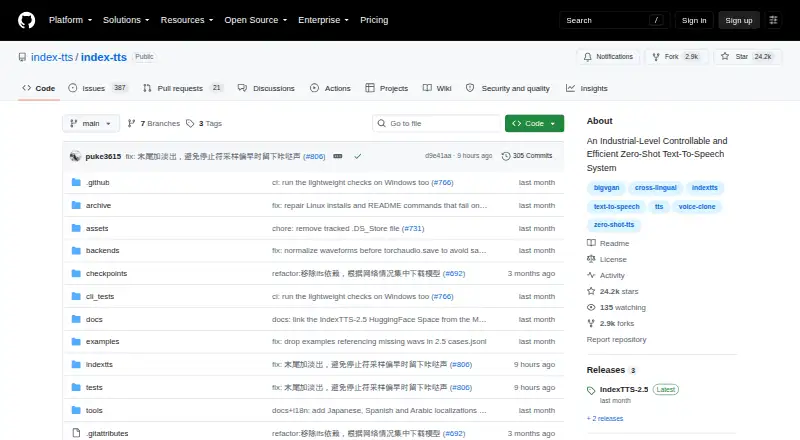
IndexTTS is an open-source text-to-speech system that can create speech using a single reference audio clip to clone a voice. IndexTTS-2.5 supports Chinese, English, Japanese, Spanish, and Arabic, with WAV export. Users can guide emotion through an emotional reference recording, an emotion vector, or text input, and adjust speaking speed with duration_factor values from 0.5 to 2.0, where 1.0 is normal. Pronunciation controls include Chinese Pinyin, English CMU phonemes, and Japanese Kana; for IndexTTS-2, Pinyin control is limited to supported cases in the project’s vocabulary file. The repository provides a browser WebUI, a Python API, and a vLLM recipe for production serving. Setup instructions cover Windows and Linux, with model downloads through Hugging Face or ModelScope. They call for Git and uv, and recommend CUDA Toolkit 12.8 or newer for CUDA installation errors. DeepSpeed is optional, and its impact depends on hardware, drivers, and operating system. The project uses the bilibili Model Use License Agreement and directs commercial users to contact its team. The maintainers identify the GitHub repository as their only official channel.
Good
- Clones a voice from one reference audio clip.
- Supports five listed languages.
- Offers emotion and speaking-speed controls.
- Provides a WebUI and Python API.
- Free, open-source downloadable model and inference code.
Watch out
- Commercial users are directed to contact the project.
- Pinyin control is limited to listed supported cases.
- Windows DeepSpeed installation may be difficult.
Who it suits
IndexTTS suits users who want to generate speech from a voice reference and control emotion, speed, or pronunciation. It offers both a browser interface and a Python API for inference.
Verdict
IndexTTS combines voice cloning with language, emotion, speed, and pronunciation controls, and can be used through a WebUI or API. Review its license and setup requirements before choosing it, especially for commercial use.
Plans and prices
From IndexTTS's own pricing page, checked 9 Oct 2026.
| Plan | Price | What it gives you |
|---|---|---|
| IndexTTS | Free | No hosted plan or price listed; downloadable model and inference code |
The facts
Each one read from IndexTTS's own pages, with the date it was checked.
What it does
- Acceleration
- Optional DeepSpeed support may speed up inference on some systems, but the repository says results depend on hardware, drivers, and operating system.checked 9 Oct 2026
- API access
- Yeschecked 20 Sep 2026
- Commercial use
- For commercial usage and cooperation, the project directs users to contact [email protected].checked 9 Oct 2026
- Deployment
- The project documents a local WebUI, a Python API, and production serving through a vLLM recipe.checked 9 Oct 2026
- Emotion control
- Speech emotion can be controlled with an emotional reference recording, an emotion vector, or text.checked 9 Oct 2026
- Export formats
- WAVchecked 20 Sep 2026
- Hardware
- The README recommends NVIDIA CUDA Toolkit 12.8 or newer on Linux or Windows when a CUDA installation error occurs.checked 9 Oct 2026
- Interfaces
- The repository provides a browser-based WebUI and a Python API for inference.checked 9 Oct 2026
- Languages
- IndexTTS-2.5 supports Chinese, English, Japanese, Spanish, and Arabic.checked 9 Oct 2026
- License
- The project says it is released under the bilibili Model Use License Agreement and asks users to read its disclaimer before use.checked 9 Oct 2026
- Model downloads
- The README provides model download instructions using Hugging Face or ModelScope.checked 9 Oct 2026
- Notable pronunciation limit
- For IndexTTS-2, Pinyin control works only for supported Chinese Pinyin cases listed in the project's vocabulary file.checked 9 Oct 2026
- Official channel
- The maintainers identify the GitHub repository as the only official channel maintained by the core team and say other sites or services are not official.checked 9 Oct 2026
- Official channel and security
- The maintainers say the GitHub repository is their only official channel and that they cannot guarantee the security, accuracy, or timeliness of other websites or services.checked 9 Oct 2026
- Product
- IndexTTS is a zero-shot text-to-speech system that clones a voice from a single reference audio clip.checked 9 Oct 2026
- Pronunciation
- IndexTTS-2.5 supports pronunciation control using Chinese Pinyin, English CMU phonemes, and Japanese Kana.checked 9 Oct 2026
- Purpose
- IndexTTS is a zero-shot text-to-speech system that clones a voice from a single reference audio clip.checked 9 Oct 2026
- Requirements
- The setup instructions call for Git, uv, and, for Linux or Windows CUDA installations, CUDA Toolkit 12.8 or newer.checked 9 Oct 2026
- Speaking speed
- IndexTTS-2.5 supports duration_factor values from 0.5 to 2.0, with 1.0 as normal speed.checked 9 Oct 2026
- Speed control
- IndexTTS-2.5 supports speaking speed adjustment through duration_factor from 0.5 to 2.0.checked 9 Oct 2026
- Support
- The README lists QQ groups, a Discord server, and [email protected] as community contact options.checked 9 Oct 2026
- Voice and emotion controls
- The project describes fine-grained emotion control using emotional reference audio, emotion vectors, or text-based emotion input.checked 9 Oct 2026
Where it runs
- Installation platforms
- The README gives installation guidance for Windows and Linux and notes that DeepSpeed may be difficult to install on Windows.checked 9 Oct 2026
- Platforms
- web,windows,linux,api,self_hostedchecked 20 Sep 2026
The full review of IndexTTS
IndexTTS is a zero-shot speech generator that reproduces a voice from one reference recording. It is best suited to developers and technically confident creators who want to run inference themselves and tune how speech is delivered.
Overview
IndexTTS converts text into WAV speech while preserving the character of a supplied voice clip. IndexTTS-2.5 supports Chinese, English, Japanese, Spanish, and Arabic, giving multilingual projects a useful starting range. Because the system is downloadable and self-hosted, you can keep inference in your own environment rather than depend on a hosted usage meter.
The project is open source and free to download, but it is not a managed online service with a published hosted subscription. Commercial use and cooperation are directed to bilibili at [email protected]. The bilibili Model Use License Agreement and its disclaimer therefore matter as much as the technical capability when this is considered for client work or a product.
Key features
Voice cloning and expression
A single reference audio clip supplies the voice identity, which makes prototyping less demanding than workflows that require a large speaker dataset. Emotion can be steered with an emotional reference recording, an emotion vector, or text-based emotion input. That range is valuable for narration, dialogue, and localized content where the same voice must convey different moods, although achieving a consistent performance still depends on the quality of the references and the chosen controls.
Speed and pronunciation
IndexTTS-2.5 exposes a duration_factor from 0.5 to 2.0, with 1.0 representing normal speed. This is a practical way to tighten a voice-over, slow instructional speech, or match timing without changing the selected voice. Pronunciation can be specified with Chinese Pinyin, English CMU phonemes, and Japanese Kana, giving technical users more control than ordinary text input. For IndexTTS-2, Pinyin control applies only to supported cases in the project's vocabulary file, so it should not be treated as unrestricted phonetic coverage.
Interfaces and serving
The repository offers a browser-based WebUI and a Python API for inference. A vLLM recipe is documented for production serving, which gives teams a path from experimentation to an API-backed deployment. Optional DeepSpeed support may accelerate inference, but the project notes that results depend on hardware, drivers, and operating system rather than promising a uniform gain.
Pricing
| Plan | Price | What you get |
|---|---|---|
| IndexTTS | free | Downloadable model and inference code; no hosted plan or published usage price |
There are no seat charges, monthly quotas, trial periods, or renewal terms attached to the free download. The saving is meaningful for teams able to supply their own compute and maintenance. It does not include a managed endpoint, guaranteed capacity, or a commercial-use permission beyond the project's license terms, so organizations seeking those assurances should contact bilibili before committing.
Platforms
IndexTTS supports API, Linux, self-hosted, web, and Windows use. Installation guidance covers Windows and Linux and calls for Git and uv. For CUDA installation problems, the project recommends NVIDIA CUDA Toolkit 12.8 or newer on either operating system. DeepSpeed can be difficult to install on Windows, making Linux the more predictable choice for users who want that optional acceleration. Model downloads are documented through Hugging Face or ModelScope.
Who it's for
Choose IndexTTS if you are building a self-hosted application, need voice cloning without a recurring hosted bill, or require explicit emotion, speed, and phoneme controls. It also fits teams comfortable with Python, model downloads, GPU drivers, and serving infrastructure. It is a weaker match for nontechnical creators who want an immediately available studio, for buyers needing a vendor-managed SLA, or for commercial projects that cannot accommodate a license review and direct rights discussion.
Pros and cons
Pros
- Single-clip cloning: a reference recording is enough to establish a voice for zero-shot generation.
- Detailed delivery controls: emotion inputs, a 0.5–2.0 speed range, and language-specific phoneme controls support precise narration work.
- Flexible deployment: WebUI, Python API, and a vLLM serving recipe cover experimentation and self-hosted integration.
- No software charge: downloadable models and inference code cost nothing.
Cons
- Setup is technical: Git, uv, model downloads, and CUDA troubleshooting place the operational burden on the user.
- Windows acceleration friction: DeepSpeed may be difficult to install on Windows.
- Pronunciation boundaries: IndexTTS-2 Pinyin control is limited to entries supported by the project vocabulary.
- Commercial uncertainty: the bilibili Model Use License Agreement and a required commercial contact make this less turnkey than a standard paid service.
Alternatives
For a broader directory of comparable tools, see Voice Cloning Software and Text-to-Speech Software.
- Resemble AI is the better choice when you want a paid hosted platform with Android, iOS, desktop, API, and self-hosted access, plus a free trial and a pay-as-you-go Flex option.
- Fish Audio suits users who prefer a freemium service with 8,000 monthly credits and browser or API access rather than managing models locally.
- Voicebox is an alternative free, self-hosted project maintained as a spare-time side project.
- VoiceStudio is another free option spanning API, web, desktop, and self-hosted platforms.
- VoxCPM is worth considering if you want free open-source models with no stated paid tiers or usage limits.
- Fish Speech offers a free tier with monthly credits and generation caps for users who prefer a quota-based service.
- Kits AI is a better fit for web-based vocal conversion with a freemium plan and paid upgrade path.
- Qwen3-TTS is an alternative if Apache-2.0 licensing and open-source models supporting 10 languages are the priority.
Verdict
IndexTTS is a strong pick for developers and creators who value local voice cloning and unusually granular control over emotion, pace, and pronunciation. Its free, self-hosted delivery avoids service quotas, but the installation workload, hardware considerations, and bilibili license process are decisive reasons to choose a hosted alternative when convenience or commercial certainty matters more.
Alternatives to IndexTTS
- 1

Voicebox
Free planOpen sourceAndroidiOSWebAPI9.3From $12 a year - 2

Speechify
Free planAndroidiOSWebAPI9.0From $10 a month - 3

Resemble AI
Free planAndroidiOSWebAPI9.0From $280 a month - 4
iSpeech
Free planOpen sourceAndroidiOSWebAPI9.0Free plan - 5

Fliki
Free planAndroidiOSWebAPI8.8From $28 a month - 6
Voice.ai
Free planAndroidiOSWebAPI8.8From $5 a month