Qwen3-TTS
C
C tier on Text-to-Speech SoftwareScore 5.9 · #151 of 215
- Android app
- Not listed
- Free plan
- Yes
- Runs on
- api, Linux, self-hosted, Web
Summary
Qwen3-TTS is ranked #151 of 215 in text-to-speech software on Everything Xiaomi. It runs on API, Linux, Self-hosted, Web. There is a free plan.
Qwen3-TTS plans and pricing
All plansQwen3-TTS open-source models Free The project is released under the Apache-2.0 license; no price is stated. 0.6B and 1.7B models · 10 languages github.com · 7 Oct 2026
Compared on text-to-speech software
- Commercial use
- Yesgithub.com
- Voice cloning
- Yesgithub.com
- API access
- Yesgithub.com
- Languages
- 10 languagesgithub.com
- Export formats
- WAVgithub.com
- Platforms
- Web, API, self_hostedgithub.com
Facts
- Product
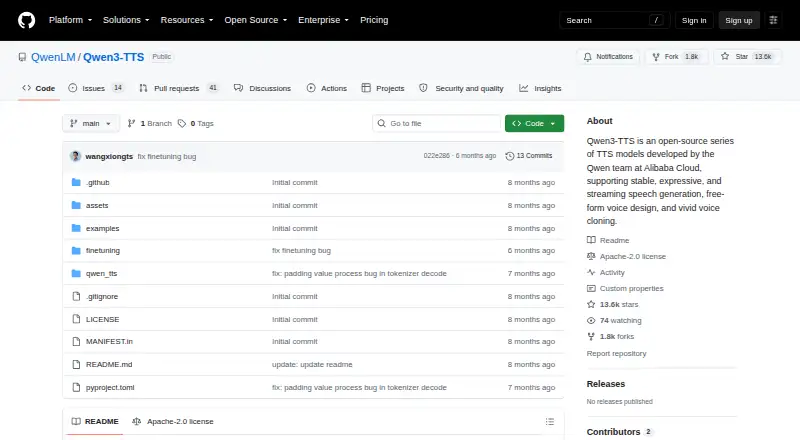
- Qwen3-TTS is an open-source series of text-to-speech models developed by the Qwen team at Alibaba Cloud.github.com · 7 Oct 2026
- Generation modes
- The models support streaming and non-streaming speech generation, voice design, voice cloning, and natural-language voice control.github.com · 7 Oct 2026
- Latency
- The README says the streaming architecture can produce the first audio packet after one character and reports end-to-end synthesis latency as low as 97 ms.github.com · 7 Oct 2026
- Model sizes
- Released models include 0.6B and 1.7B parameter variants for custom voice or base tasks, plus a 1.7B voice design model.github.com · 7 Oct 2026
- Local installation
- The project provides a Python package install and says it recommends a fresh Python 3.12 environment.github.com · 7 Oct 2026
- Local web interface
- A local Gradio web UI demo can be launched with the qwen-tts-demo command.github.com · 7 Oct 2026
- Model hosting
- The README links model downloads on Hugging Face and ModelScope and documents loading weights locally or by model ID.github.com · 7 Oct 2026
- API integration
- The project links Alibaba Cloud DashScope real-time APIs for custom voice, voice cloning, and voice design.github.com · 7 Oct 2026
- Inference integration
- The README states that vLLM-Omni supports offline Qwen3-TTS inference and that online serving is planned for later support.github.com · 7 Oct 2026
- License
- The GitHub repository lists the Apache-2.0 license.github.com · 7 Oct 2026
- API requirements
- The linked Alibaba Cloud real-time synthesis guide says API use requires configuring an API key and installing the latest DashScope SDK when using that SDK.help.aliyun.com · 7 Oct 2026
- What it does
- Qwen3-TTS is an open-source series of text-to-speech models for speech generation, voice design, and voice cloning.github.com · 7 Oct 2026
- Voice options
- The released models support custom voices, voice design from natural-language descriptions, and voice cloning from reference audio.github.com · 7 Oct 2026
- Streaming
- The README says the models support streaming and non-streaming generation and reports end-to-end synthesis latency as low as 97 ms.github.com · 7 Oct 2026
- Voice cloning input
- Voice cloning uses reference audio and its transcript; the README says using only the speaker embedding without a transcript may reduce cloning quality.github.com · 7 Oct 2026
- Download and install
- Models can be downloaded through Hugging Face or ModelScope, and the project provides a `qwen-tts` Python package installable from PyPI.github.com · 7 Oct 2026
- Hardware and setup
- The README demonstrates model loading on CUDA and recommends FlashAttention 2 to reduce GPU memory use, subject to compatible hardware.github.com · 7 Oct 2026
- Web demo
- The project includes a local web UI demo launched with `qwen-tts-demo`.github.com · 7 Oct 2026
- Serving limitation
- The README says vLLM-Omni supports offline inference currently, with online serving planned for later.github.com · 7 Oct 2026
- API pricing
- Alibaba Cloud lists international Qwen3-TTS API rates of $0.115 per 10,000 input characters for Voice Design and Voice Cloning, with output free; the page also lists a 110,000-character free quota for each.alibabacloud.com · 7 Oct 2026
Best Qwen3-TTS alternatives
See all 20





Where it ranks on Everything Xiaomi
- Best Text-to-Speech Software in 2026#151 of 215
- Best Voice Cloning Software in 2026#19 of 24
Is Qwen3-TTS yours?
Claim it for free: prove the domain, then correct facts, plans and screenshots. An editor reviews every change.
Sources
- github.com/QwenLM/Qwen3-TTS· checked 7 Oct 2026
- help.aliyun.com/zh/model-studio/realtime-tts-user-guide· checked 7 Oct 2026
- alibabacloud.com/help/en/model-studio/model-pricing· checked 7 Oct 2026