Fish Speech
Fish Speech is an open source text-to-speech system for generating expressive speech in multiple languages.
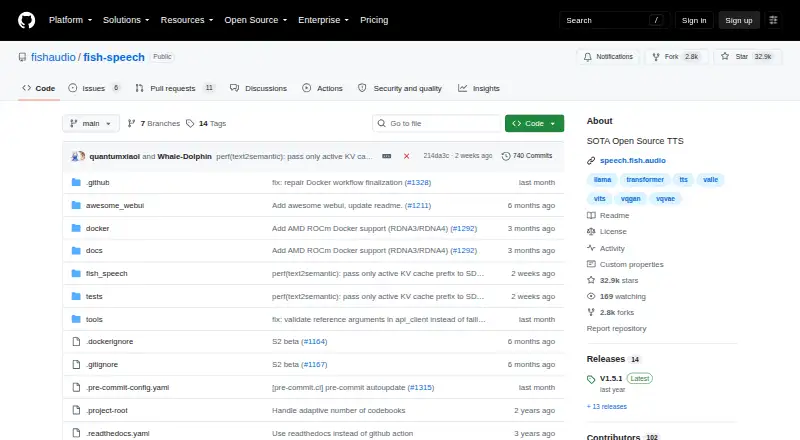
What Fish Speech is
Fish Speech is an open source text-to-speech system for generating expressive speech in multiple languages. Its S2 model accepts natural-language tags to shape emotion and prosody, and can clone a voice from a short reference sample, typically 10–30 seconds, without additional fine-tuning. It can also use multiple reference speakers and speaker ID tokens to generate dialogue in one session. The repository describes S2 Pro as supporting more than 80 languages without phonemes or language-specific preprocessing. Installation options include command-line use, a WebUI, a server, and Docker; the guide documents both CPU installation and GPU deployment. For inference, the guide lists Linux or WSL and 24 GB of GPU memory as requirements. Fish Speech provides API access. The Fish Audio Research License allows research and non-commercial use free of charge, while commercial use requires a separate written license. Plans include a free tier with 8,000 monthly credits and paid options beginning at $11 a month. Enterprise offerings list self-hosting and zero data retention; Fish Audio says its SOC 2 Type II audit is underway.
Good
- S2 supports more than 80 languages
- Voice cloning from short reference samples
- Multiple speakers can generate dialogue together
- Command-line, WebUI, server, and Docker options
- Free tier includes 8,000 monthly credits
Watch out
- Commercial use requires a separate written license
- Inference guide lists 24 GB GPU memory
- Linux or WSL listed as system requirements
Who it suits
Fish Speech suits developers and creators looking for multilingual speech generation who can meet its installation requirements. Its research license is for research and non-commercial use; commercial users need a separate written license.
Verdict
Fish Speech offers configurable speech generation and several deployment paths, including self-hosting. Check the hardware requirements and license terms before choosing it, especially for commercial use.
Plans and prices
From Fish Speech's own pricing page, checked 5 Oct 2026.
| Plan | Price | What it gives you |
|---|---|---|
| Free Tier | Free | 8,000 credits monthly · up to 7 minutes generation · up to 500 characters per generation · 3 public voice slots · standard generation speed |
| Plus | $11 a month | 250,000 credits monthly · up to 200 minutes · up to 15,000 characters per generation · priority generation · 1 professional voice slot · $132 billed annually |
| Pro | $75 a month | 2,000,000 credits monthly · up to 1,620 minutes · 3 team seats · up to 30,000 characters per generation · 5 professional voice slots · $900 billed annually |
| Max | $749 a month | 25,000,000 credits monthly · up to 6,250 minutes · 10 team seats · 15 professional voice slots · $8988 billed annually |
| Enterprise | Priced on request | Pay as you go · zero data retention · on-premise deployment · SOC2 compliance · custom SSO coming soon · volume pricing billed annually |
The facts
Each one read from Fish Speech's own pages, with the date it was checked.
What it does
- Commercial limits
- The model license does not grant commercial rights, which require a separate written license from Fish Audio.checked 5 Oct 2026
- Emotion and prosody control
- S2 supports fine-grained inline control of prosody and emotion through natural-language tags.checked 5 Oct 2026
- Hardware requirement
- The installation guide lists 24 GB of GPU memory for inference and Linux or WSL as system requirements.checked 5 Oct 2026
- Integrations
- The enterprise page lists support for real-time pipelines, WebRTC infrastructure, workflow automation, Vapi, Twilio, and Retell.checked 5 Oct 2026
- Languages
- The repository describes S2 Pro as supporting more than 80 languages without phonemes or language-specific preprocessing.checked 5 Oct 2026
- License
- The Fish Audio Research License permits research and non-commercial use free of charge, while commercial use requires a separate written license.checked 5 Oct 2026
- Multiple speakers
- S2 can use multi-speaker reference audio and speaker ID tokens to generate dialogue with multiple speakers in one generation.checked 5 Oct 2026
- Purpose
- Fish Speech is an open source multilingual text-to-speech system that generates expressive speech.checked 5 Oct 2026
- Security and compliance
- Fish Audio says its SOC 2 Type II audit is underway and offers zero data retention, HIPAA-aligned configurations, and self-hosted deployments for enterprise workloads.checked 5 Oct 2026
- Streaming
- The documentation describes SGLang serving optimizations including continuous batching, paged KV cache, CUDA graphs, and prefix caching.checked 5 Oct 2026
- Support
- Enterprise support includes 24/7 production support, a technical account manager, and a 99% uptime SLA.checked 5 Oct 2026
- Voice cloning
- S2 supports voice cloning from short reference samples, typically 10–30 seconds, without additional fine-tuning.checked 5 Oct 2026
- Ways to run
- The installation guide documents command-line, WebUI, server, and Docker setups, including CPU installation and GPU deployment.checked 5 Oct 2026
The full review of Fish Speech
Overview
Fish Speech is an open-source multilingual text-to-speech system for generating expressive speech, with both self-hosted and service-oriented ways to run it. It suits developers and teams who want control over voice generation and can meet its hardware and licensing requirements. Its strongest case is flexible speech generation; its clearest caveat is that the model license does not permit commercial use without a separate written license.
Key features
S2 combines broad language coverage with controls useful for more than straightforward narration. Its natural-language tags allow fine-grained adjustment of emotion and prosody, while the repository describes S2 Pro as supporting more than 80 languages without phonemes or language-specific preprocessing. That breadth is attractive for multilingual projects, though it does not remove the need to plan for the listed hardware requirements.
Voice cloning uses short reference samples, typically 10–30 seconds, without additional fine-tuning. S2 can also take multiple speaker references and speaker ID tokens to generate dialogue with multiple speakers in one pass. These capabilities make it a more flexible fit for character dialogue or voiced scenes than a simple single-voice workflow.
For serving, the documentation describes SGLang optimizations including continuous batching, paged KV cache, CUDA graphs, and prefix caching. These are relevant to teams building generation pipelines, rather than a reason on their own for an individual user to choose the system.
Pricing
The model is open source and free for research and non-commercial use under the Fish Audio Research License. Commercial use requires a separate written license from Fish Audio; the free model license does not grant those rights. The service plans below have listed prices, but those prices do not change the model license’s commercial-use restriction.
| Plan | Price and included limits |
|---|---|
| Free Tier | free; 8,000 credits monthly, up to 7 minutes of generation, 500 characters per generation, 3 public voice slots, and standard generation speed. |
| Plus | $11 a month, billed $132 billed annually; 250,000 credits monthly, up to 200 minutes, 15,000 characters per generation, priority generation, and 1 professional voice slot. |
| Pro | $75 a month, billed $900 billed annually; 2,000,000 credits monthly, up to 1,620 minutes, 3 team seats, 30,000 characters per generation, and 5 professional voice slots. |
| Max | $749 a month, billed $8988 billed annually; 25,000,000 credits monthly, up to 6,250 minutes, 10 team seats, and 15 professional voice slots. |
| Enterprise | Custom pricing; billed volume pricing billed annually. Includes pay-as-you-go, zero data retention, on-premise deployment, and SOC2 compliance; custom SSO is coming soon. |
The Free Tier is a bounded way to try generation, but its short monthly allowance, 500-character cap, and public-only voice slots constrain sustained or private work. Plus adds priority speed and one professional voice slot, making it a modest step up for an individual. Pro is the first listed tier with team seats; Max expands both seats and monthly capacity for larger workloads. Enterprise is the fit for organizations needing on-premise deployment or zero data retention, but it uses custom pricing.
Platforms
Fish Speech supports API, Linux, self-hosted, and web use. The installation guide documents command-line, WebUI, server, and Docker setups, including CPU installation and GPU deployment. However, its stated inference requirement is 24 GB of GPU memory, with Linux or WSL as system requirements. That makes local deployment a poor match for users without suitable GPU resources or a compatible system.
Enterprise support includes 24/7 production support, a technical account manager, and a 99% uptime SLA. Fish Audio says its SOC 2 Type II audit is underway and offers zero data retention, HIPAA-aligned configurations, and self-hosted deployments for enterprise workloads. Its enterprise integrations include real-time pipelines, WebRTC infrastructure, workflow automation, Vapi, Twilio, and Retell.
Who it's for
Fish Speech is best for developers, researchers, and production teams that need multilingual speech generation, voice cloning, or multi-speaker output and can manage the deployment. It is especially compelling when natural-language emotion controls and self-hosting matter. Casual users seeking a lightweight local install should look elsewhere if they cannot meet the 24 GB GPU-memory requirement; commercial users should secure written licensing before relying on it.
Pros and cons
- Pro: Fine-grained emotion and prosody tags provide expressive control beyond basic text-to-speech.
- Pro: Short-sample cloning and multi-speaker generation support varied voice and dialogue workflows without additional fine-tuning.
- Pro: Command-line, WebUI, server, and Docker options give technical users several deployment routes.
- Con: The 24 GB GPU-memory requirement and Linux or WSL requirement make self-hosting demanding for many personal devices.
- Con: Commercial use requires a separate written license, limiting what the free research and non-commercial license allows.
- Con: The free service tier caps monthly generation at 7 minutes and limits each generation to 500 characters.
Alternatives
For a broader directory of voice-cloning options, browse Voice Cloning Software; for game-focused voice generation choices, see Game Voice Generators.
- Fish Audio is the related freemium option, with web and desktop-platform support in addition to API, Linux, and self-hosting.
- Voicebox is another free-plan option spanning mobile, desktop, API, and self-hosted platforms.
- VoiceStudio is a free alternative with API, web, desktop, and self-hosted platform support.
- VoxCPM is a free alternative with no paid tiers or usage limits stated.
- Kits AI is a freemium alternative whose free plan includes 15 conversion minutes, but no voice slots or download minutes.
- Qwen3-TTS offers open-source models under Apache-2.0, including 0.6B and 1.7B models supporting 10 languages.
- Sprag is a paid API, self-hosted, and web option with stock-voice text-to-speech priced at $0.70 a month for Chorus.
- Chatterbox TTS offers free open-source models under the MIT license for research and development, across Linux, macOS, and self-hosted use.
Verdict
Choose Fish Speech if you need expressive, multilingual speech generation with cloning and multi-speaker controls, and have the technical capacity to deploy it. Its flexible workflows make it a strong option for developers and research teams; the hardware burden and separate commercial licensing make it a less straightforward choice for casual users or businesses seeking immediate commercial rights.
Alternatives to Fish Speech
- 1
Resemble AI
Free planAndroidiOSWebAPI8.3From $280 a month - 2

Speechify
Free planAndroidiOSWebAPI8.3From $10 a month - 3

Algebras AI Game Localization Agent
Free planOpen sourceWebAPILinuxmacOS8.1From $15 a month - 4
Neocortex
Free planAndroidiOSWebAPI8.0From €9 a month - 5

Altered Studio
Free planWebAPImacOSSelf-hosted7.9From $30 a month - 6

Acapela Group
AndroidiOSWebAPI7.8From €99 a year