Hi3D
Hi3D is an AI image-to-3D tool powered by Math Magic’s Sparc3D and Ultra3D models.
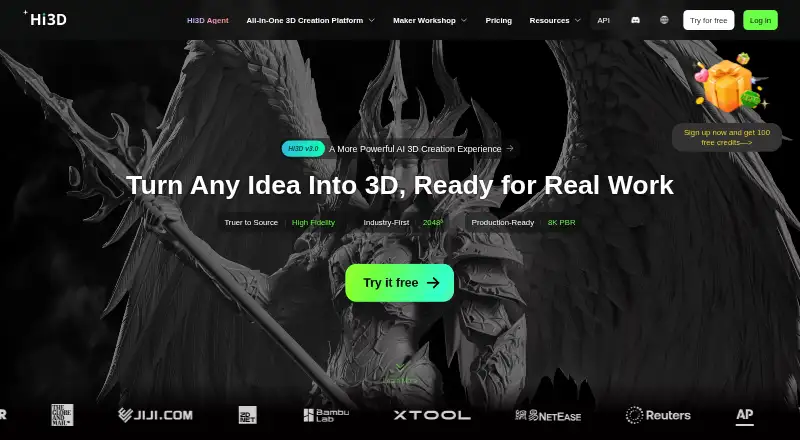
What Hi3D is
Hi3D is an AI image-to-3D tool powered by Math Magic’s Sparc3D and Ultra3D models. It generates 3D models from a single image or multiple views, and also lists text-to-3D, AI texturing, 3D relief generation, and character splitting into printable parts. Models can be exported in FBX, GLB, OBJ, STL, and USDZ formats, and sent directly to Bambu Studio and OrcaSlicer. Other listed integrations include Snapmaker, Creality Print, ElegooSlicer, ComfyUI, and Blender. An Open Platform API lets developers and enterprises add image-to-3D generation to their products; API operation costs vary by model and resolution, with one credit listed at $0.020. The Free plan includes 100 lifetime credits, up to 10 asset generations, one concurrent task, storage for seven models, and public models under CC BY 4.0. Paid plans include private and commercial use, and the listed pricing note says they start at $19.90/mo. Subscription credits reset monthly without rollover, but purchased Credit Pack credits do not expire. Hi3D Scan supports video capture or gallery uploads for model reconstruction.
Good
- Generates models from single or multiple images.
- Exports FBX, GLB, OBJ, STL, and USDZ.
- Free plan includes 100 lifetime credits.
- Paid plans include private and commercial use.
Watch out
- Free plan models are public under CC BY 4.0.
- Subscription credits reset monthly without rollover.
- Paid plan prices are not displayed in the listed details.
Who it suits
It may suit people making 3D assets for printing, game design, film and VFX, art, architecture, or fashion and jewelry. Developers and enterprises can also use its Open Platform API for image-to-3D generation.
Verdict
Hi3D combines image-to-3D generation with texturing, relief, and export tools. Its free tier has generation and storage limits, while paid plans add private and commercial use.
Plans and prices
From Hi3D's own pricing page, checked 3 Oct 2001.
| Plan | Price | What it gives you |
|---|---|---|
| Free | Free | 100 credits lifetime · up to 10 asset generations · 1 concurrent task · save up to 7 models · public models (CC BY 4.0) |
| Max | — | 2,400 credits/month · up to 240 asset generations/month · 20 concurrent tasks · save up to 400 models · private and commercial use · Monthly or annual billing options are shown; plan price not displayed in the opened page. |
| Pro | — | 1,000 credits/month · up to 100 asset generations/month · 10 concurrent tasks · save up to 200 models · private and commercial use · Monthly or annual billing options are shown; plan price not displayed in the opened page. |
| Ultra | — | 8,000 credits/month · up to 800 asset generations/month · 30 concurrent tasks · unlimited model storage · private and commercial use · Monthly or annual billing options are shown; plan price not displayed in the opened page. |
The facts
Each one read from Hi3D's own pages, with the date it was checked.
What it does
- Additional tools
- The site lists AI texturing, 3D relief generation, and one-click character splitting into printable parts.checked 3 Oct 2001
- API
- Hi3D offers an Open Platform API for developers and enterprises to integrate image-to-3D generation into their products.checked 3 Oct 2001
- API pricing
- The API pricing documentation lists one credit at $0.020 and prices individual generation operations by model and resolution.checked 3 Oct 2001
- Commercial licensing
- Paid plans include private and commercial use, while the Free plan lists public models under CC BY 4.0.checked 3 Oct 2001
- Image to 3D
- The platform converts images into 3D models and supports single-image and multi-view generation.checked 3 Oct 2001
- Intended users
- Hi3D presents use cases including 3D printing, game design, film and VFX, art and sculpture, architecture, and fashion and jewelry design.checked 3 Oct 2001
- Limits
- Subscription credits reset each month, do not roll over, and purchased Credit Pack credits do not expire.checked 3 Oct 2001
- Other integrations
- The pricing page lists Bambu Studio, OrcaSlicer, Snapmaker, Creality Print, ElegooSlicer, ComfyUI, and Blender under Integrations.checked 3 Oct 2001
- Output formats
- Generated models can be exported in FBX, GLB, OBJ, STL, and USDZ formats.checked 3 Oct 2001
- Printer integrations
- The site says models can be sent directly to Bambu Studio and OrcaSlicer.checked 3 Oct 2001
- Product
- Hi3D describes itself as an AI image-to-3D tool powered by Math Magic’s in-house Sparc3D and Ultra3D models.checked 3 Oct 2001
- Security
- Hi3D’s privacy policy says it uses access controls, encryption in transit and at rest where appropriate, and regular security assessments.checked 3 Oct 2001
- Support
- The pricing page provides [email protected] for subscription help and lists Discord, email support, and dedicated support among plan support options.checked 3 Oct 2001
Where it runs
- Mobile app
- Hi3D Scan is a mobile application for video capture or gallery upload and 3D model reconstruction.checked 3 Oct 2001
The full review of Hi3D
Hi3D suits creators who want to turn references or prompts into 3D assets and carry them toward printing or other production workflows. Its generation, texturing and export tools make it a flexible starting point, but the free plan’s small lifetime allowance and public-model license sharply limit its usefulness for ongoing work.
Overview
Hi3D is an AI 3D creation platform powered by Math Magic’s Sparc3D and Ultra3D models. It generates models from a single image or multiple views, and also supports text-to-3D. Rather than stopping at generation, it adds texturing, relief creation and character splitting for printing. That breadth is valuable when one service needs to cover several steps, though it does not remove the need to consider quotas, licensing and the rest of a production workflow.
Key features
- Image and text generation: Single-image and multi-view input accommodate different reference material, while text-to-3D gives users a route from a prompt when no image is available. The choice is useful for concept creation, but monthly generation allowances still constrain volume on paid plans.
- Model preparation: AI texturing and 3D relief generation extend Hi3D beyond basic conversion. One-click character splitting into printable parts is particularly relevant to 3D-printing projects; it matters less to users who only need a model for game, film or visual-design work.
- Export and printing connections: Models can be exported in FBX, GLB, OBJ, STL and USDZ, giving creators options for different downstream uses. Direct sending to Bambu Studio and OrcaSlicer, alongside integrations that include Snapmaker, Creality Print, ElegooSlicer, ComfyUI and Blender, makes Hi3D more practical for workflows that use those tools.
- Developer access: The Open Platform API lets developers and enterprises integrate image-to-3D generation into their products. API generation is priced by model and resolution; the documented rate is $0.020 per credit, so API users should account for operation-specific credit costs.
- Mobile capture: Hi3D Scan supports video capture or gallery upload for 3D model reconstruction. This gives mobile users a separate capture route alongside the platform’s image and prompt generation.
Pricing
Hi3D uses a freemium model, with paid plans starting at $19.90/mo. Free costs nothing and includes 100 lifetime credits, up to 10 asset generations, one concurrent task and storage for up to seven models. Models are public under CC BY 4.0. That makes Free suitable for limited exploration, not for private or commercial work, and its lifetime allowance is easy to exhaust.
Max, Pro and Ultra show monthly or annual billing options, but their prices are custom pricing. Max includes 2,400 credits/month, up to 240 generations/month, 20 concurrent tasks and storage for up to 400 models. Pro includes 1,000 credits/month, up to 100 generations/month, 10 concurrent tasks and storage for up to 200 models. Ultra includes 8,000 credits/month, up to 800 generations/month, 30 concurrent tasks and unlimited model storage. All three paid plans include private and commercial use.
Pro is the lower-volume paid option for users who need private or commercial use without Max’s larger quota. Max increases generation capacity and concurrency; Ultra is for heavier workloads or users who need unlimited storage. Subscription credits reset monthly and do not roll over, so unused allowance is lost. Purchased Credit Pack credits do not expire. Support options across the plans include Discord, email support and dedicated support; subscription help is available at [email protected].
Platforms
Hi3D supports Android, iOS, web and API access. Its combination of mobile apps and web access suits creators who want to work across devices, while the API is aimed at teams integrating generation into other products.
Who it's for
Hi3D is a sensible fit for 3D-printing creators who value model splitting and slicer connections, as well as people exploring game design, film and VFX, art and sculpture, architecture, or fashion and jewelry design. The wide export selection supports varied downstream workflows. It is a weaker fit for anyone who needs a generous free allowance, private use without a paid plan, or predictable API costs without evaluating each operation’s credit price.
Pros and cons
- Pro: Image, multi-view and text generation provide several starting points for creating an asset.
- Pro: Texturing, relief generation and printable-part splitting add practical preparation tools beyond model generation.
- Pro: Five export formats and connections to printing and 3D software support varied workflows.
- Con: Free use is capped at 100 lifetime credits and 10 generations, with only seven saved models and one concurrent task.
- Con: Free models are public under CC BY 4.0; private and commercial use require a paid plan.
- Con: Paid-plan prices are custom pricing, and subscription credits expire at each monthly reset.
Alternatives
For a broader comparison, see AI 3D Model Generators.
- Polar Cloud is a freemium option for printer workflows; its Free plan covers one printer, five print jobs per month, seven-day history and 300 MB of storage, but limits files to mesh formats and 30 MB.
- Meshy is another freemium option on Android, API, iOS and web, with a Free plan offering 100 credits and 10 monthly downloads for Meshy 6 Lite models.
- Stable Fast 3D is a paid option with a free Community License for research and non-commercial use, plus commercial use for organizations with annual revenue of $1,000,000 or less.
- Polycam may suit mobile capture workflows: it runs on Android, iOS and web, and its Free plan includes limited space, object and AI captures, GLTF exports and public link sharing.
- Unique3D offers a free online demo that requires a registration invitation code.
- Crisp3D is a web-based freemium alternative whose Free plan limits users to one concurrent task and public models, with a non-commercial license and no downloads.
- Sloyd is a web and API alternative with a Guest plan allowing one 3D generation per day.
- Hyper3D Rodin is another freemium alternative for web and API.
Verdict
Choose Hi3D if you want image- or prompt-led 3D generation with useful texturing, printing preparation and export options in one platform. Its clearest advantage is that workflow breadth; its main drawback is that the free tier is too limited and public for sustained private or commercial projects. Creators who need those rights should budget for a paid plan, while those seeking a different capture or printer-management focus should compare the alternatives.
Alternatives to Hi3D
- 1

Meshy
Free planAndroidiOSWebAPI8.3From $20 a month - 2

Tripo AI
Free planAndroidiOSWebAPI8.2From $4.58 a month - 3

Polar Cloud
Free planAndroidiOSWebAPI8.1From $6.58 a month - 4
Hunyuan3D
Free planWebAPILinuxmacOS7.5CN¥100, paid once - 5

Polycam
Free planAndroidiOSWeb7.5From $12.50 a month - 6

Hyper3D Rodin
Free planWebAPI6.9From $30 a month