
Tripo AI
Tripo AI is a web and API platform for generating and refining 3D assets.
What Tripo AI is
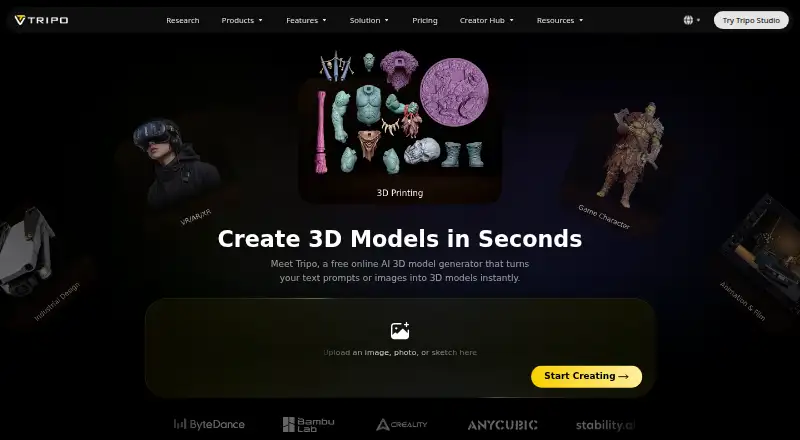
Tripo AI is a web and API platform for generating and refining 3D assets. It can turn text, images, sketches, or multiple views into 3D models, then apply AI texturing, segmentation, retopology, rigging, animation, and Smart UV unwrapping. Its High Detail Model feature produces models with up to 2 million polygons for rendering, visual effects, 3D printing, e-commerce visuals, and game production. Smart Mesh creates quad-based meshes from 500 to 25,000 quads, aimed at game, animation, and VR/AR/XR work. Exports include GLB, GLTF, FBX, OBJ, USDZ, STL, and 3MF. The DCC Bridge lists Blender, 3ds Max, Unity, Unreal, Maya, Cocos, Godot, and ZBrush. Developers can connect generation to their own products through an API using API-key authentication and a v3 base URL; most generation requests are asynchronous and require polling for results. The Free plan costs nothing, includes 200 monthly credits, and restricts use to non-commercial projects with public models. Tripo AI, founded in 2023 and headquartered in Sai Ying Pun, Hong Kong, states that it holds ISO/IEC 27001:2022 certification.
Good
- Generates 3D models from text, images, sketches, and multiple views
- High Detail Model supports up to 2 million polygons
- Smart Mesh creates 500–25,000-quad meshes
- Includes texturing, retopology, rigging, and animation tools
- Exports seven listed 3D file formats
- Provides API access and DCC Bridge integrations
Watch out
- Free plan is limited to non-commercial use
- Free-plan models are public
- Free plan allows 200 monthly credits and 15 exports
- Free plan stores 10 models and one concurrent task
Who it suits
Tripo AI suits creators who need generated 3D assets from text, images, sketches, or multiple views. It also fits developers and teams needing API access, DCC integrations, mesh optimization, or animation tools.
Verdict
Pick Tripo AI when you need a broad 3D generation workflow spanning creation, mesh preparation, texturing, and animation. Its API and listed DCC connections support product and production pipelines. Look elsewhere if free use must be commercial or models must remain private.
Plans and prices
From Tripo AI's own pricing page, checked 14 Oct 2026.
| Plan | Price | What it gives you |
|---|---|---|
| Pro | $20 a month | 3,000 monthly credits · ≈200 models · 10 concurrent tasks · private models · commercial use · batch generation · DCC Bridge · $240.00/year when billed annually |
| Max | $90 a month | 25,000 monthly credits · ≈1,660 models · 100 concurrent tasks · private models · commercial use · 8K textures · 3 free Pro Refine uses · $1,080.00/year when billed annually |
| Team | $55 a month | 90,000 monthly credits · ≈6,000 models · 200 concurrent tasks · shared workspace · centralized billing and administration · $1,980.00/year for a team seat when billed annually |
| Free | Free | 200 monthly credits · ≈13 models · 1 concurrent task · public models · non-commercial use · limited history, storage and exports · $0.00/Month |
| API pay-as-you-go | $0.01, paid once | credits consumed per generation, processing and export task · 300 introductory credits over two weeks · $1.00 buys 100 credits; volume and custom contracts require sales contact |
| Credits | $1,000, paid once | 100,000 + 30,000 credits |
The facts
Each one read from Tripo AI's own pages, with the date it was checked.
What it does
- AI texturing
- Tripo can generate textures and materials and provides later texture editing and customization.checked 14 Oct 2026
- API endpoint
- The documented API is available at https://api.tripo3d.ai/v2/openapi, with newer SDK examples using the V3 endpoint at https://openapi.tripo3d.ai/v3.checked 14 Oct 2026
- API operation
- API generation is asynchronous: a request returns a task identifier that is polled until completion, and requests use Bearer API-key authentication.checked 14 Oct 2026
- API workflow
- Most generation API tasks are asynchronous: clients create a task and poll for its result.checked 12 Oct 2026
- Asset privacy
- API models are private by default, and users can schedule deletion; public assets may remain after account deletion.checked 14 Oct 2026
- Data handling
- The privacy policy says submitted inputs and generated outputs may be reviewed as reasonably necessary to operate, secure, troubleshoot, and evaluate the service, separately from model training.checked 12 Oct 2026
- Developer API
- The Tripo API lets developers integrate 3D generation into their products and uses API-key authentication with a v3 base URL.checked 12 Oct 2026
- Documentation depth
- Developer documentation includes quick starts, authentication, task examples, pricing tables, plugin downloads and SDK code for five languages.checked 14 Oct 2026
- Editing tools
- The product supports AI texturing, model segmentation, retopology, rigging, animation, and Smart UV unwrapping.checked 12 Oct 2026
- High-detail model
- The high-detail workflow supports models up to about two million polygons for rendering, VFX, printing and similar uses.checked 14 Oct 2026
- High-detail models
- Its High Detail Model feature creates models with up to 2 million polygons for rendering, VFX, 3D printing, e-commerce visuals, and game workflows.checked 12 Oct 2026
- Image to 3D
- A single image or sketch can be converted into a 3D asset.checked 14 Oct 2026
- Integrations
- Official bridges and plugins cover Blender, 3ds Max, Unity, Unreal Engine, Maya, Godot, Cocos Creator, ZBrush, MetaTailor, Roblox and ComfyUI.checked 14 Oct 2026
- Legal seller name
- The Apple listing names HOLYMOLLY LIMITED as seller and shows copyright for Hangzhou Wa Si Ta Technology Co., Ltd.checked 14 Oct 2026
- Licence
- The hosted Tripo product is proprietary, while the related TripoSR model and official Python SDK repositories are released under the MIT licence.checked 14 Oct 2026
- Limit: editor issues
- Tripo's update log acknowledges rough segmentation edges, no Ctrl+Z, intermittent Magic Brush failures, unstable animation and Smart Low Poly problems on complex meshes.checked 14 Oct 2026
Where it runs
- Apple app availability
- The iOS app requires iOS 16 or later; the Mac version requires macOS 13 and an Apple M1 or newer, with listed in-app plans from $15.99 to $539.99.checked 14 Oct 2026
The company
- Company profile
- LinkedIn lists Tripo AI as privately held, founded in 2023, headquartered in San Francisco and employing 51–200 people.checked 14 Oct 2026
- Founded
- 2023checked 23 Sep 2026
- Headquarters
- Sai Ying Pun, Hong Kongchecked 23 Sep 2026
Money
- Free plan
- Yeschecked 20 Sep 2026
- Free plan restriction
- The Free plan is limited to non-commercial use and its models are public.checked 12 Oct 2026
- Free-user rights
- For free users, Tripo's terms give Tripo all rights to inputs and outputs, with no equivalent training restriction stated.checked 14 Oct 2026
- Limit: credits and billing
- Reviewers complain that unused monthly credits expire, cancellation or refunds can be difficult, and downloads or exports may require additional payment.checked 14 Oct 2026
The full review of Tripo AI
Tripo AI is a web and API platform that turns text, images, multi-view references, and sketches into 3D assets, then helps prepare those assets for production. It suits independent creators, game and immersive-media teams, and developers embedding generation in a product. The main trade-off is breadth versus control: the workflow is unusually broad, but the free tier is constrained for anything beyond personal exploration.
Overview
Tripo covers the path from initial idea to an exportable model. Text-to-3D, image-to-3D, multi-view-to-3D, and sketch-to-3D inputs let artists choose the reference that best represents the object. That makes it useful when a finished mesh is not available, but output still needs preparation before it belongs in a game, animation, visualization, or print workflow.
The company, founded in 2023 and headquartered in Sai Ying Pun, Hong Kong, offers both a browser product and an API. Its privacy policy says personal information is not used to train models, although anonymised information may support product and model improvement. Submitted inputs and generated outputs may be reviewed when reasonably necessary to run, secure, troubleshoot, and evaluate the service. The pricing page states ISO/IEC 27001:2022 information-security certification.
Key features
Editing tools include AI texturing, model segmentation, retopology, rigging, animation, and Smart UV unwrapping. That combination matters when generation is only the first stage: retopology and UV work address mesh preparation, while rigging and animation move an asset toward a usable character or scene element. It is a stronger proposition than a generator that stops at a static draft, though plan quotas still determine how many iterations a team can make.
High Detail Model supports up to 2 million polygons, targeting rendering, VFX, 3D printing, e-commerce visuals, and game work where surface detail matters. Smart Mesh takes a different approach, producing quad meshes from 500 to 25,000 quads for games, animation, and VR/AR/XR. The two modes give users a practical choice between dense detail and topology aimed at downstream editing.
Exports cover GLB, GLTF, FBX, OBJ, USDZ, STL, and 3MF. DCC Bridge names Blender, 3ds Max, Unity, Unreal, Maya, Cocos, Godot, and ZBrush, which is useful for teams already organised around those applications. The API uses API-key authentication and a v3 base URL. Most generation jobs are asynchronous: an integration creates a task and polls for its result, so developers must account for job-state handling rather than expect an immediate response.
Pricing
Tripo uses a freemium structure. Free costs nothing and provides 200 monthly credits, one concurrent task, 15 exports, and 10 stored models. It is suitable for learning and personal prototyping, but models are public and the plan is limited to non-commercial use, making it unsuitable for confidential client work or commercial release.
Pro has custom pricing and includes 3,000 monthly credits, 10 concurrent tasks, 30 batch generations, and seven-day edit history. It fits an individual or small production workload that needs parallel generation and short-term revision. Max, also custom pricing, raises the allowance to 25,000 credits, 100 concurrent tasks, 30 batch generations, and permanent edit history, better matching intensive solo or team pipelines. Team provides 90,000 monthly credits, 200 concurrent tasks, permanent edit history, and unlimited storage at custom pricing; it is the clearest fit for a shared production operation.
A separate Credits purchase costs 1000.00 USD once for 100,000 plus 30,000 credits. That option suits usage spikes without changing the recurring plan structure. Separate user-support and enterprise-support contacts are provided.
Platforms
Tripo runs on the web and through its API. The DCC Bridge lists Blender, 3ds Max, Unity, Unreal, Maya, Cocos, Godot, and ZBrush, so it can sit alongside established modeling, engine, and animation tools rather than requiring a standalone workflow.
Who it's for
Choose Tripo for broad 3D asset work: concept artists moving from references to meshes, game and XR teams needing topology and export options, or developers adding generation to their own software. It is less appropriate when assets must stay private on a free plan, when commercial rights are required without a paid arrangement, or when a project needs predictable capacity beyond its credit and concurrency limits.
Pros and cons
- Pros: Multiple generation inputs, substantial mesh and editing coverage, high-detail output up to 2 million polygons, quad-mesh options, broad export support, named DCC connections, and an asynchronous developer API.
- Cons: The Free plan is non-commercial, makes models public, limits exports to 15, and stores only 10 models; paid plan prices are custom; API users must build polling around asynchronous jobs.
Alternatives
Meshy is a fit when Android or iOS access matters, or when a 20.00 USD monthly Pro plan and 100 free monthly credits are preferable to Tripo's custom-priced tiers.
AnnoMotion suits readers wanting Windows support and a small GBP-priced credit entry, including 15 credits after email verification and eight free daily credits.
Asset Forge is the better choice for a paid, one-time starter purchase: its 19.00 USD Starter plan includes 4,000 credits, batch generation, transparent PNGs, and an AI feedback loop.
DeepMotion Animate 3D is an alternative for animation-focused work, with a freemium allowance of 25 credits per month and 20 seconds per clip.
Goblin3D offers a smaller free starting point—150 credits, public models, standard queue, and one concurrent generation.
PixelLab is the alternative for a broad multi-platform image-generation workflow rather than Tripo's dedicated 3D pipeline.
Spritefy is aimed at sprite-style asset creation, with 150 one-time credits and PNG exports on its free plan.
DreamForge Asset Studio is a web-based freemium option with published monthly tiers from 5,000 to 70,000 credits.
For wider comparisons, browse AI Game Asset Generators, AI 3D Model Generators, Game Character Creation Software, Game 3D Modeling Software, and 3D modeling software.
Verdict
Pick Tripo AI when one workflow must span 3D generation, mesh preparation, texturing, rigging, animation, exports, and API integration. Its breadth and DCC connections are the strongest reasons to choose it. Look elsewhere if commercial use and private models are essential at no cost, or if you need transparent paid pricing before committing.
Getting started
- Open https://www.tripo3d.ai/ in a web browser
- Choose text-to-3D, image-to-3D, sketch-to-3D, or multi-view generation
- Generate and refine the model with the available editing tools
- Export the result in a supported format such as GLB, FBX, OBJ, or STL
- For software integration, authenticate API requests with an API key and poll asynchronous tasks
Limits worth knowing
The Free plan provides 200 monthly credits, one concurrent task, 15 exports, and 10 stored models. It is restricted to non-commercial use, and its models are public.
Questions
Is Tripo AI free?
Yes. The Free plan costs nothing and includes 200 monthly credits.
Which platforms does Tripo AI support?
It is available on the web and through an API.
Can Tripo AI generate models from sketches?
Yes. Sketch-to-3D is listed alongside text-, image-, and multi-view-to-3D generation.
Which formats can I export?
Exports include GLB, GLTF, FBX, OBJ, USDZ, STL, and 3MF.
Can developers integrate Tripo AI?
Yes. The API uses API-key authentication and a v3 base URL; most generation tasks are asynchronous.
Alternatives to Tripo AI
- 1
Rhino 3D
Free planiOSAPILinuxmacOS8.9Free plan - 2

Meshy
Free planAndroidiOSWebAPI8.9From $20 a month - 3

Onshape
Free planAndroidiOSWeb8.7From $1,500 a year - 4

SketchUp
Free planiOSWebWindows8.6From $55 a year - 5

ZBrush
Free planiOSAPImacOSWindows8.6Free plan - 6

Blockbench
Free planOpen sourceAndroidiOSWebAPI8.6Free plan