Stable Fast 3D
Stable Fast 3D is Stability AI’s image-to-3D model.
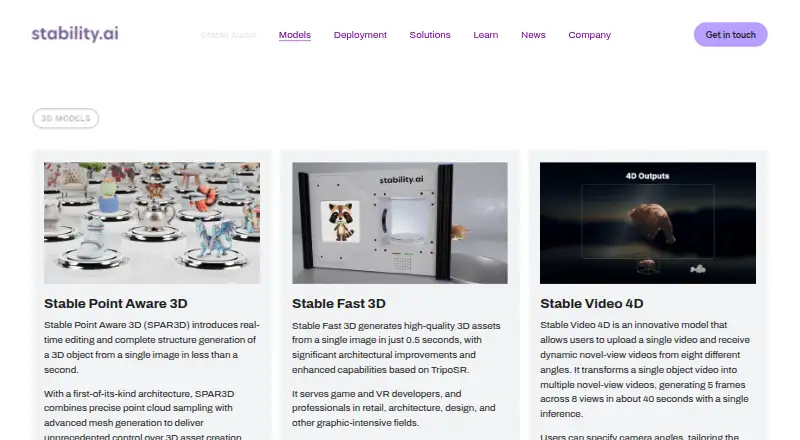
What Stable Fast 3D is
Stable Fast 3D is Stability AI’s image-to-3D model. It takes one image of an object and produces a textured, UV-unwrapped mesh, with the model page describing generation in under one second. The model performs a delighting step and predicts roughness and metallic material parameters for each object. It expects an input image of 512 × 512 pixels, and the official code example saves the reconstructed model as a GLB file. The repository includes custom nodes and an example workflow for ComfyUI, as well as API access. Documented inference options include CUDA, CPU, and experimental Mac MPS support; Windows support is marked experimental. Default settings use about 6 GB of VRAM for one image. Stability AI identifies game and VR developers and professionals in retail, architecture, design, and other graphics-intensive fields as intended users. Access to model files requires agreeing to share contact information and accepting the license. The Community License is free for research and non-commercial use, and permits commercial use for organizations or individuals with annual revenue of $1 million or less. Above that revenue, an Enterprise License is required before commercial use of the model or its derivatives.
Good
- Creates a textured mesh from one image
- Exports reconstructed models as GLB
- Includes ComfyUI nodes and workflow
- API access is available
- Free Community License under stated terms
Watch out
- Requires a 512 × 512 pixel input
- Default settings use about 6 GB of VRAM
- Windows support is experimental
- Revenue above $1 million requires Enterprise License for commercial use
Who it suits
It is aimed at game and VR developers and professionals in retail, architecture, design, and other graphics-intensive fields. The license terms and documented hardware requirements are important considerations for users planning to access or use the model.
Verdict
Stable Fast 3D turns a single object image into a textured 3D mesh and offers API and ComfyUI access. Check the access agreement, hardware needs, and commercial license threshold before using it.
Plans and prices
From Stable Fast 3D's own pricing page, checked 5 Oct 2001.
| Plan | Price | What it gives you |
|---|---|---|
| Community License | Free | Free for research, non-commercial and commercial use if annual revenue is $1,000,000 or less · commercial use above that revenue requires an Enterprise License |
| Stable Fast 3D API | — | 10 credits per generation · 1 credit = $0.01 |
The facts
Each one read from Stable Fast 3D's own pages, with the date it was checked.
What it does
- Access requirement
- The model repository requires users to agree to share contact information and accept the license agreement to access model files.checked 5 Oct 2001
- Generation speed
- The model page says it is trained to create a 3D model from one image in under one second.checked 5 Oct 2001
- Hardware
- The repository documents CUDA, experimental Mac MPS support, and CPU inference; Windows support is marked experimental.checked 5 Oct 2001
- Image-to-3D
- Stable Fast 3D takes one image of an object and generates a textured, UV-unwrapped 3D mesh asset.checked 5 Oct 2001
- Input requirement
- The model expects an input size of 512 × 512 pixels.checked 5 Oct 2001
- Integrations
- The repository provides custom nodes and an example workflow for ComfyUI.checked 5 Oct 2001
- Licensing limit
- Organizations or individuals with annual revenue above US $1 million must obtain an Enterprise License before commercial use of the model or its derivatives.checked 5 Oct 2001
- Materials and lighting
- The model performs a delighting step and predicts per-object roughness and metallic material parameters.checked 5 Oct 2001
- Output format
- The official code example saves the reconstructed 3D model as a GLB file.checked 5 Oct 2001
- Resource use
- The README says default settings use about 6 GB of VRAM for one image input.checked 5 Oct 2001
- Safety
- Stability AI recommends that developers test the model and add safeguards appropriate to their own use cases.checked 5 Oct 2001
- Support
- Stability AI directs users to submit a support request through its Knowledge Base.checked 5 Oct 2001
- Who it serves
- Stability AI describes the model as serving game and VR developers and professionals in retail, architecture, design, and other graphics-intensive fields.checked 5 Oct 2001
The company
- Company
- Stability AI identifies itself as the maker of Stable Fast 3D, and a company announcement describes it as headquartered in London.checked 5 Oct 2001
- Headquarters
- London, England, UKchecked 28 Sep 2001
The full review of Stable Fast 3D
Stable Fast 3D is a model for turning an object image into a 3D asset. It is best suited to developers and graphics professionals who need image-driven mesh generation and can work within its technical and licensing terms. Its defining advantage is speed; it is not a general-purpose text-to-3D or animation tool.
Overview
From a single object image, Stable Fast 3D generates a textured, UV-unwrapped mesh, with the model page stating a generation time of under one second. That makes it a focused option for workflows that need to move from a visual reference to a 3D asset quickly. The 512 × 512 input requirement and image-only approach narrow its usefulness when source images vary in size or the workflow starts with a text prompt.
The model applies delighting and predicts per-object roughness and metallic parameters, giving the output more material information than geometry alone. The documented output is GLB, so it fits best when that format works with the rest of the pipeline. There is no rigging or animation.
Key features
- Image-to-3D: One object image produces a textured, UV-unwrapped mesh. The narrow input method is useful for image-based asset creation, but excludes text-to-3D generation.
- Material prediction: Delighting and roughness and metallic predictions offer a material-aware starting point for graphics work; they do not make this a complete animation or modeling suite.
- ComfyUI workflow: Repository custom nodes and an example workflow connect Stable Fast 3D to ComfyUI, which may suit users already building workflows there.
- API: API access is available, with each generation costing 10 credits at $0.01 per credit. That gives developers a metered route to generation, though the cost per generation adds up with volume.
Pricing
The Community License costs nothing. It covers research and non-commercial use, as well as commercial use by individuals or organizations with annual revenue of $1,000,000 or less. Commercial use above that threshold requires an Enterprise License. This is the relevant route for eligible users who can run the model under those terms.
The Stable Fast 3D API has custom pricing: each generation uses 10 credits, and 1 credit = $0.01. Choose it when API access suits the workflow; account for the per-generation charge if usage is frequent. There is no free trial.
To access model files, users must agree to share contact information and accept the license agreement. Organizations and individuals above the revenue threshold should resolve Enterprise licensing before commercial use of the model or its derivatives.
Platforms
Stable Fast 3D is available through API, Linux, macOS, web, and Windows. The repository documents CUDA, experimental Mac MPS support, and CPU inference; Windows support is marked experimental. Default settings use about 6 GB of VRAM for one image input, making hardware a practical consideration for local use rather than a detail to leave until deployment.
Who it's for
Stability AI positions the model for game and VR developers, alongside professionals in retail, architecture, design, and other graphics-intensive fields. It is a good fit when a team needs fast, image-based mesh generation, can accept GLB output, and has an appropriate route to run or access the model. It is a weaker choice for anyone who needs text-based generation, rigging, or animation in the same tool.
Developers should test the model and add safeguards suited to their use case. Support requests go through Stability AI's Knowledge Base.
Pros and cons
- Pros: Under-one-second generation is useful for workflows that value rapid conversion from image to asset.
- Pros: Texturing, UV unwrapping, delighting, and material-parameter prediction provide a more complete starting asset than a bare mesh.
- Pros: API access and ComfyUI nodes offer options for integrating generation into a broader workflow.
- Cons: The 512 × 512 input and single-image approach limit flexibility, and there is no text-to-3D route.
- Cons: GLB is the documented output, with no rigging or animation for teams that need those capabilities.
- Cons: Default local use takes about 6 GB of VRAM per image input, while Windows support is experimental.
- Cons: Model-file access requires sharing contact information and accepting the license agreement; commercial use above $1,000,000 in annual revenue requires an Enterprise License.
Alternatives
Browse AI 3D Model Generators to compare more tools in the category.
- Polar Cloud is a better fit for 3D printing workflows: its free plan supports one printer, five print jobs per month, 300 MB of storage, and mesh files up to 30 MB.
- Hunyuan3D is worth considering if open-source access matters: Tencent says Hunyuan3D-2.1 releases full model weights and training code.
- Meshy offers a free plan with 100 credits and 10 monthly downloads for Meshy 6 Lite models, making it an alternative for users who want a freemium service.
- Hi3D has a free plan with 100 lifetime credits, up to 10 asset generations, and public models under CC BY 4.0.
- Polycam is an option for users who want an app spanning Android, iOS, and web, with a free plan that includes GLTF exports.
- Unique3D offers a free online demo that requires a registration invitation code.
- Crisp3D is a web-based alternative with a free plan, though that plan limits downloads and permits only public models under a non-commercial license.
- Sloyd is another option for users seeking a 3D generation tool.
Verdict
Choose Stable Fast 3D if you need quick, single-image mesh generation with material-aware GLB output and have the hardware and license eligibility to support your workflow. Its speed and API and ComfyUI access are compelling for graphics professionals, but look elsewhere if you need text-to-3D, animation, or a more flexible input and output pipeline.
Alternatives to Stable Fast 3D
- 1

Meshy
Free planAndroidiOSWebAPI8.3From $20 a month - 2

Tripo AI
Free planAndroidiOSWebAPI8.2From $4.58 a month - 3

Polar Cloud
Free planAndroidiOSWebAPI8.1From $6.58 a month - 4
Hunyuan3D
Free planWebAPILinuxmacOS7.5CN¥100, paid once - 5

Polycam
Free planAndroidiOSWeb7.5From $12.50 a month - 6

Hyper3D Rodin
Free planWebAPI6.9From $30 a month