
Hyper3D Rodin
Hyper3D Rodin creates 3D assets from text prompts, images, or sketches, with clean topology and physically based rendering materials.
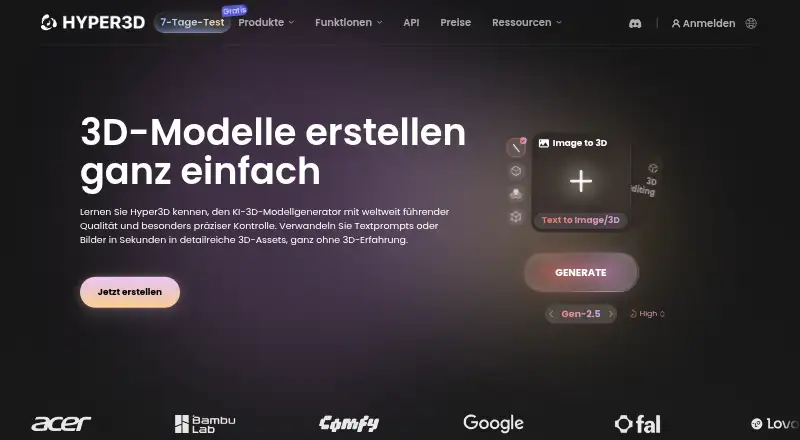
What Hyper3D Rodin is
Hyper3D Rodin creates 3D assets from text prompts, images, or sketches, with clean topology and physically based rendering materials. Its site says one image can generate most objects, while adding views can supply more visual detail. Rodin Gen-2.5 supports models of up to 10 million polygons and textures up to 12K with HighPack. Exports include GLB, FBX, OBJ, STL, USDZ, glTF, 3MF, and DXF, for uses such as 3D printing, games, AR/VR, and product visualization. The web product also has an API for image and text generation, multi-image workflows, AI texturing, previews, export handling, and asynchronous automation. Add-ons are listed for Unity, Unreal Engine, Blender, 3ds Max, Cinema 4D, Maya, Godot, and Omniverse. A free plan includes 10 private assets for basic exploration; Creator is $30 per month or $24 per month billed yearly. API data remains in active systems for seven days and is not used for training. The API page lists ISO/IEC 27001 and GDPR certification and a 99.9% enterprise-grade uptime SLA.
Good
- Creates 3D assets from text, images, or sketches
- Exports include GLB, FBX, OBJ, STL, and USDZ
- API supports texturing, previews, and task automation
- Free plan includes 10 private assets
Watch out
- Creator costs $30 monthly unless billed yearly
- Business API rate limits are not publicly documented
- API requests and output remain in active systems for seven days
Who it suits
Rodin suits artists, indie teams, and creators who want to generate 3D assets from text or images. Its Business plan is positioned for studios, product teams, and API workflows.
Verdict
Rodin brings text- and image-based 3D generation together with an API and a broad set of export formats. Its free plan supports basic exploration, while higher-volume and studio workflows have separate paid plans.
Plans and prices
From Hyper3D Rodin's own pricing page, checked 29 Sep 2026.
| Plan | Price | What it gives you |
|---|---|---|
| Free | Free | 10 private assets · Basic image-to-3D and text-to-3D exploration · Direct credits $1.5 per credit |
| Creator | $30 a month | About 60 models · Multi-image to 3D · Smart Low-Poly · HD and custom textures · Unlimited export and private assets · $30 / month; yearly $288 today ($24 / mo) |
| Business | $120 a month | About 416 models · Full API access · High-resolution textures and High-Poly Quads · 120 RPM on first three tiers; 240 RPM on higher tiers · $120 / month; yearly $1,152 today ($96 / mo) |
| Enterprise | Priced on request | Custom usage, deployment, and support · Team controls · Private on-premise deployment · Custom LoRA and fine-tuning · Custom annual agreements available |
The facts
Each one read from Hyper3D Rodin's own pages, with the date it was checked.
What it does
- API data retention
- Rodin API requests and generated output are retained in active systems for seven days, are not used to train models, and are not published to public assets.checked 29 Sep 2026
- API data sharing
- The API retention policy says request payloads and generated output are not made available to other users or shared with third parties for their independent purposes.checked 29 Sep 2026
- API limitations
- The API tier comparison lists Business rate limits as not publicly documented and Enterprise rate limits as custom by agreement.checked 29 Sep 2026
- API workflows
- The API supports image-to-3D, text-to-3D, multi-image generation, AI texturing, export handling, preview delivery, and asynchronous task automation.checked 29 Sep 2026
- Exports and uses
- The site lists STL, FBX, OBJ, GLB, GLTF, and USDZ formats and use cases including 3D printing, games, AR/VR, and product visualization.checked 29 Sep 2026
- Generation quality
- Rodin Gen-2.5 is listed as supporting models up to 10 million polygons and textures up to 12K with HighPack.checked 29 Sep 2026
- Image input
- The site says one image can generate most objects and optional additional views can provide more visual detail.checked 29 Sep 2026
- Integrations
- Available add-ons are listed for Unity, Unreal Engine, Blender, 3ds Max, Cinema 4D, Maya, Godot, and Omniverse.checked 29 Sep 2026
- Intended users
- The pricing page describes Creator for artists, indie teams, and creators, and Business for studios, product teams, and API workflows.checked 29 Sep 2026
- Purpose
- Rodin generates 3D assets from text prompts or images, with clean topology and PBR materials.checked 29 Sep 2026
- Security claims
- The API page states ISO/IEC 27001 and GDPR certified and lists a 99.9% uptime SLA for enterprise-grade API performance.checked 29 Sep 2026
- Support
- Enterprise plans list AI+Artist support for nearly production-ready 3D assets and custom support terms.checked 29 Sep 2026
Money
- Free plan
- Yeschecked 20 Sep 2026
The company
- Maker
- The privacy policy identifies Deemos Corporation, a Delaware corporation with a registered address in Wilmington, as the operator of hyper3d.ai.checked 29 Sep 2026
The full review of Hyper3D Rodin
Hyper3D Rodin is a web and API service for generating 3D assets from text, images, and sketches. It is best suited to creators and teams who need models across several production formats; the choice between its free exploration tier and production-oriented paid plans is the key trade-off.
Overview
Rodin combines text-to-3D and image-to-3D generation with AI texturing and export handling. Its image workflow can use a single image for most objects, with extra views as an option when more visual detail matters. That flexibility makes it useful for turning references into starting assets, while its range of output formats and integrations helps fit those assets into different pipelines.
Rodin Gen-2.5 supports models up to 10 million polygons and textures up to 12K with HighPack. Those ceilings will interest teams seeking detailed output, but they are capability limits, not a guarantee that every generation will reach them. The API adds automated workflows for multi-image generation, previews, asynchronous tasks, and exports, making it more relevant to repeatable studio work than to occasional experimentation alone.
Key features
- Multiple input paths: Text, images, and sketches are supported. A single image can generate most objects; additional views can contribute more visual detail.
- Production-oriented output: Rodin lists clean topology and PBR materials, and supports GLB, FBX, OBJ, STL, USDZ, glTF, 3MF, and DXF. The breadth suits workflows spanning 3D printing, games, AR/VR, and product visualization.
- Pipeline integrations: Add-ons are listed for Unity, Unreal Engine, Blender, 3ds Max, Cinema 4D, Maya, Godot, and Omniverse. That range is useful for teams already working in those tools.
- API automation and data handling: The API supports image- and text-based generation, AI texturing, export handling, preview delivery, and asynchronous task automation. Requests and outputs remain in active systems for seven days, are not used to train models, and are not published as public assets or shared with third parties for their independent purposes.
- Enterprise service claims: The API page states ISO/IEC 27001 and GDPR certification and a 99.9% uptime SLA for enterprise-grade API performance. Enterprise plans also include AI+Artist support for nearly production-ready assets and custom support terms. Business rate limits are not publicly documented; Enterprise limits are set by agreement.
Pricing
Rodin is freemium, with a free plan and a seven-day trial stated in its pricing note. The Free trial field is marked no, so the paid-plan trial terms are unclear. The free plan costs nothing and allows 10 private assets, basic image-to-3D and text-to-3D exploration, and direct credits at $1.5 per credit. It is a low-commitment way to explore the core workflows, but the private-asset cap and paid credits limit its appeal for sustained use.
Creator costs $30 a month when billed monthly, or yearly $288 today ($24 / mo). It includes about 60 models, multi-image to 3D, Smart Low-Poly, HD and custom textures, and unlimited export and private assets. This is the clearest fit for artists, indie teams, and creators who need more than basic trials and do not require full API access.
Business costs $120 a month, or yearly $1,152 today ($96 / mo). It includes about 416 models, full API access, high-resolution textures, High-Poly Quads, and rate limits of 120 RPM on the first three tiers and 240 RPM on higher tiers. That makes it the plan for studios, product teams, and API workflows, though the undisclosed Business rate limits make it harder to judge throughput requirements in advance.
Enterprise has custom pricing and includes team-grade controls and administration, private on-premise deployment, custom LoRA and fine-tuning, volume discounts, and AI+Artist production support. It is aimed at organizations that need deployment and support beyond the standard plans. The cheaper plans give up those enterprise controls and production support.
Platforms
Rodin is available on the web and through an API. The listed integrations extend its workflow into Unity, Unreal Engine, Blender, 3ds Max, Cinema 4D, Maya, Godot, and Omniverse.
Who it's for
Rodin is a strong fit for creators who want text- and image-driven 3D generation with several export choices, and for studios that need API automation or integration with existing 3D tools. It is less compelling for someone who only needs a few assets: the free tier is capped at 10 private assets, while its paid offerings are structured around larger creation volumes and workflow needs.
Pros and cons
- Pros: Multiple input types, a broad set of export formats, and add-ons for major 3D and game-development tools make Rodin adaptable across workflows.
- Pros: Creator offers unlimited exports and private assets, while Business adds full API access and higher-detail output options.
- Pros: API output is not used for training or published publicly, with seven-day active-system retention.
- Cons: Free use is limited to 10 private assets, so it is best treated as an exploration tier rather than an ongoing production plan.
- Cons: Business costs $120 a month monthly, and its rate limits are not publicly documented, which complicates planning for API-heavy workflows.
Alternatives
Compare Rodin with AI 3D Model Generators and AI Game Asset Generators if you want to survey category options. Meshy is worth considering if you need Android or iOS access and a free plan with 100 credits and 10 monthly downloads for Meshy 6 Lite models. Spritefy is an alternative with a free starter-credit plan for personal, non-commercial use and PNG exports. Tripo AI offers 200 monthly credits, one concurrent task, and 15 exports on its free plan. Goblin3D has a free tier with 150 starter credits, public models, standard queue, and one concurrent generation. Scenario offers 50 free daily credits for personal and evaluation use and includes a free trial. SpriteShip starts with 1,500 credits and three concurrent jobs on its free plan. StudioSprite is a web-based alternative whose free tier is limited to pixel art and personal use. DeepMotion Animate 3D is an alternative with a freemium plan that includes 25 credits per month and clips up to 20 seconds.
Verdict
Choose Rodin if you want a flexible 3D-generation workflow that spans text, images, multiple exports, and—at higher tiers—API automation. Its main advantage is how much of the asset pipeline it brings together; look elsewhere if a small free allowance or mobile access matters more than its production-oriented plans and integrations.
Alternatives to Hyper3D Rodin
- 1

Meshy
Free planAndroidiOSWebAPI8.3From $20 a month - 2

Tripo AI
Free planAndroidiOSWebAPI8.2From $20 a month - 3

AnnoMotion
Free planWebAPIWindows7.6From £4.50 a month - 4

Scenario
Free planWebAPI7.5From $15 a month - 5
PixelLab
AndroidiOSWebAPI7.0From $12 a month - 6
Layer Audio Cleanup
Free planWebAPIExtension6.9From $10 a month