
GymPoint
GymPoint combines gym billing, scheduling, check-in, point of sale, waivers and a member portal with an installable member app.
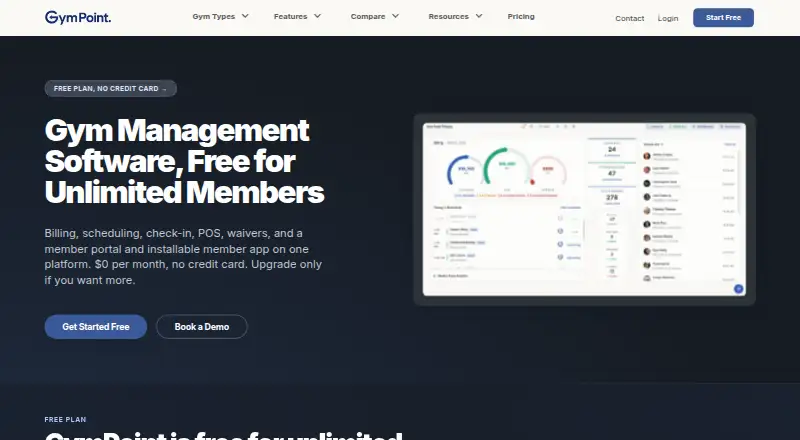
What GymPoint is
GymPoint combines gym billing, scheduling, check-in, point of sale, waivers and a member portal with an installable member app. Its member profiles can bring together contact details, membership status, billing history, private staff notes and check-in history. For classes, gyms can use recurring schedule templates, capacity limits, automated waitlists and member bookings. Trial-class bookings can also create leads.
GymPoint Payments supports tap, chip, swipe and contactless payments, as well as point of sale and inventory. GymPoint says payment processors, rather than gym servers, handle card data; it does not store, process or transmit raw cardholder data. Pulse AI offers lead scoring, churn prediction, failed-payment recovery and weekly business insight digests. The Free plan includes a $1 monthly Pulse AI credit. GymPoint lists a public REST API, Zapier-compatible outbound webhooks, Wellhub, Poynt Payments and embeddable schedule and signup widgets.
The Free plan includes unlimited members and core platform tools, but requires GymPoint Payments as the processor. Growth costs $149 per month for one location, while Pro costs $249 per month and supports unlimited locations. Annual billing saves 20% on paid plans, and a seven-day trial is listed. GymPoint describes plans for gyms of any size, including multi-location operators, and fitness types such as CrossFit, martial arts, boxing, yoga, gymnastics, dance, Pilates and personal training.
Good
- Free plan includes unlimited members and core platform tools.
- Scheduling supports capacity limits, automated waitlists and trial-class bookings.
- Payments include tap, chip, swipe and contactless options.
- Pulse AI includes lead scoring and churn prediction.
- Lists a public REST API and Zapier-compatible outbound webhooks.
Watch out
- The Free plan requires GymPoint Payments as the processor.
- Growth costs $149 per month for one location.
- The seven-day trial is limited to seven days.
Who it suits
GymPoint is suited to gyms looking to combine billing, scheduling, check-in, POS and member access in one platform. Its plan options and unlimited-location Pro tier may suit both individual gyms and multi-location operators; its listed fitness types include martial arts, yoga, dance and personal training.
Verdict
Choose GymPoint if you want billing, scheduling, POS and member tools combined, with a free plan that supports unlimited members. Consider the paid tiers if you need Growth features or unlimited locations; the Free plan requires GymPoint Payments, and the listed trial lasts seven days.
Plans and prices
From GymPoint's own pricing page, checked 29 Sep 2001.
| Plan | Price | What it gives you |
|---|---|---|
| Free | Free | Unlimited members · Core platform: members, billing, scheduling, POS, kiosk, portal · Requires GymPoint Payments as processor · Free plan |
| Free | Free | Unlimited members · 1 location · core members, billing, scheduling, POS, kiosk, waivers and portal · U.S. gyms must keep GymPoint Payments connected · $0/mo forever |
| Growth | $149 a month | 1 location · Full Growth Suite · Smart Dunning and CRM · $10 monthly Pulse AI budget · $149/mo; annual billing saves 20% |
| Pro | $249 a month | Unlimited locations · Everything in Growth · $10 monthly Pulse AI budget · $249/mo; annual billing saves 20% |
The facts
Each one read from GymPoint's own pages, with the date it was checked.
Money
- Automated billing
- Recurring billing creates invoices, charges stored payment tokens, retries failures and sends receipts automatically.checked 14 Oct 2001
- Limit: paid-plan discrepancy
- Capterra lists a $79 Starter plan and says no free version is included, which conflicts with GymPoint’s own published Free, Growth and Pro pricing.checked 14 Oct 2001
What it does
- Class scheduling
- The scheduler supports online booking, capacity limits, waitlists, personal-training appointments and recurring templates.checked 14 Oct 2001
- Data retention
- Cancelled-account data is retained for 90 days, backups for 30 days and audit logs for at least 12 months.checked 14 Oct 2001
- Documentation
- The knowledge base contains setup and troubleshooting articles for billing, scheduling, portals, integrations, payments, security and data migration.checked 14 Oct 2001
- Door access
- GymPoint connects membership status to Kisi doors, including billing-gated entry, QR passes, fobs and automatic check-ins.checked 14 Oct 2001
- Founder
- The about page names Derrick Hess as GymPoint’s founder and says he previously operated fitness centers and worked in payments and software development.checked 14 Oct 2001
- Google Play privacy claim
- The NUBT Google Play listing states that no data is collected and no data is shared with third parties.checked 14 Oct 2001
- Integrations
- Official integrations include Poynt payments, Wellhub (formerly Gympass), Zapier-compatible webhooks, Kisi and embeddable schedule or signup widgets.checked 14 Oct 2001
- Lead CRM
- A visual Kanban pipeline tracks inquiries through membership conversion with automated follow-ups and source analytics.checked 14 Oct 2001
- Limit: hosted deployment
- GymPoint describes itself as hosted software and publishes no self-hosting or open-source distribution option.checked 14 Oct 2001
- Limit: payment-provider requirement
- The Free plan requires U.S. gyms to keep GymPoint Payments connected, although it has no processing minimum.checked 14 Oct 2001
- Limit: terminal threshold
- The free payment terminal is limited to accounts processing more than $5,000 per month; other volumes require purchase or rental options.checked 14 Oct 2001
- Member management
- Member profiles include attendance, payment history, ranks and engagement alerts.checked 14 Oct 2001
- Operator legal name
- GymPoint’s security policy identifies ZeroPoint LLC as the operating entity.checked 14 Oct 2001
- Payment compliance
- GymPoint says raw card data is kept out of its systems and handled by PCI DSS-compliant processors using tokenization.checked 14 Oct 2001
- Payments
- GymPoint Payments supports tap, chip, swipe, and contactless payments, POS and inventory, and card data handled by its processor rather than gym servers.checked 29 Sep 2001
- Payment security
- GymPoint says it does not store, process, or transmit raw cardholder data and uses PCI DSS-compliant third-party payment processors.checked 29 Sep 2001
- Praise: digital waivers and overdue texts
- The sole Capterra reviewer praised digital waivers and texting members about overdue payments.checked 14 Oct 2001
- Product
- GymPoint combines gym billing, scheduling, check-in, POS, waivers, and a member portal and installable member app on one platform.checked 29 Sep 2001
The company
- Company size
- LinkedIn lists GymPoint as a privately held wellness and fitness company with 2–10 employees.checked 14 Oct 2001
- Headquarters
- LinkedIn lists headquarters in Hammond, Louisiana, United States.checked 14 Oct 2001
Where it runs
- Google Play app
- A separate GymPoint workout-tracker app by NUBT offers plans, exercise logging, progress statistics and local-only data storage without registration.checked 14 Oct 2001
- POS and inventory
- The POS handles retail products, supplements and passes with integrated card-present payments and inventory tools.checked 14 Oct 2001
The full review of GymPoint
GymPoint is a gym-management platform that brings billing, class scheduling, check-in, point of sale and member access together. It is best suited to operators who want those workflows under one roof, from single-location gyms to multi-location businesses. The free tier covers core operations, but the requirement to use GymPoint Payments is an important trade-off.
Overview
GymPoint combines member administration with tools for running classes, taking payments and managing sales. Profiles include contact details, membership status, billing and check-in histories, and private staff notes, which gives staff useful context for routine member interactions. Recurring billing, inventory tracking, barcode scanning and service sales make it relevant beyond class-based businesses.
The range of listed fitness types is broad: CrossFit, martial arts, boxing, yoga, gymnastics, dance, Pilates and personal training. That breadth makes GymPoint a plausible fit for different gym formats, though the strongest case is for operators who want membership, scheduling and payment workflows in a single system.
Key features
Scheduling supports recurring templates, capacity limits, automated waitlists and member bookings. Trial-class bookings create leads, linking class intake with prospect follow-up rather than treating the schedule as a standalone calendar. This combination is useful for busy classes and gyms that use introductory sessions to attract members.
Pulse AI provides lead scoring, churn prediction, failed-payment recovery and weekly business insight digests. These features focus on follow-up and retention, but the Free plan's $1 monthly credit is a narrow allowance. Growth raises the quota to 500 per month, while Pro removes the quota.
GymPoint Payments accepts tap, chip, swipe and contactless payments and supports POS and inventory. GymPoint says raw cardholder data is not stored, processed or transmitted by the company; its policy describes use of PCI DSS-compliant third-party processors. Security measures also include HTTPS/TLS and Fernet encryption at rest for specified sensitive database data. Cancelled-account data is retained for 90 days before deletion, with backups kept for 30 days.
Integrations include a public REST API, Zapier-compatible outbound webhooks, Wellhub, Poynt Payments, and embeddable schedule and signup widgets.
Pricing
Free: free. It includes unlimited members and core features for members, billing, scheduling, POS, kiosk and portal. The key caveat is that GymPoint Payments must be the processor. The plan is a substantial way to cover core operations without a per-member ceiling, but it does not offer the paid plans' Growth Suite or meaningful Pulse AI capacity.
Growth: $149 a month, billed monthly. It supports one location and includes 500 Pulse AI credits per month, the Full Growth Suite, and Smart Dunning & CRM. This is the step-up for a single-site gym that needs growth and payment-recovery tools beyond the Free plan.
Pro: $249 a month, billed monthly. It includes everything in Growth, unlimited locations and unlimited Pulse AI, making it the fit for operators managing multiple sites or needing unrestricted AI credits. Annual billing saves 20% on paid plans. GymPoint also offers a seven-day trial; recurring billing applies to paid plans.
Platforms
GymPoint is available on Android, iOS and the web, and provides an API. That gives members mobile access while leaving operators a browser-based option and an integration route for connected systems.
Who it's for
GymPoint suits gyms that want billing, member records, class booking and POS together, particularly those combining recurring memberships with scheduled classes. The Free plan can serve a single-location operation with core needs and unlimited members, provided it is willing to use GymPoint Payments. Established operators needing the Growth Suite can consider Growth; multi-location businesses need Pro.
Pros and cons
- Pros: The Free plan supports unlimited members and includes billing, scheduling, POS, kiosk and portal, making core operations accessible without a membership cap.
- Pros: Scheduling connects capacity management and waitlists with trial-class lead creation, useful for gyms balancing class demand and prospect intake.
- Pros: Pro combines unlimited locations with unlimited Pulse AI credits, addressing two meaningful constraints for multi-site operators.
- Cons: Free requires GymPoint Payments, so gyms that need to keep another processor cannot use the no-cost plan on its stated terms.
- Cons: Growth is limited to one location, and its 500 monthly AI credits may not suit businesses that need unlimited capacity.
- Cons: The Free plan's $1 monthly Pulse AI credit offers little room to rely on the AI features.
Alternatives
Gym POS Software is a useful category comparison for readers weighing point-of-sale options. Choose Club Bar if a free, self-hosted setup is preferable; it runs on club-provided hosting and hardware. OpenEOS offers a free self-hosted plan with all features and unlimited events, which may suit clubs that want their own server and community support.
Bepoz Club POS is another option for readers comparing club POS products, with custom pricing. ParallelPOS may suit buyers seeking a paid POS package with inventory, HR, expenses, reports and CRM; its Basic plan is $149.99 a month per location. TouchPoint is another paid gym POS option.
Clubspeed is worth considering for a paid package combining POS, booking, gift cards and integrated payments; its Core plan is $319 a year with annual billing. clubcloud uses custom pricing based on club volume, programming mix and growth plans. Waresport Pro Shop POS may be a better fit for sports organizations: its Team plan is $69.99 a month for up to 75 athletes, and its Club plan is $129.99 a month for up to 300 athletes.
Verdict
GymPoint is a strong choice for gyms that want member administration, recurring billing, scheduling and POS in one platform, with a genuinely useful no-cost core plan for unlimited members. Choose it if GymPoint Payments works for your operation and the plan's location limits fit. Look elsewhere if keeping another processor is essential, or if you need multiple locations without paying for Pro.
Getting started
- Visit the GymPoint website.
- Choose the Free plan or review the Growth and Pro plans.
- Use the seven-day trial if you want to try the service first.
- Set GymPoint Payments as the processor for the Free plan.
- Access GymPoint through Android, iOS, the web or its API.
Limits worth knowing
The Free plan requires GymPoint Payments as the processor and includes a $1 monthly Pulse AI credit. Growth is limited to one location and includes 500 Pulse AI credits per month; Pro supports unlimited locations and unlimited Pulse AI.
Questions
Does GymPoint have a free plan?
Yes. The Free plan includes unlimited members and core platform tools, and requires GymPoint Payments as the processor.
How much do the paid plans cost?
Growth costs $149 per month and Pro costs $249 per month. Annual billing saves 20% on paid plans.
Does GymPoint offer a trial?
Yes. A seven-day trial is listed.
What platforms does GymPoint support?
It lists Android, iOS, web and an API.
What integrations and connection options are listed?
GymPoint lists a public REST API, Zapier-compatible outbound webhooks, Wellhub, Poynt Payments, and embeddable schedule and signup widgets.
Who founded GymPoint?
Its about page names Derrick Hess as its founder.
Alternatives to GymPoint
- 1
OpenEOS
Free planOpen sourceAndroidiOSWebAPI8.4€25, paid once - 2

MyStudio
AndroidiOSWeb7.2From $79 a month - 3
ParallelPOS
iOSWebLinuxmacOS7.1From $149.99 a month - 4

Waresport Pro Shop POS
AndroidiOSWeb7.1From $69.99 a month - 5
Clubspeed
AndroidiOSWebAPI6.7From $26.58 a month - 6

GymRoute POS
AndroidiOSWeb6.6From $99 a month