GrassBlade LRS
GrassBlade LRS is a Learning Record Store for capturing eLearning data and reporting on xAPI ecosystems.
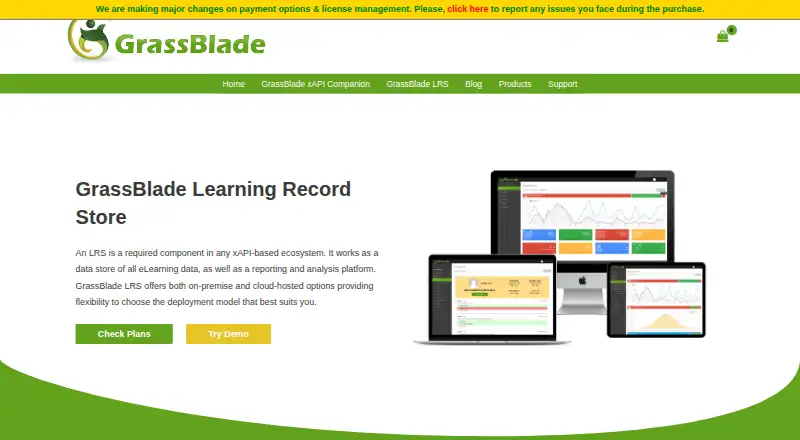
What GrassBlade LRS is
GrassBlade LRS is a Learning Record Store for capturing eLearning data and reporting on xAPI ecosystems. It is available as a cloud service or an on-premise installation; the self-hosted version runs on PHP/MySQL servers and can keep data on your own server. Its reporting includes filtered custom reports with PDF and CSV downloads, plus automated email distribution. Rich Quiz Reports cover multiple attempts and learner performance comparisons for tools such as Storyline, Rise, Captivate and iSpring. Advanced Video Reporting provides video overview, completion and gradebook reports, along with activity data and progress heatmaps. GrassBlade Cloud LRS supports xAPI, SCORM and cmi5 content from authoring tools including Articulate, Adobe Captivate, iSpring and H5P. The included mobile app works on Android, iPhone, iPad and MacBook with Apple silicon. Plans are billed yearly; Lite is $12 a year, and there is no free plan or free trial.
Good
- Cloud-hosted and on-premise deployment options.
- Custom reports export to PDF and CSV.
- Quiz reports compare attempts and learner performance.
- Supports xAPI, SCORM and cmi5 content.
- Mobile app is included with all plans.
Watch out
- No free plan or free trial.
- Lite allows 5,000 statements per month.
- Self-hosting requires PHP 7.3+ and MySQL 4+.
- Plan overage fees apply to statement limits.
Who it suits
It suits organizations that need to store learning activity data and report on courses, quizzes or video progress. Teams needing control over data location can use the self-hosted installation, provided they have the required server setup.
Verdict
GrassBlade LRS combines learning-data storage with reporting for quizzes, video and xAPI ecosystems. Check the yearly plan limits and server requirements before choosing a deployment.
Plans and prices
From GrassBlade LRS's own pricing page, checked 30 Sep 2001.
| Plan | Price | What it gives you |
|---|---|---|
| Essential | $66 a year | 25000 Statements/mo · 1 Instance · Overage Fee: $4 per 1,000 statements · Yearly |
| Lite | $144 a year | 5000 Statements/mo · 1 Instance · Overage Fee: $7 per 1,000 statements · $144.00 per year (= $12.00/month, billed annually) |
| Pro | $166 a year | 100000 Statements/mo · 3 Instance · Overage Fee: $3.5 per 1,000 statements · Yearly |
| Starter | $399 a year | upto 250 Learners · 2 Installations · Production & Development · Sold Out · Yearly |
| Advanced | $499 a year | 500000 Statements/mo · 5 Instance · Overage Fee: $3 per 1,000 statements · Yearly |
| Business | $665 a year | 1Million Statements/mo · 5 Instance · Overage Fee: $2 per 1,000 statements · Yearly |
| Standard | $999 a year | upto 1000 Learners · 2 Installations · Production & Development · Offline Licensing Available · Yearly |
| Premium | $2,999 a year | upto 5000 Learners · 3 Installations · Production, Staging & Development · Offline Licensing Available · Yearly |
| Premium+ (Managed) | $5,999 a year | upto 5000 Learners · 3 Installations · Production, Staging & Development · Unlimited Free Installation Service · Yearly |
| Enterprise | Priced on request | ~ Learners · 3 Installations · Production, Staging & Development · Unlimited Free Installation Service · Yearly |
The facts
Each one read from GrassBlade LRS's own pages, with the date it was checked.
What it does
- Authoring standards
- GrassBlade Cloud LRS supports authoring tools that publish xAPI, SCORM and cmi5 content, including Articulate, Adobe Captivate, iSpring and H5P.checked 30 Sep 2001
- Deployment
- GrassBlade LRS is available as both an on-premise installation and a cloud-hosted service.checked 30 Sep 2001
- Integrations
- Listed integrations include LearnDash, WP Courseware, LearnPress, LifterLMS, Tutor LMS, MasterStudy, Vimeo, Zapier, Dropbox, GamiPress, Gravity Forms and H5P.org.checked 30 Sep 2001
- Mobile access
- GrassBlade LRS App is included with all plans and works on Android, iPhone, iPad and MacBook with Apple silicon.checked 30 Sep 2001
- Product purpose
- GrassBlade LRS is a Learning Record Store that stores eLearning data and provides reporting and analysis for xAPI ecosystems.checked 30 Sep 2001
- Quiz analytics
- Rich Quiz Reports support multiple attempts and learner performance comparisons for authoring tools including Storyline, Rise, Captivate and iSpring.checked 30 Sep 2001
- Reporting
- The product provides filtered custom reports with PDF and CSV downloads and automated email distribution.checked 30 Sep 2001
- Security
- The product lists SSO support and secured tokens, and says self-hosting provides higher security by keeping data on the customer’s server.checked 30 Sep 2001
- Self-hosting
- The self-hosted product works with PHP/MySQL servers and can keep data on the customer’s own server.checked 30 Sep 2001
- Statement limits
- The product page says there is no statement limit from GrassBlade’s side for self-hosted or cloud versions, with capacity depending on the server and plan overage rules.checked 30 Sep 2001
- Support
- Customers receive guides and documentation and can contact support by ticket or email at [email protected].checked 30 Sep 2001
- System requirements
- The documented requirements include an HTTP server, mod_rewrite, cURL, PHP 7.3+, MySQL 4+ and the PDO PHP module for MySQL.checked 30 Sep 2001
- Video reporting
- Advanced Video Reporting includes video overview, completion and gradebook reports with activity data and progress heatmaps.checked 30 Sep 2001
- Zapier
- The GrassBlade Cloud LRS Zapier integration connects with more than 1500 applications.checked 30 Sep 2001
Money
- Free trial
- The vendor states that it does not offer free trials but provides a product demo.checked 30 Sep 2001
The full review of GrassBlade LRS
GrassBlade LRS is a learning record store for organizations that need to capture and interpret activity across xAPI-based learning systems. It is particularly well suited to teams combining quiz and video analytics with either cloud hosting or a self-managed server. The main decision is whether your workload fits statement-based cloud limits or learner-based annual licensing.
Overview
GrassBlade stores eLearning records and turns them into reports and analysis for xAPI ecosystems. Cloud-hosted and on-premise deployment cover different operational priorities: the cloud option avoids server administration, while self-hosting keeps data on the customer’s own PHP/MySQL server and can offer a higher-security posture for organizations that require local control.
Self-hosting is not server-agnostic. It requires an HTTP server with mod_rewrite and cURL, PHP 7.3 or newer, MySQL 4 or newer, and the PDO PHP module for MySQL. Those requirements are reasonable for established web infrastructure, but they make GrassBlade less suitable for buyers wanting a turnkey local appliance.
Key features
Reporting goes beyond basic statement storage. Filtered custom reports can be exported to PDF or CSV and sent automatically by email, making recurring compliance or management summaries practical without manually rebuilding them. Rich Quiz Reports handle multiple attempts and compare learner performance for Storyline, Rise, Captivate and iSpring content; that is valuable when improvement across attempts matters more than a single completion score.
Advanced Video Reporting adds overview, completion and gradebook reports, along with activity data and progress heatmaps. These views suit video-led training where watching time and progression need closer examination than a simple pass or fail.
GrassBlade Cloud LRS accepts content published in xAPI, SCORM and cmi5, including material from Articulate, Adobe Captivate, iSpring and H5P. Integrations span LearnDash, WP Courseware, LearnPress, LifterLMS, Tutor LMS, MasterStudy, Vimeo, Dropbox, GamiPress, Gravity Forms and H5P.org. Its Zapier connection reaches more than 1,500 applications, useful for organizations that need to move learning events into broader business workflows.
The GrassBlade LRS App is included with every plan and works on Android, iPhone, iPad and Apple-silicon MacBook. SSO and secured tokens address access control, while CSV export provides a straightforward route to downstream analysis. GrassBlade states that it imposes no statement limit on either deployment type; practical capacity is governed by the server and by each plan’s overage rules.
Pricing
GrassBlade has no free plan or trial. The advertised entry point is $12/mo on an annual commitment, represented by Lite at $144 a year, with 5,000 statements per month, one instance and a $7 per 1,000-statement overage fee. It fits a small deployment with predictable volume, but the low headline price comes with the smallest statement allowance.
Essential costs $66 a year for 25,000 statements per month and one instance; overage is $4 per 1,000 statements. Despite its lower annual price, it offers five times Lite’s statement quota, so it is the more logical choice when volume matters more than minimizing the subscription line.
Pro is $166 a year, allowing 100,000 statements monthly across three instances, with $3.5 per 1,000 statements overage. Advanced costs $499 a year for 500,000 statements, five instances and $3 per 1,000 overage. Business is $665 a year for 1 million statements, five instances and $2 per 1,000 overage. These tiers suit growing or multi-environment cloud deployments; the falling overage rate becomes meaningful at sustained high volume.
Starter is $399 a year for up to 250 learners, two installations, and production plus development, but it is marked Sold Out. Standard costs $999 a year for up to 1,000 learners and two installations, with production and development plus offline licensing. Premium is $2,999 a year for up to 5,000 learners and three installations covering production, staging and development, also with offline licensing. Premium+ (Managed) costs $5,999 a year on the same learner and installation allowance and adds unlimited free installation service. Enterprise has custom pricing, three installations, production, staging and development, and unlimited free installation service, with the learner allowance shown as approximately defined rather than a fixed cap. All listed plans bill yearly, so buyers should match the quota model to expected usage before renewal.
Platforms
GrassBlade supports Android, iOS, Linux, macOS, Windows, web, API access and self-hosted deployment. That range covers learner-facing mobile and desktop access as well as server-side integration, but self-hosted customers remain responsible for compatible PHP/MySQL infrastructure.
Who it's for
Choose GrassBlade for an organization running several authoring tools or LMS integrations that needs searchable reporting, quiz-attempt comparisons, video progress analysis and automated report delivery. It is also a strong fit when policy requires learning data to remain on a controlled server. Buyers seeking only a minimal, low-volume LRS, a free starting tier or month-to-month experimentation should look elsewhere because every GrassBlade option is paid and billed annually.
Pros and cons
Pros
- Deep learning analytics: quiz comparisons, video heatmaps, gradebooks and filtered exports support decisions beyond completion tracking.
- Deployment choice: cloud hosting and PHP/MySQL self-hosting accommodate different data-control requirements.
- Broad ecosystem coverage: xAPI, SCORM, cmi5, major authoring tools, LMS plugins and a 1,500-plus-app Zapier integration reduce integration gaps.
- Included mobile app: the app is bundled with every plan across Android, iPhone, iPad and Apple-silicon MacBook.
Cons
- No free evaluation: there is neither a free plan nor a trial, increasing commitment before adoption.
- Annual-only budgeting: all published plans bill yearly, and overage charges apply when statement quotas are exceeded.
- Complex plan split: cloud tiers use statement and instance quotas while other tiers use learner and installation limits, making direct comparison difficult.
- Infrastructure burden for local hosting: customers must meet the documented web-stack requirements and manage capacity themselves.
Alternatives
If you want a wider range of learning-record products to compare, browse the Learning Record Store Software list.
Veracity Learning is the better starting point when a freemium route matters: its Lite plan is free for five LRSs, with paid Starter pricing at $100 a month.
Pick SQL LRS when open-source self-hosting is the priority; it is Apache 2.0 software with implementation and support quoted separately.
xh is a free open-source command-line HTTP client rather than a like-for-like LRS, so it suits request tooling needs instead of learning analytics.
Cluelabs LRS is worth considering for a free plan on Android, iOS, web and API platforms.
Mosra offers a free launch-period plan with unlimited lessons and exports, making it preferable for early exploration while paid plans are still planned.
ADL Open Source LRS is a free proof-of-concept option intended for a small number of users.
Ralph suits developers wanting an MIT-licensed Python package and Docker image at no software cost.
Sereni LRS is the stronger value choice for a free allowance of up to 100,000 xAPI statements, 1 GB storage and unlimited LRSs, reporting and analytics.
Verdict
GrassBlade LRS is a strong recommendation for training teams that need serious quiz and video reporting, broad authoring and LMS integration, and a choice between hosted service and controlled self-hosting. Its annual pricing, absent trial and quota-based overages are the main reasons to look elsewhere, especially if you need a free pilot or a simpler single-limit plan.
Alternatives to GrassBlade LRS
- 1
xh
Free planOpen sourceAndroidLinuxmacOSWindows7.6Free plan - 2
SQL LRS
Free planOpen sourceWebAPILinuxmacOS7.5Free plan - 3
Cluelabs LRS
Free planAndroidiOSWebAPI7.2From $19.95 a month - 4
Veracity Learning
Free planWebAPILinuxmacOS7.1From $100 a month - 5
Mosra
Free planWebmacOSSelf-hostedWindows7.0Free plan - 6
Jupiter
Free planWebSelf-hosted6.4From $1 a month