Veracity Learning
Veracity Learning is a learning and performance data platform built around the Experience API (xAPI) standard.
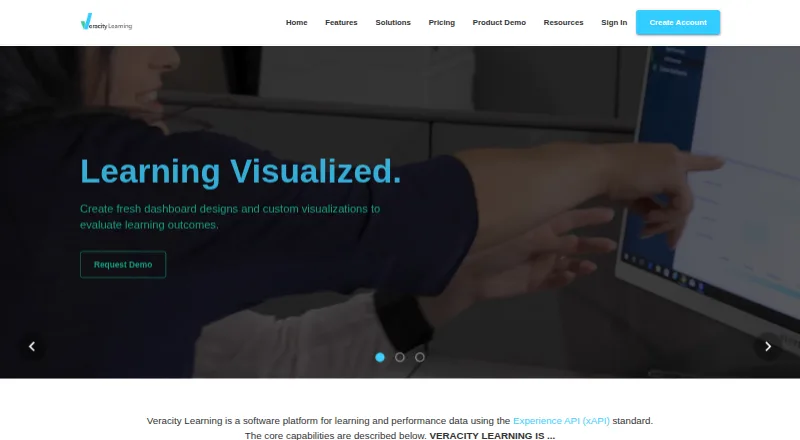
What Veracity Learning is
Veracity Learning is a learning and performance data platform built around the Experience API (xAPI) standard. Its Learning Record Store stores and retrieves xAPI statements, including signatures, binary attachments, and document stores. Analytics include default and custom dashboards, a chart builder, advanced graph queries, and support for common xAPI profiles. Data exchange supports CSV, JSON, and URL-based data dumps, along with forwarding statements between LRSs. The product provides an advanced search API, Veracity Query Language, and an LRS API for managing learners, lessons, and other data objects or launching content. Its multi-tenant architecture keeps separate LRS instances from sharing keys, analytics, or databases. Customers can use cloud-hosted SaaS in a browser or install it on their own network; the SaaS option uses AWS by default. Veracity Lite is a free download with fewer features. The Learner Portal is a content player for integrating with other applications, not an LMS. Starter is listed at $100 a month; other plans may require a quote or have no listed price.
Good
- Stores and retrieves xAPI statements
- Includes dashboards, chart builder, and graph queries
- Imports and exports CSV and JSON
- Offers SaaS or customer-premises deployment
- Separate LRS instances do not share keys or analytics
Watch out
- Learner Portal is not an LMS
- Lite has fewer features than SaaS and on-premises versions
- Starter is listed at $100 a month
- Several plans require a quote or lack listed pricing
Who it suits
It suits organizations handling learning and performance data through xAPI, including corporate, education, and government users. Teams needing a learning management system should note that the Learner Portal is not an LMS.
Verdict
Veracity Learning focuses on xAPI statement storage, analytics, and data exchange, with cloud and self-hosted deployment options. Its Learner Portal is a content player rather than an LMS.
Plans and prices
From Veracity Learning's own pricing page, checked 29 Sep 2001.
| Plan | Price | What it gives you |
|---|---|---|
| Lite (Free) | Free | 5 LRSs · based on your infrastructure · free LRS Lite download also available |
| Starter | $100 a month | 5 LRSs · 1GB storage · 100K - 1M xAPI statements · 25K/day API calls · The page says costs can be paid monthly or in bulk for the year. |
| Pro | $400 a month | 10 LRSs · 5GB storage · 1 - 5M xAPI statements · 100K/day API calls · The page says costs can be paid monthly or in bulk for the year. |
| Enterprise (On-Premises) | Priced on request | Unlimited LRSs · infrastructure and license based · Requires a quote. |
| Free | — | 3 LRSs · 100MB storage · 50k - 100K xAPI statements · 10K/day API calls · The page says costs can be paid monthly or in bulk for the year. |
| White Label | Priced on request | Unlimited LRSs · infrastructure and license based · Requires a quote. |
| Expert | Priced on request | Unlimited LRSs · dedicated server · 30GB storage · 5 - 30M xAPI statements · unlimited API calls** · Requires a quote. |
| Enterprise | Priced on request | Unlimited LRSs · dedicated high-availability, geographically distributed hardware · storage based on infrastructure · statement and API limits based on infrastructure · Requires a quote. |
The facts
Each one read from Veracity Learning's own pages, with the date it was checked.
What it does
- Analytics
- Its analytics features include default dashboards, custom dashboards, a chart builder, advanced graph query tools, and support for common xAPI profiles.checked 29 Sep 2001
- API and queries
- The product provides an advanced search API, Veracity Query Language (VQL), and an LRS API for creating and removing learners, lessons, and other data objects or launching content.checked 29 Sep 2001
- Audience
- The company describes its markets as government and commercial and says the LRS is used in corporate, education, government, and other industries.checked 29 Sep 2001
- Cloud hosting
- The SaaS option runs in a web browser without downloads or installations, and by default uses AWS cloud services.checked 29 Sep 2001
- Content playback limit
- The pricing page says the Learner Portal is a content player for integrating with other applications and is not an LMS.checked 29 Sep 2001
- Data exchange
- The platform supports importing and exporting data as CSV, JSON, and data dumps via URL, as well as statement forwarding between LRSs.checked 29 Sep 2001
- Deployment
- The LRS is available as cloud-hosted SaaS or can be installed on the customer's own network premises.checked 29 Sep 2001
- Integrations
- The LRS supports OpenID Connect and names Okta, GLUU, and Auth0 as compatible identity providers.checked 29 Sep 2001
- Lite edition
- Veracity Lite is a free download for commercial or non-commercial use and has fewer features than the SaaS and on-premises versions.checked 29 Sep 2001
- LRS
- The product stores and retrieves xAPI statements, including statement signatures, binary attachments, and document stores.checked 29 Sep 2001
- Multi-tenancy
- Its multi-tenant architecture allows separate LRS instances that do not share keys, analytics, or databases.checked 29 Sep 2001
- Product
- Veracity Learning is a platform for learning and performance data built around the Experience API (xAPI) standard.checked 29 Sep 2001
- Security and privacy
- The privacy policy says Veracity complies with the EU-U.S., UK Extension, and Swiss-U.S. Data Privacy Frameworks.checked 29 Sep 2001
- Support
- The site links customers to a help desk, user manual, FAQs, and release notes.checked 29 Sep 2001
The company
- Headquarters
- Pensacola, Florida, United Stateschecked 23 Sep 2001
The full review of Veracity Learning
Overview
Veracity Learning is best suited to organizations that need a configurable store and analysis layer for xAPI activity across learning systems. Its strongest case is the combination of analytics, data exchange, and cloud or on-premises deployment; it is a poor fit for buyers seeking a complete LMS.
Key features
Store, query, and analyze learning data
The LRS stores and retrieves xAPI statements, including signatures, binary attachments, and document stores. Default and custom dashboards, a chart builder, advanced graph queries, and support for common xAPI profiles give teams several ways to inspect activity without treating the store as a passive archive. The advanced search API and Veracity Query Language add flexibility for technical users, though this is a data platform rather than a turnkey course-management workflow.
Exchange and manage records
CSV, JSON, and URL-based data dumps support moving records in and out, while statement forwarding between LRSs can connect separate stores. The LRS API can create and remove learners, lessons, and other data objects, or launch content. OpenID Connect support includes Okta, GLUU, and Auth0. The Learner Portal plays content integrated with other applications, but it is not an LMS.
Separate environments and deployment
Multi-tenancy allows separate LRS instances without shared keys, analytics, or databases, useful when different groups need isolated data. The stated tenant limit is five. Customers can use browser-based SaaS, which runs on AWS by default, or install the LRS on their own network. Veracity Lite is a free download for commercial or non-commercial use, but has fewer features than SaaS and on-premises editions. cmi5 is supported.
Pricing
Veracity has a free plan and paid plans from $100 a month. Costs can be paid monthly or in bulk for the year; the listed monthly prices are $100 a month for Starter and $400 a month for Pro.
- Lite (Free): free, up to five LRSs, based on your infrastructure. A free LRS Lite download is also available. Its reduced feature set makes it a sensible starting point when local infrastructure and a smaller feature set are acceptable.
- Free: custom pricing; three LRSs, 100MB storage, 50k–100K xAPI statements, and 10K API calls per day. This gives a smaller cloud allowance than Starter, but no listed price is attached to the plan.
- Starter: $100 a month; five LRSs, 1GB storage, 100K–1M xAPI statements, and 25K API calls per day. It suits teams needing a modest hosted capacity, with statement volume and API calls capped.
- Pro: $400 a month; 10 LRSs, 5GB storage, 1–5M xAPI statements, and 100K API calls per day. The higher limits fit heavier workloads, at four times Starter's monthly price.
- Enterprise (On-Premises): custom pricing, unlimited LRSs, with infrastructure and license based pricing. This is the on-site option for organizations that need more instances.
- White Label: custom pricing, unlimited LRSs, infrastructure and license based.
- Expert: custom pricing, unlimited LRSs, a dedicated server, 30GB storage, 5–30M statements, and unlimited API calls.
- Enterprise: custom pricing, unlimited LRSs, dedicated high-availability, geographically distributed hardware, with storage, statement, and API limits based on infrastructure.
Platforms
Veracity supports API, Linux, macOS, web, Windows, and self-hosted use. The cloud option runs in a browser without downloads or installation; self-hosting is available for organizations that want the LRS on their own network.
Who it's for
Its stated markets include government and commercial organizations, with use across corporate, education, government, and other industries. It makes the most sense where teams need to collect xAPI data from multiple sources, analyze it, and control how LRS instances are deployed or separated. Buyers primarily looking for course delivery and administration should choose an LMS instead.
Pros and cons
- Pro: Multiple dashboards, graph queries, and xAPI profile support make the stored activity more useful for analysis.
- Pro: SaaS and on-premises deployment, plus isolated LRS instances, suit organizations with distinct hosting or data-separation needs.
- Pro: Import, export, forwarding, and API tools support integration and data movement.
- Con: The Learner Portal is only a content player, not a full LMS, so it does not replace a learning-management system.
- Con: Starter and Pro impose storage, statement, and daily API limits; higher-capacity options require custom pricing.
- Con: Lite has fewer features than the SaaS and on-premises versions, so its free status does not mean feature parity.
Alternatives
Compare Learning Record Store Software if you want to assess the broader category.
- SQL LRS is a free, Apache 2.0 open-source, self-hosted option; choose it if you prefer that model and can arrange implementation and support separately.
- Mosra is free during its launch period, with unlimited lessons and listed features and exports; its paid plans are planned but not live.
- GrassBlade LRS suits buyers looking for a paid option with a $12 a year Lite plan, 5,000 statements monthly, one instance, and a $7 per 1,000 statement overage fee.
- Sereni LRS offers a free plan with up to 100,000 xAPI statements or events, 1GB storage, unlimited LRSs, and unlimited reporting and analytics; consider it if those free limits fit.
- xh is another free option.
- SCORM Cloud LRS has a free, non-time-based trial with three courses, up to 5GB storage, and 10 resettable registrations; it is worth considering if a trial with those allowances fits your evaluation.
- Cluelabs LRS offers a freemium option with a free plan.
- xSTAGE LRS is a paid alternative with pricing available by contacting Ginger App.
Verdict
Choose Veracity Learning if you need xAPI storage with meaningful analytics and the choice of hosted or on-premises deployment. Its flexible querying and isolated LRS instances are the main reasons to favor it; look elsewhere if you need a full LMS or want uncapped capacity at a published price.
Getting started
- Visit https://lrs.io/home/ to explore the product.
- Choose cloud-hosted SaaS in a browser or an on-premises installation.
- For a free option, use the Lite download or review the free plan.
- Choose Starter at $100 a month for 5 LRSs, 1GB storage, 100K–1M xAPI statements, and 25K daily API calls.
Limits worth knowing
Veracity Lite has fewer features than the SaaS and on-premises versions. The Lite (Free) plan provides 5 LRSs based on your infrastructure; the separate Free plan lists 3 LRSs, 100MB storage, 50K–100K xAPI statements, and 10K daily API calls.
Questions
Is Veracity Learning free?
Yes. Veracity Lite is a free download, and a Free plan is also listed. Lite has fewer features than the SaaS and on-premises versions.
How much does a paid plan cost?
Starter is listed at $100 a month, and Pro at $400 a month. The pricing page says costs can be paid monthly or in bulk for the year.
What platforms does it support?
Listed platforms are API, Linux, macOS, self-hosted, web, and Windows.
Can it be installed on a customer's own network?
Yes. The LRS is available as cloud-hosted SaaS or can be installed on the customer's network premises.
What does the Learner Portal do?
It is a content player for integrating with other applications, not an LMS.
Which identity providers are named as compatible?
The LRS supports OpenID Connect and names Okta, GLUU, and Auth0 as compatible identity providers.
Alternatives to Veracity Learning
- 1
xh
Free planOpen sourceAndroidLinuxmacOSWindows7.6Free plan - 2
SQL LRS
Free planOpen sourceWebAPILinuxmacOS7.5Free plan - 3
Cluelabs LRS
Free planAndroidiOSWebAPI7.2From $19.95 a month - 4
Mosra
Free planWebmacOSSelf-hostedWindows7.0Free plan - 5
GrassBlade LRS
AndroidiOSWebAPI6.7From $5.50 a month - 6
Jupiter
Free planWebSelf-hosted6.4From $1 a month