Sereni LRS
Sereni LRS is a Learning Record Store for capturing, validating, enriching, storing, analyzing, and using xAPI learning data.
What Sereni LRS is
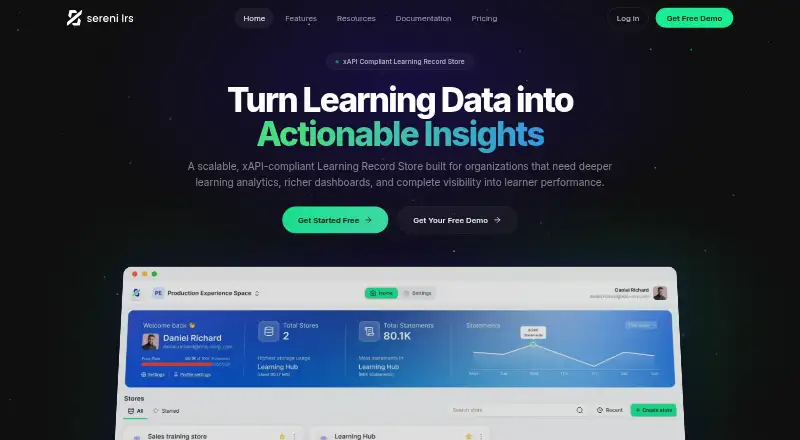
Sereni LRS is a Learning Record Store for capturing, validating, enriching, storing, analyzing, and using xAPI learning data. Its analytics workspace includes configurable dashboards, custom dimensions, aggregations, drill-downs, interactive filters, and scheduled reports. The Statement Explorer lets users inspect xAPI JSON payloads alongside attachments, metadata, validation status, and processing history. Integrations cover learning management and experience platforms, assessment and simulation tools, HR systems, business intelligence, and custom applications. APIs support statements, queries, analytics, reporting, store management, and authentication; OAuth 2.0 and webhooks are also listed. Deployment can be in the cloud or self-hosted within an organization's infrastructure. Security controls include role-based access, fine-grained permissions, audit logs, and encryption at rest and in transit. A Learning Locker migration utility preserves original IDs and timestamps and can safely rerun interrupted imports. The free plan costs nothing and includes up to 100,000 statements or events, 1 GB storage, unlimited Learning Record Stores, reporting, and analytics. Paid plans are for higher-volume and enterprise-scale use, with support and migration assistance. Saved dashboards and CSV, Excel, and PDF exports are marked Coming Soon.
Good
- Free plan includes up to 100,000 statements or events.
- Unlimited Learning Record Stores on the free plan.
- Analytics include filters, drill-downs, and scheduled reports.
- Can be cloud-deployed or self-hosted.
- Migration utility preserves IDs and timestamps.
Watch out
- Free plan includes 1 GB data storage.
- Saved dashboards are marked Coming Soon.
- CSV, Excel, and PDF exports are marked Coming Soon.
- Paid-plan pricing requires contacting sales.
Who it suits
The free plan suits evaluation, development, and small-scale learning deployments. The paid plan is aimed at organizations processing over 100,000 xAPI statements or events and needing enterprise-scale usage or support.
Verdict
Sereni LRS offers xAPI storage, inspection, and analytics with cloud or self-hosted deployment. Its free tier has defined event and storage limits, while higher-volume use is directed to a paid plan.
Plans and prices
From Sereni LRS's own pricing page, checked 2 Oct 2001.
| Plan | Price | What it gives you |
|---|---|---|
| Free Plan | Free | Up to 100,000 xAPI statements/events · 1 GB data storage · Unlimited Learning Record Stores · Unlimited reporting and analytics · $0/forever |
| Paid Plan | Priced on request | For more than 100,000 xAPI statements/events · Higher storage and enterprise-scale usage · Enterprise support and commercial licensing where applicable · Priority onboarding and migration assistance · Contact Sales |
The facts
Each one read from Sereni LRS's own pages, with the date it was checked.
What it does
- Analytics
- Its analytics workspace includes configurable dashboards, custom dimensions, aggregations, drill-down analytics, interactive filters, and scheduled reports.checked 2 Oct 2001
- APIs
- It exposes xAPI statement, query, analytics, reporting, store management, and authentication APIs, and lists OAuth 2.0 and webhooks.checked 2 Oct 2001
- Coming soon
- Saved dashboards and CSV, Excel, and PDF exports are marked Coming Soon.checked 2 Oct 2001
- Deployment
- The product page says Sereni LRS can be deployed in the cloud or self-hosted within an organization's own infrastructure.checked 2 Oct 2001
- Integrations
- The product lists integrations with LMSs, learning experience platforms, assessment engines, simulation platforms, HR systems, business intelligence tools, and custom applications.checked 2 Oct 2001
- Intended audience
- The free plan is described as ideal for evaluation, development, and small-scale learning deployments; the paid plan is for organizations processing over 100,000 xAPI statements or events.checked 2 Oct 2001
- Migration
- The home page describes a Learning Locker migration utility that preserves original IDs and timestamps and supports safely rerunning interrupted imports.checked 2 Oct 2001
- Product
- Sereni LRS is a Learning Record Store that captures, validates, enriches, stores, analyzes, and operationalizes xAPI learning data.checked 2 Oct 2001
- Security
- Listed security controls include role-based access control, OAuth 2.0 authentication, audit logs, encryption at rest, TLS in transit, and fine-grained permissions.checked 2 Oct 2001
- Statement explorer
- The Statement Explorer can inspect xAPI JSON payloads, attachments, metadata, validation status, and processing history.checked 2 Oct 2001
- Storage architecture
- The features page says Sereni LRS uses ClickHouse and AWS S3 or Azure Storage.checked 2 Oct 2001
- Support
- The paid plan lists enterprise support, priority onboarding, and migration assistance.checked 2 Oct 2001
The full review of Sereni LRS
Sereni LRS is a Learning Record Store for organizations that need to capture and work with xAPI learning data. It suits teams evaluating an LRS or running a small deployment, as well as larger organizations that need cloud or self-hosted operation. Its strongest case is the combination of statement inspection, analytics, and APIs; its free tier has firm storage and event caps.
Overview
Sereni LRS handles xAPI data from capture and validation through storage, analysis, and operational use. It can connect with LMSs, learning experience platforms, assessment and simulation systems, HR platforms, BI tools, and custom applications, making it a fit for organizations consolidating learning records across several systems.
Cloud and self-hosted deployment provide flexibility over where the service runs. Its architecture uses ClickHouse alongside AWS S3 or Azure Storage. Multi-tenant support and unlimited Learning Record Stores on the free plan are useful for separating deployments, though the free plan's 1 GB storage limit can constrain sustained use.
Key features
Inspection and analytics
The Statement Explorer exposes xAPI payloads, attachments, metadata, validation status, and processing history. That makes it useful for tracing data quality and processing issues, not just storing records. The analytics workspace supports configurable dashboards, custom dimensions, aggregations, drill-downs, interactive filters, and scheduled reports. Saved dashboards and CSV, Excel, and PDF exports are marked as coming soon, so teams that depend on those workflows should not treat them as current capabilities.
Integration, APIs, and controls
Statement, query, analytics, reporting, store-management, and authentication APIs give developers several routes to integrate and retrieve data; OAuth 2.0 and webhooks are also listed. Security controls include role-based access, fine-grained permissions, audit logs, encryption at rest, and TLS in transit. A Learning Locker migration utility is described as preserving original IDs and timestamps and allowing interrupted imports to be safely rerun, a practical advantage for teams moving an existing store.
Pricing
The Free Plan costs nothing, billed $0/forever. It includes up to 100,000 xAPI statements or events, 1 GB of storage, unlimited Learning Record Stores, and unlimited reporting and analytics. That makes it a credible option for evaluation, development, and small-scale deployments, but the storage ceiling and event quota set clear boundaries for production growth.
The Paid Plan has custom pricing and is aimed at organizations processing more than 100,000 statements or events. It offers higher storage, enterprise-scale usage, enterprise support, commercial licensing where applicable, priority onboarding, and migration assistance. The move up is relevant when volume exceeds the free allowance or enterprise support is needed; organizations should seek a quote to assess the commercial fit.
Platforms
Sereni LRS is available through an API and web interface, with self-hosted deployment as an option alongside cloud operation. That choice can suit organizations with infrastructure requirements, while teams seeking a specific native desktop or mobile client should look elsewhere.
Who it's for
Sereni LRS is best suited to learning technology teams that need to collect xAPI data across multiple systems, inspect individual statements, and analyze activity through configurable reporting. The free tier lowers the barrier for pilots and small deployments; larger organizations can consider the paid plan for expanded capacity and migration support. It is less compelling for buyers who require saved dashboards or spreadsheet and PDF exports today, or whose expected usage outgrows the free caps but cannot accommodate custom pricing.
Pros and cons
- Pros: Statement-level inspection includes validation and processing history, which helps teams investigate data issues.
- Pros: The free plan combines unlimited stores and analytics with a 100,000-event allowance, making evaluation more substantial than a short trial.
- Pros: Cloud and self-hosted deployment, multi-tenant support, and broad APIs suit varied integration and infrastructure needs.
- Cons: Free storage stops at 1 GB, which may become the tighter constraint for growing records even before the event cap.
- Cons: Saved dashboards and common file exports are not ready yet, limiting established reporting workflows.
- Cons: The paid plan uses custom pricing, so larger-volume buyers must consult sales rather than compare a published rate.
Alternatives
Learning Record Store Software is the category directory for comparing other LRS options. Choose Veracity Learning if its free Lite plan's five LRSs and infrastructure-based deployment better match your setup. GrassBlade LRS is an alternative for buyers seeking a paid product with a published annual Essential plan and a stated monthly statement allowance.
Cluelabs LRS is another freemium option to compare. Choose SQL LRS if Apache 2.0 open-source self-hosting is the priority and separately quoted implementation or support services are acceptable. SCORM Cloud LRS may suit buyers who want a time-unlimited trial with a defined course, storage, and registration allowance before choosing a paid plan.
Jupiter is worth comparing for its hosted option with a stated allowance of up to 1 million events per year. Mosra is a free launch-period alternative with paid plans planned but not yet live. Ralph is an alternative if an MIT-licensed Python package and Docker image fit your self-hosted setup.
Verdict
Sereni LRS is a strong fit for teams that need xAPI storage plus meaningful inspection and analytics, particularly when cloud or self-hosted deployment matters. Its free plan offers room to evaluate or run a small deployment without sacrificing reporting, but the 1 GB cap and the paid plan's custom pricing are important constraints. Choose it for its data workflow and deployment flexibility; look elsewhere if ready-made exports, saved dashboards, or transparent high-volume pricing are essential.
Alternatives to Sereni LRS
- 1
xh
Free planOpen sourceAndroidLinuxmacOSWindows7.6Free plan - 2
SQL LRS
Free planOpen sourceWebAPILinuxmacOS7.5Free plan - 3
Cluelabs LRS
Free planAndroidiOSWebAPI7.2From $19.95 a month - 4
Veracity Learning
Free planWebAPILinuxmacOS7.1From $100 a month - 5
Mosra
Free planWebmacOSSelf-hostedWindows7.0Free plan - 6
GrassBlade LRS
AndroidiOSWebAPI6.7From $5.50 a month