ADL Open Source LRS
ADL Open Source LRS stores learning data collected through the Experience API, or xAPI.
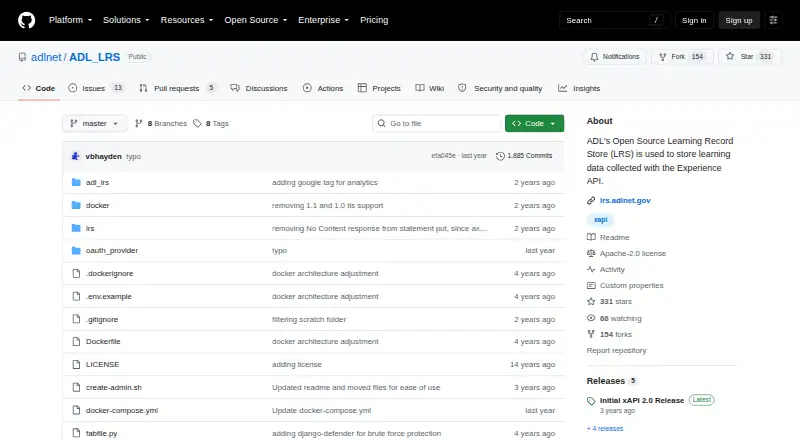
What ADL Open Source LRS is
ADL Open Source LRS stores learning data collected through the Experience API, or xAPI. The project says this version matches IEEE 9274.1.1, also known as xAPI 2.0, and describes it as stable for proof-of-concept use with a small number of users. It is free and distributed under the Apache License, Version 2.0.
Docker and Docker Compose are the recommended installation method. The deployment includes a Django web service with uWSGI, an nginx HTTP/HTTPS proxy, PostgreSQL, RabbitMQ, and Redis. OAuth is disabled by default; it can be enabled through the OAUTH_ENABLED setting, with clients registered to the LRS. Optional webhooks can filter incoming statements and forward matches to a client endpoint, and are also disabled by default. A webhook can include a secret for an HMAC signature. Celery processes activity metadata retrieval, statement voiding, and LRS hooks asynchronously. Database settings can be changed through settings.ini. The installation guide describes using an included Certbot container to obtain a certificate for a publicly available domain and restarting nginx to use it.
Good
- Free and distributed under Apache License 2.0.
- Updated for IEEE 9274.1.1, also known as xAPI 2.0.
- Docker deployment includes database and supporting services.
- Optional webhooks can filter and forward statements.
- Database settings can be changed through settings.ini.
Watch out
- Intended to support only a small number of users.
- OAuth is disabled by default.
- Webhooks are disabled by default.
Who it suits
ADL Open Source LRS may suit developers or teams implementing xAPI storage for a proof of concept with a small user base. It is intended for users comfortable with its recommended Docker-based setup and configuration options.
Verdict
ADL Open Source LRS provides a free, self-hosted option for storing xAPI learning data, with configurable services and optional integrations. Its stated small-user proof-of-concept scope is an important limitation to consider.
Plans and prices
From ADL Open Source LRS's own pricing page, checked 4 Oct 2001.
| Plan | Price | What it gives you |
|---|---|---|
| ADL Open Source LRS | Free | proof of concept · intended to support a small amount of users |
The facts
Each one read from ADL Open Source LRS's own pages, with the date it was checked.
What it does
- Asynchronous processing
- The project uses Celery to retrieve activity metadata, process statement voiding and check LRS hooks asynchronously.checked 4 Oct 2001
- Database configuration
- The installation guide says the database can be changed through the database settings in settings.ini.checked 4 Oct 2001
- Deployment
- The project recommends Docker and Docker Compose as the simplest installation method.checked 4 Oct 2001
- Included services
- The Docker deployment includes a Django web service with uWSGI, an nginx HTTP/HTTPS proxy, PostgreSQL, RabbitMQ and Redis.checked 4 Oct 2001
- License
- The repository distributes the software under the Apache License, Version 2.0.checked 4 Oct 2001
- OAuth
- OAuth is not enabled by default; the wiki describes enabling it through the OAUTH_ENABLED setting and registering clients with the LRS.checked 4 Oct 2001
- Purpose
- The LRS stores learning data collected with the Experience API (xAPI).checked 4 Oct 2001
- Scale
- The project describes this version as stable but intended to support only a small number of users as a proof of concept.checked 4 Oct 2001
- SSL
- The Docker installation guide describes an included Certbot container for obtaining a certificate for a publicly available domain and restarting nginx to use it.checked 4 Oct 2001
- Standard
- The repository says the LRS was updated to match IEEE 9274.1.1, also known as xAPI 2.0.checked 4 Oct 2001
- Statement webhooks
- Optional webhooks can filter incoming xAPI statements and send matching statements to a client endpoint; they are disabled by default.checked 4 Oct 2001
- Support and contributions
- The repository invites contributions through pull requests and directs users who do not want to edit code to submit an issue.checked 4 Oct 2001
- Webhook signing
- A webhook can optionally include a secret that the LRS uses to send an HMAC hex digest in the X-LRS-Signature header.checked 4 Oct 2001
Alternatives to ADL Open Source LRS
- 1
xh
Free planOpen sourceAndroidLinuxmacOSWindows7.6Free plan - 2
SQL LRS
Free planOpen sourceWebAPILinuxmacOS7.5Free plan - 3
Cluelabs LRS
Free planAndroidiOSWebAPI7.2From $19.95 a month - 4
Veracity Learning
Free planWebAPILinuxmacOS7.1From $100 a month - 5
Mosra
Free planWebmacOSSelf-hostedWindows7.0Free plan - 6
GrassBlade LRS
AndroidiOSWebAPI6.7From $5.50 a month