Google Config Sync
Google Config Sync automates configuration and policy synchronization across Kubernetes clusters.
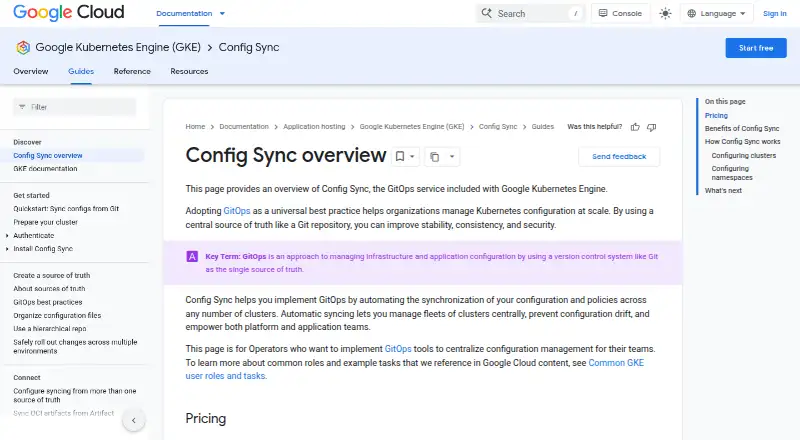
What Google Config Sync is
Google Config Sync automates configuration and policy synchronization across Kubernetes clusters. It monitors a source of truth and reconciles cluster state to help prevent configuration drift. Configuration can come from Git repositories, OCI images, or Helm charts, and the service can apply Policy Controller constraints across registered and connected clusters. It can also provision and manage namespaces with namespace-scoped policies such as RBAC roles for multi-tenancy. Config Sync supports Autopilot and Standard GKE clusters, along with GKE-attached clusters, including EKS and AKS. Clusters must be registered to a fleet before Config Sync can be enabled. Its architecture combines hosted components in Google Cloud with open source components on GKE. For OCI repositories, it can integrate with an admission webhook signature verification server to help ensure only trusted images are used. Config Sync is included with Google Kubernetes Engine at no added listed price, but requires a GKE-supported cluster version and fleet registration. It runs only on x86-based nodes, not Arm nodes. The drift-prevention admission webhook can use high amounts of memory and cause out-of-memory errors in clusters with many custom resources.
Good
- Synchronizes configurations from Git, OCI, and Helm sources.
- Supports Autopilot and Standard GKE clusters.
- Manages namespaces with namespace-scoped policies.
- Included with Google Kubernetes Engine.
Watch out
- Clusters must be registered to a fleet.
- Runs only on x86-based nodes, not Arm nodes.
- The drift-prevention webhook can cause high memory use.
Who it suits
It suits teams managing configuration and policies across GKE clusters, including attached clusters. Its requirements and node-architecture limit matter for teams planning a deployment.
Verdict
Config Sync automates reconciliation and policy management across connected Kubernetes clusters. Check fleet registration, supported cluster versions, node architecture, and potential webhook memory use before enabling it.
Plans and prices
From Google Config Sync's own pricing page, checked 15 Oct 2026.
| Plan | Price | What it gives you |
|---|---|---|
| Config Sync included with GKE | Free | GKE cluster required · fleet registration required · supports Autopilot and Standard clusters · No separate Config Sync charge; underlying GKE resources are billed |
The facts
Each one read from Google Config Sync's own pages, with the date it was checked.
What it does
- API and extensibility
- RootSync and RepoSync Kubernetes custom resources expose configuration fields such as source type, repository, revision, directory, and authentication.checked 15 Oct 2026
- Architecture
- Config Sync includes hosted components running in Google Cloud and open source components running on the GKE cluster.checked 1 Oct 2026
- Authentication options
- Supported repository authentication includes SSH keys, tokens, Kubernetes service accounts, Google service accounts, and GitHub Apps, with method-specific limitations.checked 15 Oct 2026
- Automatic reconciliation
- It continuously monitors the source of truth and reconciles cluster state to match it, preventing configuration drift.checked 1 Oct 2026
- CLI tooling
- Documentation provides the nomos command-line tool for validation, status inspection, hydration, and troubleshooting.checked 15 Oct 2026
- Cloud integrations
- Google documents integrations with the Google Cloud console, Terraform, Google Cloud CLI, Policy Controller, Workload Identity Federation for GKE, and Cloud Monitoring.checked 15 Oct 2026
- Cluster modes
- Config Sync supports both Autopilot and Standard GKE clusters.checked 1 Oct 2026
- Documentation depth
- The documentation includes guides, quickstarts, installation instructions, gcloud references, error references, RootSync and RepoSync fields, release notes, training, and troubleshooting.checked 15 Oct 2026
- Drift prevention limitation
- The drift-prevention admission webhook can cause high memory usage and out-of-memory errors in clusters with many custom resources.checked 1 Oct 2026
- Drift reconciliation
- Config Sync continuously compares cluster state with the declared source and reconciles differences automatically.checked 15 Oct 2026
- Fleet requirement
- Clusters must be registered to a fleet before Config Sync can be enabled.checked 15 Oct 2026
- GitOps synchronization
- Config Sync automates synchronization of configuration and policies across any number of clusters.checked 1 Oct 2026
- Go module
- pkg.go.dev lists Config Sync version v1.23.3 as an Apache-2.0, tagged, redistributable Go module published March 11, 2026.checked 15 Oct 2026
- Helm rendering
- Config Sync fetches and renders Helm charts and can deploy their resulting resources into a namespace.checked 15 Oct 2026
- Identity security
- Workload Identity Federation for GKE is the recommended way to securely connect to Google Cloud services and is required for fleet packages.checked 1 Oct 2026
- Independent service description
- A UK government G-Cloud service summary describes Config Sync as keeping configuration in version control and automatically applying it consistently across Kubernetes clusters.checked 15 Oct 2026
- Kustomize support
- It automatically renders native Kustomize configurations and Helm references, but excludes custom Kustomize plugins.checked 15 Oct 2026
- Licence
- The open-source Config Sync repository is published under the Apache-2.0 licence.checked 15 Oct 2026
- Limit: built-in roles
- Config Sync cannot directly manage GKE built-in ClusterRoles such as cluster-admin, admin, edit, and view.checked 15 Oct 2026
The company
- Company founded
- Crunchbase lists Google as founded in 1998.checked 15 Oct 2026
- Company headquarters
- Crunchbase lists Google's headquarters as Mountain View, California, United States.checked 15 Oct 2026
- Company legal name
- Crunchbase identifies the maker's legal name as Google LLC and its parent as Alphabet.checked 15 Oct 2026
- Company ownership
- Crunchbase identifies Google as a subsidiary of Alphabet and a for-profit public company traded as NASDAQ:GOOG.checked 15 Oct 2026
Where it runs
- Limit: application delivery
- Google describes Config Sync as complementary to CI/CD and primarily suited to base-layer resources rather than replacing application deployment systems.checked 15 Oct 2026
The full review of Google Config Sync
Google Config Sync is a cloud-delivered GitOps service for teams that need Kubernetes configuration and policy kept consistent across a fleet. It is most compelling for GKE operators managing several clusters, including attached EKS or AKS clusters, who want reconciliation to replace recurring manual correction. The trade-off is operational: fleet registration, x86 nodes, and careful handling of admission webhooks are prerequisites.
Overview
Config Sync treats Git repositories, OCI images, or Helm charts as sources of truth and continually brings connected cluster state back into alignment. That makes it a strong fit for organizations where drift, inconsistent namespaces, or policy exceptions create real governance risk. It is less suitable for Arm-only infrastructure or teams that do not want a cloud-managed component alongside software running in their clusters.
Key features
Automatic reconciliation works across any number of clusters, so a change can be propagated through a common workflow instead of repeated cluster-by-cluster edits. Supported Git sources include GitHub, GitLab, Bitbucket, Cloud Source Repositories, and Secure Source Manager. Deployment targets cover GKE and GKE-attached clusters, including EKS and AKS, giving multi-cloud estates a single synchronization model.
Policy Controller constraints can be applied consistently to registered and connected clusters. Rego policies, testing, admission control, runtime enforcement, policy reporting, and audit logs provide a broad policy lifecycle rather than synchronization alone. Namespace provisioning and namespace-scoped controls such as RBAC roles are particularly useful for multi-tenancy, where every cluster needs the same isolation rules.
Progressive delivery, CI/CD integration, infrastructure provisioning, infrastructure-as-code support, Kubernetes management, and role-based access control extend the service beyond basic file copying. OCI repositories can be paired with an admission-webhook signature verification server, helping organizations reject untrusted images before they are admitted.
The architecture combines hosted Google Cloud components with open-source components on GKE. Autopilot and Standard GKE clusters are supported, but a cluster must first be registered to a fleet. Workload Identity Federation for GKE is the recommended secure connection to Google Cloud services and is required for fleet packages.
Pricing
| Plan | Price | Best for |
|---|---|---|
| Config Sync included with GKE | free | Teams already using Google Kubernetes Engine |
The plan is billed as included with Google Kubernetes Engine, rather than as a separate Config Sync charge. It requires a GKE-supported cluster version and fleet registration, so the zero price does not remove the infrastructure and eligibility requirements. Google Cloud also sells support packages with 24/7 coverage, phone support, and access to a technical support manager. Support does not extend to customer-owned YAML configurations, which leaves configuration quality and troubleshooting responsibility with the customer.
Platforms
Config Sync is delivered through the cloud and is listed for API, self-hosted, and web use. It supports both Autopilot and Standard GKE clusters, plus GKE-attached EKS and AKS clusters. The major platform restriction is architectural: it runs only on x86-based nodes, not Arm nodes.
Who it's for
Choose it when a GKE fleet needs one source of truth for configuration, namespaces, and policy, especially in multi-tenant or multi-cloud Kubernetes operations. It also suits teams that need policy testing, admission controls, runtime enforcement, and auditable reporting in the same operating model. Look elsewhere if your nodes are Arm-based, if fleet registration is unacceptable, or if your organization needs vendor support to cover its own YAML authoring and errors.
Pros and cons
Pros
- Fleet-wide reconciliation: continuously corrects drift across any number of clusters.
- Broad source and target coverage: combines major Git providers, OCI, Helm, GKE, EKS, and AKS-attached environments.
- Serious policy controls: Rego, testing, admission, runtime enforcement, reporting, and audit logs support governed deployments.
- Included GKE pricing: avoids a separate Config Sync license charge for eligible GKE use.
Cons
- Fleet registration is mandatory: it adds an onboarding dependency before enablement.
- x86-only execution: Arm node environments cannot run the service.
- Webhook memory risk: drift-prevention admission webhooks can cause high memory use and out-of-memory errors with many custom resources.
- YAML support boundary: Google does not support issues in customer-owned YAML files.
Alternatives
Cloudify is a better fit for teams wanting a freemium platform with Linux, macOS, Windows, self-hosted, API, and web options; its free Community plan has no time limit but requires Docker or a VM and a cloud provider.
Kubermatic Kubernetes Platform suits organizations preferring open-source Apache 2.0 community software, with an enterprise consumption-based subscription also available.
Apache CloudStack is the straightforward choice for free, open-source IaaS cloud software rather than a managed Config Sync workflow.
KubeSphere is an alternative for teams seeking a free, enterprise-grade open-source Kubernetes container platform.
Qstack offers a free lifetime basic plan for small IDC teams and a 9,999 CNY annual professional plan for growing IDC businesses.
CloudBolt fits teams wanting a freemium cloud-management platform with its free tier capped at 100 resources.
Karmada is a free, open-source Kubernetes management system without a free trial.
Crossplane is suited to teams wanting an Apache 2.0 open-source project that runs inside an existing Kubernetes cluster.
Verdict
Google Config Sync is a strong choice for GKE-centered teams that need dependable, policy-aware synchronization across a registered fleet and attached clusters. Its included pricing and deep governance features are persuasive. Choose another platform when Arm support, independent fleet onboarding, or broader responsibility for customer configuration is more important than Google’s integrated fleet model.
Alternatives to Google Config Sync
- 1

Portainer
Free planOpen sourceAndroidiOSWebAPI8.6Free plan - 2
Plural
Free planOpen sourceWebAPILinuxmacOS8.2From $450 a month - 3
Nullstone
Free planWebAPILinuxmacOS7.9From $50 a month - 4

PipeCD
Free planOpen sourceWebAPILinuxmacOS7.5Free plan - 5

Pulumi
Free planWebAPILinuxmacOS7.4From $40 a month - 6

GitLab Package Registry
Free planWebAPILinuxSelf-hosted7.1Free plan