Godot Engine
Godot Engine is a free, open-source engine for building 2D and 3D games, cross-platform projects, and XR experiences.
What Godot Engine is
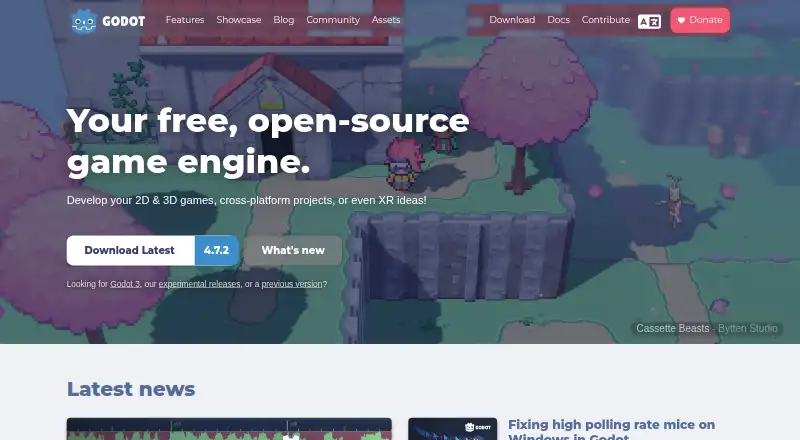
Godot Engine is a free, open-source engine for building 2D and 3D games, cross-platform projects, and XR experiences. Its node-and-scene system supports reusable components and hierarchical organization of game logic. The dedicated 2D pipeline includes pixel-based coordinates, a tile map editor, and interface tools; 3D asset imports include Blender files, glTF, and FBX. Developers can use GDScript, C#/.NET, and C++ through GDExtension, with other community language bindings also available. Godot includes OpenXR and WebXR support, with other XR SDKs accessible through plugins. Projects can be published to desktop, mobile, and web; console releases are supported through third-party publishers. The engine uses the MIT license, allowing commercial use and redistribution when its copyright notice and license statement are included. Creators retain copyright in their game content. C# is available for desktop and mobile; web support is available in Godot 3, while Godot 4 web support is planned. The latest stable download listed is Godot 4.7.2.
Good
- Free and open-source under the MIT license.
- Includes dedicated 2D and 3D tools.
- Supports GDScript, C#/.NET, and C++ via GDExtension.
- Includes OpenXR and WebXR support.
- Deploys to desktop, mobile, and web.
Watch out
- Godot 4 C# support is limited to desktop and mobile.
- Console releases use third-party publishers.
- Godot 4 web C# support is planned, not available.
Who it suits
Godot suits developers building 2D or 3D games, cross-platform projects, or XR experiences. Its MIT license permits commercial use and redistribution subject to including the required notices.
Verdict
Godot provides 2D, 3D, and XR development tools under an MIT license. Check the C# platform limits and third-party console publishing requirement against your target platforms.
Plans and prices
From Godot Engine's own pricing page, checked 30 Sep 2026.
| Plan | Price | What it gives you |
|---|---|---|
| Godot Engine | Free | Free and open-source game engine · no contracts or hidden fees |
The facts
Each one read from Godot Engine's own pages, with the date it was checked.
What it does
- 2D tools
- Godot has a dedicated 2D pipeline with pixel-based coordinates, a built-in tile map editor, and a GUI system for game interfaces and tools.checked 30 Sep 2026
- 3D features
- Provides 3D nodes for building, animating, and rendering 3D worlds and characters.checked 27 Sep 2026
- 3D tools
- The 3D asset pipeline imports Blender files, glTF, and FBX, and Godot's rendering options include Vulkan, Direct3D 12, and Metal.checked 30 Sep 2026
- C# limitation
- Godot's C# support is available for desktop and mobile, while the feature page says web support is planned for the future and points to Godot 3 for C# on web.checked 30 Sep 2026
- Community contribution
- People can contribute through code, documentation, or problem reports.checked 27 Sep 2026
- Community support
- The site directs users to community forums and invites bug reports, documentation contributions, and code contributions.checked 30 Sep 2026
- Console export
- Yeschecked 24 Sep 2026
- Console support
- Console deployment is supported through third-party publishers.checked 27 Sep 2026
- Dedicated 2D engine
- Includes a dedicated 2D rendering engine with pixel coordinates and 2D nodes.checked 27 Sep 2026
- Deployment
- The site describes publishing games to desktop, mobile, and web, with console releases supported through third-party publishers.checked 30 Sep 2026
- Development fund
- Users can support the project through the Godot Engine development fund.checked 27 Sep 2026
- Documentation support
- The project invites API reference updates, guides, and corrections.checked 27 Sep 2026
- Engine scope
- Supports 2D games, 3D games, cross-platform projects, and XR ideas.checked 27 Sep 2026
- Issue reporting
- Users can report engine problems so developers can track them.checked 27 Sep 2026
- Languages
- Godot includes GDScript and supports C#/.NET, C++ through GDExtension, and community language bindings such as Rust, Nim, Python, and JavaScript.checked 30 Sep 2026
- Latest version
- The latest listed version is Godot 4.7.2.checked 27 Sep 2026
- License
- Godot Engine is released under the MIT license, which permits commercial use and redistribution subject to including its copyright notice and license statement.checked 30 Sep 2026
- License privacy
- The site provides license and privacy policy links.checked 27 Sep 2026
- Mobile export
- Yeschecked 24 Sep 2026
- Multiplayer tools
- Yeschecked 24 Sep 2026
- Node scene system
- Its Node and Scene system is designed for power and flexibility.checked 27 Sep 2026
Where it runs
- C# platform limit
- C# is currently available only on desktop and mobile platforms in Godot 4.2.checked 27 Sep 2026
Money
- Free plan
- Yeschecked 24 Sep 2026
The company
- Game ownership
- The engine's license does not apply to content created with Godot, and creators retain copyright ownership of their games.checked 30 Sep 2026
The full review of Godot Engine
Godot Engine is a free, open-source game engine for developers building projects across desktop, mobile, and web. It suits creators who want a flexible engine with dedicated 2D tools as well as 3D and XR capabilities. Its strongest case is broad platform reach without engine licensing fees; C# and console publishing require extra planning.
Overview
Godot’s Node and Scene system organizes game logic as reusable components and hierarchies, a flexible foundation for projects that may grow in complexity. The engine’s MIT license permits commercial use and redistribution when the copyright notice and license statement are included. It does not claim ownership of games made with Godot: creators retain copyright in their content.
The latest listed stable release is Godot 4.7.2; Godot 4.8 dev 7 is a development snapshot. The distinction matters for teams choosing a stable release rather than a development build.
Key features
Dedicated 2D and 3D tools
Godot’s dedicated 2D engine uses pixel coordinates and 2D nodes, with a tile map editor and GUI system for game interfaces and tools. That makes it a particularly direct fit for 2D projects, rather than treating 2D as a secondary mode. For 3D, nodes support building, animating, and rendering worlds and characters; the asset pipeline imports Blender files, glTF, and FBX. Rendering options include Vulkan, Direct3D 12, and Metal.
Scripting and extensibility
GDScript is built in, with C#/.NET and C++ through GDExtension as other options. Community bindings extend the language choices to Rust, Nim, Python, and JavaScript. The main qualification is platform-specific: Godot 4.2 C# support is for desktop and mobile, while web C# support is planned; Godot 3 can run C# on the web. Teams committed to C# should verify that constraint against their target platforms before choosing a version.
XR and multiplayer
Godot includes OpenXR and WebXR support, with other XR SDKs available through community-maintained plugins. That gives XR developers a starting point while leaving some integrations dependent on community plugins. Multiplayer tools are also supported.
Pricing
Godot Engine: free. The free plan is the engine itself, with no contracts or hidden fees. There is no free trial because there is no paid engine plan to trial. Its MIT licensing terms permit commercial use and redistribution with the required notices, and creators keep copyright in their games.
The trade-off is not a paid-tier feature cap, but the practical limits around publishing: console deployment goes through third-party publishers, and C# does not cover web projects in Godot 4.2. Those requirements can add friction even though the engine has no licensing charge.
Platforms
Godot supports development for Windows, macOS, Linux, Android, iOS, and the web, with console releases handled through third-party publishers. Mobile export makes it a credible option for cross-platform projects, while the console route is less direct than exporting to desktop, mobile, or web. Its listed platforms also include API and extension.
Who it's for
Godot is a strong fit for independent developers and teams who want one open-source engine for 2D or 3D projects and value control over their game’s licensing. Its dedicated 2D pipeline, scripting choices, and desktop, mobile, and web deployment cover a broad range of projects. It is less straightforward for teams that need Godot 4 C# on the web or want to publish to consoles without a third-party provider.
Pros and cons
- Pros: The MIT license allows commercial use and redistribution with required notices, while creators retain copyright in their games.
- Pros: Dedicated 2D tools sit alongside 3D workflows, multiplayer support, and built-in OpenXR and WebXR.
- Pros: Desktop, mobile, and web deployment support cross-platform projects without an engine fee.
- Cons: Godot 4.2 C# is limited to desktop and mobile, so web-focused C# teams need another approach or Godot 3.
- Cons: Console deployment depends on third-party publishers, adding an external step to the release path.
Alternatives
Construct 3 is worth considering for individuals and hobbyists who want a freemium option with a free trial and a Personal License that unlocks all features and can be canceled at any time.
CRYENGINE is another free engine; its stated licensing terms are royalty-based, unlike Godot’s MIT license.
Defold is a free alternative with no licensing, royalty, or runtime fees, and a free-forever plan.
GDevelop offers a freemium route with a free plan described as a way to create a first game; consider it if that starting point better suits your needs.
GameMaker may suit developers who want to begin on a free plan, provided they can accept its non-commercial-use limit and lack of console exports.
libGDX is another free option for developers considering a game engine across mobile, web, and desktop platforms.
Stencyl offers a Starter plan for publishing to web/HTML5 and an Indie plan at $99 a year for web and desktop publishing.
Flax Engine is free for non-commercial or educational use; commercial releases pay a 4% royalty on earnings exceeding $250,000 per calendar year.
Browse Game Engine Software, Mobile Development IDEs, and Game Development Software to compare more options.
Verdict
Choose Godot if you want a capable, open-source engine for 2D or 3D games and cross-platform release without paying an engine fee. Its licensing and dedicated 2D workflow are compelling, but teams should look elsewhere or plan around it if they require Godot 4 C# on the web or a direct console publishing route.
Getting started
- Visit the Godot Engine website.
- Download the latest stable version, Godot 4.7.2.
- Choose a supported scripting option such as GDScript, C#, or C++ through GDExtension.
- Build and organize the project with nodes and scenes.
- Publish to desktop, mobile, or web; arrange console release through a third-party publisher.
Questions
How much does Godot Engine cost?
Godot Engine is free. The listed plan is free.
Is Godot Engine open source?
Yes. It is released under the MIT license, which permits commercial use and redistribution with the required copyright notice and license statement.
Which platforms can Godot projects target?
Projects can be published on desktop, mobile, and web. Console releases are supported through third-party publishers.
Which scripting languages does Godot support?
Godot includes GDScript and supports C# and C++ through GDExtension. Community bindings include Rust, Nim, Python, and JavaScript.
Can I use C# for web projects?
C# support in Godot 4 is available on desktop and mobile. Godot 3 can run C# on the web.
Who makes Godot Engine?
Godot is an open-source project that welcomes contributions to its code, documentation, and issue reporting.