
Felgo
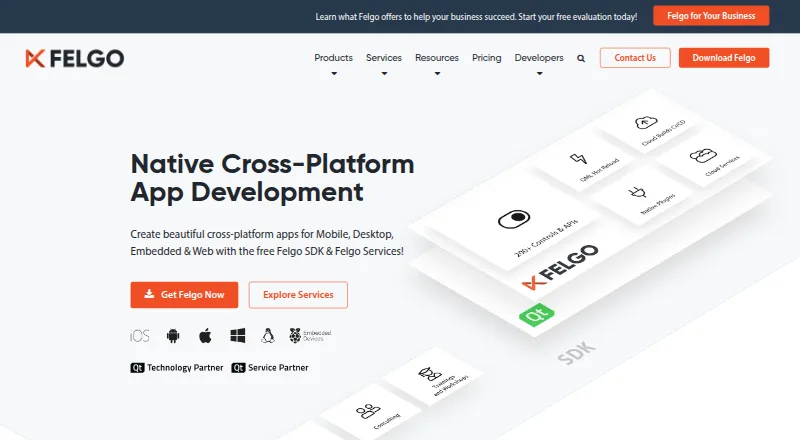
Felgo is a native cross-platform development SDK based on Qt for building applications, games and embedded software.
What Felgo is
Felgo is a native cross-platform development SDK based on Qt for building applications, games and embedded software. Developers work mainly in QML and JavaScript, and C++ is also supported. Felgo Live updates Qt QML and JavaScript on connected devices after a save, without waiting for build and deployment steps. Its Game Engine focuses on 2D casual games and includes Box2D physics, particles, multi-touch and animations. Felgo Apps can access device features such as cameras, sensors and file systems, and networking options include WebSockets, Bluetooth LE and NFC. Projects in Felgo Cloud IDE can be built and deployed through browser-based Cloud Builds. Game Network provides cross-platform achievements, leaderboards, challenges, cloud storage and offline support. Felgo lists Android, iOS, Windows, macOS, Linux and web support. The Personal plan has an annual turnover limit under €50k; Startup costs €€79 a month billed annually per developer and has a limit under €100k. Business costs €€245 a month billed annually.
Good
- QML, JavaScript and C++ are supported
- Live reload updates code on connected devices
- Game Engine includes Box2D physics and animations
- Supports mobile, desktop and web targets
- Cloud Builds can be used from a browser
Watch out
- Startup has an annual turnover limit under €100k
- Startup support is one hour per year
- Business costs €€245 a month billed annually
Who it suits
Felgo suits developers building cross-platform apps, casual 2D games or embedded applications with Qt-based tools. Its plans distinguish between turnover limits and include different levels of support.
Verdict
Felgo covers app, game and embedded development with device access, networking and browser-based builds. Check the turnover limits and support included with each plan when choosing a license.
Plans and prices
From Felgo's own pricing page, checked 28 Sep 2026.
| Plan | Price | What it gives you |
|---|---|---|
| Startup | €79 a month | Annual turnover under €100k · 1h/year premium support · mobile, desktop, web, Raspberry and Arduino platforms · source code access · billed annually per developer |
| Business | €245 a month | Unlimited annual turnover · 1h/month premium support and services · mobile, desktop, web and embedded platforms · all engine features · billed annually; €245, shown alongside €350 per developer/month |
| Personal | Free | All platforms · annual turnover under $50k · community support · monetization plugins · No credit card required |
| Indie | $79 a month | All platforms · annual turnover under $100k · one hour email support · billed annually; regular price shown as $120 per developer/month |
| Enterprise | Priced on request | Unlimited annual turnover · personal support and training · email, chat and phone support · five-hour free evaluation · custom pricing |
The facts
Each one read from Felgo's own pages, with the date it was checked.
What it does
- API extensibility
- Existing Qt applications can reuse their code with Felgo, and Felgo plugins can be added to Qt projects without Felgo components.checked 15 Oct 2026
- API surface
- The SDK extends Qt with more than 200 Felgo APIs and development tools.checked 15 Oct 2026
- Backend features
- Felgo Cloud includes cloud storage, chat, user authentication and friend-system capabilities in the paid plan comparison.checked 15 Oct 2026
- Cloud builds
- Felgo offers Cloud Builds for continuous integration and delivery of Qt and Felgo projects.checked 15 Oct 2026
- Core languages
- Felgo development uses QML and JavaScript, with Qt and C++ available for deeper integrations.checked 15 Oct 2026
- Documentation depth
- Documentation includes installation, deployment, API references, tutorials, examples, native integration, plugins, networking, storage, maps, sensors, AR, machine learning and accessibility.checked 15 Oct 2026
- Games
- The Felgo Game Engine focuses on 2D casual games and includes components such as Box2D physics, particles, multi-touch and animations.checked 28 Sep 2026
- Game services
- Felgo Game Network provides cross-platform achievements, leaderboards, challenges, cloud storage and offline support.checked 28 Sep 2026
- Game tooling
- The product includes game components, a level editor and Felgo Game Network features for sharing user-created levels.checked 15 Oct 2026
- Google Play listing
- Felgo 4 QML Dev App is listed on Google Play with 1K+ downloads and support from FELGO GmbH in Vienna.checked 15 Oct 2026
- Hot reload
- Felgo Hot Reload lets developers change QML and JavaScript and see updates without rebuilding and redeploying.checked 15 Oct 2026
- Installation
- Installing the SDK requires a Felgo account, platform prerequisites and downloading the Felgo installer.checked 15 Oct 2026
- Integrations
- Official plugins cover AdMob, Amplitude, Apple Sign In, Chartboost, Facebook, Firebase, Flurry, Game Center, OneSignal, OAuth 2.0 and other services.checked 15 Oct 2026
- Languages
- Felgo uses QML and JavaScript as its main coding languages and is based on the Qt framework.checked 28 Sep 2026
- Latest release
- Felgo 4.4.0 was released on 2026-08-27 with Android 16 support, desktop OAuth 2.0, macOS Keychain access and native macOS code components.checked 15 Oct 2026
- License expiry
- Published apps remain functional after a commercial Felgo license expires, but new updates using commercial Felgo features cannot be released.checked 15 Oct 2026
- License limits
- Personal and Startup licenses have annual turnover limits of under €50k and under €100k respectively; Business has unlimited annual turnover.checked 28 Sep 2026
Where it runs
- App-store presence
- Felgo GmbH publishes Felgo QML Developer apps and other demonstration apps on Apple's App Store.checked 15 Oct 2026
The company
- Company
- Felgo identifies itself as FELGO GmbH and lists offices in Vienna and Linz, Austria.checked 28 Sep 2026
- Company facts
- LinkedIn lists Felgo as privately held, founded in 2012, headquartered in Vienna and employing 11–50 people.checked 15 Oct 2026
- Company legal name
- The product and associated services are provided by FELGO GmbH.checked 15 Oct 2026
- Headquarters
- Vienna, Austriachecked 28 Sep 2026
Money
- Free evaluation
- Felgo offers companies a free Business evaluation with access to Business features, up to five hours of professional services and priority support.checked 28 Sep 2026
- Free plan
- Yeschecked 22 Sep 2026
The full review of Felgo
Overview
Felgo is a Qt-based SDK for creating native cross-platform apps, games and embedded software. It suits developers who want one QML and JavaScript-oriented toolkit spanning mobile, desktop, web and hardware projects. Its broad scope is useful, but licensing costs and turnover limits matter for commercial teams.
The toolkit combines a visual UI designer, emulator or simulator support and app packaging with browser-based cloud builds. Felgo is made by FELGO GmbH, which lists offices in Vienna and Linz, Austria. The company says information-storing servers are in the European Economic Area and that it acts as a GDPR data processor for EEA clients.
Key features
- Qt cross-platform development: QML and JavaScript are the main languages, with C++ supported as well. This gives teams a shared code approach across Android, iOS, Windows, macOS, Linux, web and embedded targets, while still requiring Qt familiarity.
- Live reload: Felgo Live sends saved QML and JavaScript changes to connected devices without a separate build and deployment cycle. It is particularly valuable during interface iteration and shortens feedback loops.
- 2D game engine: The engine targets casual 2D games and includes Box2D physics, particles, multi-touch and animations. It is a focused option for this style of game rather than a general statement of 3D capability.
- Services and integrations: Plugins cover AdMob, Chartboost, in-app purchases, Facebook, Flurry analytics and Google Firebase. Felgo Game Network adds achievements, leaderboards, challenges, cloud storage and offline support for cross-platform game services.
- Device and network access: Apps can use cameras, sensors and the file system, with networking features including WebSockets, Bluetooth LE and NFC. That makes the SDK relevant to connected-device and embedded work as well as conventional apps.
- Cloud workflow: Projects in Felgo Cloud IDE can be built and deployed through Felgo Cloud Builds from a browser. This helps teams that want a hosted build path, although the value depends on the selected license and support terms.
Pricing
Felgo uses a freemium model with a free plan and a free trial. Paid access starts at €79/mo (annual), but the Personal plan has no published price.
Personal
Personal is intended for projects with annual turnover under €50k. The turnover ceiling makes it suitable for hobbyists and very small commercial efforts, but businesses approaching that threshold need a higher tier.
Startup
Startup costs €79 a month, billed annually per developer. It allows annual turnover under €100k and includes one hour of premium support per year, source code access, and mobile, desktop, web, Raspberry and Arduino platforms. It is the practical paid entry point for small teams, though its support allowance is limited.
Business
Business costs €245 a month, billed annually; the listing also shows 350 EUR per developer/month. It removes the turnover ceiling, adds one hour of premium support and services each month, covers mobile, desktop, web and embedded platforms, and includes all engine features. Companies can evaluate Business features free with up to five hours of professional services and priority support.
Personal and Startup licenses impose annual-turnover limits, while Business does not. Choose by expected revenue, target platforms and the amount of premium assistance required, not just the monthly figure.
Platforms
Felgo targets Android and iOS on mobile; Windows, macOS and Linux on desktop; web; and embedded hardware. Startup specifically includes Raspberry and Arduino platforms, while Business lists embedded support. QML, JavaScript and C++ are supported, with emulator or simulator tools and app packaging included.
Who it's for
Felgo is a strong fit for developers building several platform versions from a Qt foundation, especially when QML/JavaScript live reload, device APIs or browser-based cloud builds are important. Casual 2D game teams also gain ready-made physics and game-service components. It is less suitable for organizations that need unrestricted turnover under a lower-cost license, or for teams seeking a purely free engine without commercial-plan decisions.
Pros and cons
Pros
- Wide target coverage: One SDK spans mobile, desktop, web and embedded projects.
- Fast iteration: Live reload avoids repeated build and deployment steps for QML and JavaScript edits.
- Useful device access: Camera, sensors, file system, WebSockets, Bluetooth LE and NFC support broaden project types.
- Game-oriented services: Physics, particles and Felgo Game Network reduce the need to assemble common casual-game features separately.
- EEA data location: Felgo states that service servers storing information are located in the European Economic Area.
Cons
- Revenue restrictions: Personal and Startup are capped at under €50k and under €100k annual turnover.
- Support is tiered: Startup includes only one premium-support hour per year, while more substantial assistance requires Business.
- Commercial pricing: Business at €245 a month billed annually is a significant commitment for small teams.
Alternatives
Godot Engine is the better choice when a free, open-source game engine with no contracts or hidden fees is the priority.
B4X suits developers who want free Android, iOS, desktop or Linux-oriented tools, including a commercially free B4A plan.
Codename One is worth considering for a free tier with 100 cloud-build credits per month and JavaScript-oriented cross-platform output.
Defold is preferable when permanently free game development with no licensing, royalty or runtime fees is the deciding factor.
Solar2D offers a free route for developers specifically seeking an engine without engine fees or royalties.
Monaca is an alternative for a cloud IDE workflow with a free plan including three projects and three remote builds per 24 hours.
Qt Creator is the natural alternative when you want Qt development directly, with an open-source version subject to LGPL/GPL obligations.
C++Builder is another option for teams targeting Android, iOS, macOS and Windows with a paid commercial toolset.
For broader discovery, browse the Mobile Development IDEs and Game Engine Software lists.
Verdict
Choose Felgo if you need Qt-based development across apps, casual 2D games and embedded targets, and value live reload, device integrations and cloud builds in one product. Look elsewhere if your revenue is likely to exceed the lower license caps or if a permanently free engine is more important than Felgo’s integrated platform and support options.
Alternatives to Felgo
- 1
Construct 3
Free planAndroidiOSWebLinux8.6Free plan - 2

Ren'Py
Free planOpen sourceAndroidiOSWebAPI8.6Free plan - 3
Bevy
Free planAndroidiOSWebLinux8.6From $5 a month - 4

Unity
Free planAndroidiOSWebAPI8.5Free plan - 5

Godot Engine
Free planAndroidiOSWebAPI8.3Free plan - 6

CRYENGINE
Free planAndroidiOSWebLinux8.3Free plan