Codename One
Codename One is an open-source framework for Java and Kotlin developers building native apps from a shared codebase.
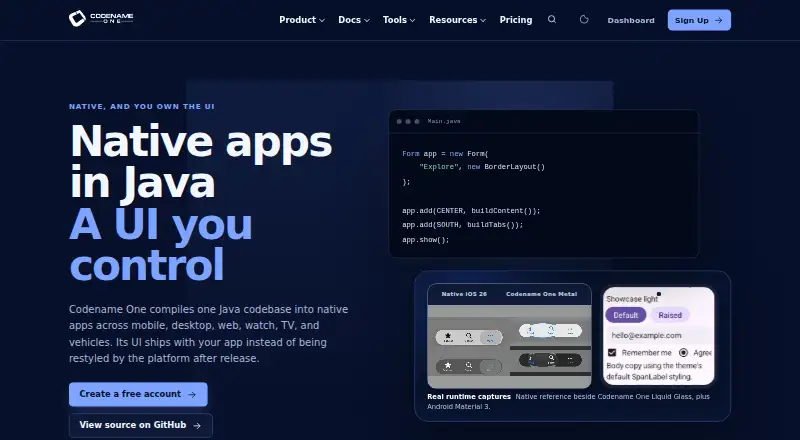
What Codename One is
Codename One is an open-source framework for Java and Kotlin developers building native apps from a shared codebase. Listed targets include Android, iOS, macOS, web browsers, Linux, and Windows. Its toolkit draws its own UI components and bundles the runtime and theme with the application. Developers can call platform SDKs through native interfaces and embed heavyweight views such as maps, web views, and camera surfaces. Projects use Maven and can be opened in IntelliJ IDEA, NetBeans, Eclipse, VS Code, or another Maven-capable IDE. The documented sign-in options cover OpenID Connect, Apple, Google, Facebook, Microsoft Entra ID, Auth0, and Firebase Authentication. Security guidance includes secure storage, encryption, certificate pinning, device integrity checks, and cryptographic APIs. The free plan includes 100 cloud build credits per month, with each iOS cloud build using eight credits, and an 8.5 MB user JAR limit. Commercial use is available without royalties or per-app fees.
Good
- Targets Android, iOS, desktop, and web
- Supports native SDK access and embedded views
- Free plan includes 100 monthly cloud build credits
- Commercial use has no royalties or per-app fees
- Supports Java and Kotlin
Watch out
- Free tier has an 8.5 MB user JAR limit
- Each iOS cloud build uses eight credits
- Pro and Enterprise support options vary by plan
Who it suits
It suits Java or Kotlin developers who want to build apps for mobile, desktop, and web targets from a shared codebase. Its free tier may suit projects that can work within the stated build-credit and JAR limits.
Verdict
Codename One offers a shared-codebase route to multiple app targets, with native interfaces and Maven-based projects. Review the free build limits and plan-specific support before deciding which tier fits.
Plans and prices
From Codename One's own pricing page, checked 14 Oct 2026.
| Plan | Price | What it gives you |
|---|---|---|
| Free | Free | 100 cloud-build credits/month · 8 credits per iOS cloud build · 8.5 MB user JAR · JavaScript cloud/local builds |
| Basic | $25 a month | Unlimited build credits · native sources · 50 MB JAR · 5,000 push notifications/month · 5 automated submissions/month · Billed annually at $300/year |
| Pro | $85 a month | Everything in Basic · concurrent builds · Crash Protection · 1 million push notifications/month · email support · Billed annually at $1020/year |
| Enterprise | $450 a month | Everything in Pro · high-priority builds and CI · on-device tests · 10 million push notifications/month · phone support · Billed annually at $5400/year |
The facts
Each one read from Codename One's own pages, with the date it was checked.
What it does
- API size
- The published client API reference lists 2,181 documented types across 182 packages.checked 14 Oct 2026
- API surface
- Documented APIs include advertising, analytics, AI inference, language, vision, push, security and many platform integrations.checked 14 Oct 2026
- Authentication integrations
- The identity guide documents OpenID Connect, Sign in with Apple, Google, Facebook, Microsoft Entra ID, Auth0, Firebase Authentication and passkeys/WebAuthn.checked 14 Oct 2026
- Authentication security
- The security implementation exposes portable hashing and HMAC plus native-provider AES, RSA, ECDSA and secure-random operations.checked 14 Oct 2026
- Build privacy
- The pricing FAQ says normal builds do not send source code to the cloud, while native platform sources may be uploaded when required for native compilation.checked 29 Sep 2026
- Build workflow
- Current projects use Maven and can be opened in IntelliJ IDEA, NetBeans, Eclipse, VS Code, or another Maven-capable IDE.checked 29 Sep 2026
- Commercial use
- The framework is available for commercial use without royalties or per-app fees.checked 29 Sep 2026
- Documentation depth
- The Developer Guide covers getting started, UI, data, networking, server-side work, platform services, AI, security, monetization, testing, shipping and platform guides.checked 14 Oct 2026
- Enterprise security feature
- App Shield is an Enterprise feature that issues short-lived attestation tokens based on server-side verification of Apple App Attest and Google Play Integrity statements.checked 29 Sep 2026
- Independent workflow review
- Baeldung describes Codename One as Maven-based, cloud-assisted, scriptable through CI and able to target iOS, Android, JavaScript, Windows and macOS.checked 14 Oct 2026
- Integrations
- The documented sign-in stack covers OpenID Connect, Sign in with Apple, Google, Facebook, Microsoft Entra ID, Auth0, and Firebase Authentication.checked 29 Sep 2026
- License
- The framework is licensed GPLv2 with the Classpath Exception and permits commercial use without royalties.checked 14 Oct 2026
- Limit: documentation and compatibility
- G2 reviewers report missing documentation, occasional platform discrepancies and the need for extra error checks.checked 14 Oct 2026
- Limit: graphics and portability
- A Stack Overflow discussion describes gaps in the Java portability layer, possible need for native integrations and suboptimal graphics performance for text-heavy screens.checked 14 Oct 2026
- Limit: setup and libraries
- Trustpilot reviewers report Certificate Wizard or server errors, outdated UI-builder plugins and difficulty integrating third-party libraries.checked 14 Oct 2026
- Local builds
- Android, iOS, JavaScript and desktop targets can be built locally when the required native toolchains are installed.checked 14 Oct 2026
- Maps integration
- The maps API offers a provider-neutral MapView plus NativeMap integrations with providers such as Apple MapKit and Google Maps.checked 14 Oct 2026
- Monetization
- The framework supports consumable, non-consumable and renewable or non-renewable in-app purchases and subscriptions on Android and iOS.checked 14 Oct 2026
Where it runs
- App targets
- The listed targets include Android, iOS, macOS, web browsers, Linux, and Windows.checked 29 Sep 2026
The company
- Company history
- Codename One's press page lists its initial release as 2012 and says its open-source project began in 2007 within Sun Microsystems.checked 29 Sep 2026
- Company legal name
- The official site footer identifies the maker as Codename One LTD.checked 14 Oct 2026
- Founded
- 2012checked 28 Sep 2026
- Independent company profile
- LinkedIn lists Codename One as privately held, founded in 2012, headquartered in Tel Aviv and employing 2–10 people.checked 14 Oct 2026
Money
- Free limits
- The free cloud tier has 100 build credits per month, with iOS builds using eight credits, and an 8.5 MB user JAR limit.checked 29 Sep 2026
The full review of Codename One
Codename One is a Java and Kotlin framework for building apps from one codebase, best suited to developers who want mobile, desktop, and web targets with platform SDK access. It offers unusually broad reach, though its own UI toolkit and cloud-build limits make it a more considered fit than a universal shortcut.
Overview
Codename One is an open-source framework whose project began in 2007 within Sun Microsystems; its initial release followed in 2012. Projects use Maven and can be opened in IntelliJ IDEA, NetBeans, Eclipse, VS Code, or another Maven-capable IDE. Commercial use carries no royalties or per-app fees, a practical advantage for products that may be shipped across multiple targets.
Key features
Shared toolkit, platform access
The framework draws its own UI components and bundles its runtime and theme with the app. That gives teams a consistent toolkit across targets, but it is not the best fit for developers who want each platform’s native controls to define the interface. Native interfaces provide access to platform SDKs, and heavyweight views such as maps, web views, and camera surfaces can be embedded when needed.
Builds, integrations, and security
Maven-based projects fit into several established IDEs rather than requiring a dedicated editor. The sign-in integrations cover OpenID Connect, Sign in with Apple, Google, Facebook, Microsoft Entra ID, Auth0, and Firebase Authentication. Security guidance includes secure storage, encryption, certificate pinning, device integrity checks, and cryptographic APIs. Enterprise adds App Shield, which issues short-lived attestation tokens based on server-side verification of Apple App Attest and Google Play Integrity statements.
Pricing
Codename One is freemium, with a 14-day trial and paid plans starting at $25/user/mo (annual). The Free plan costs nothing, billed Always free. It allows 100 cloud build credits per month; each iOS cloud build uses eight credits. The 8.5 MB user JAR cap and limited credits make Free suitable for learning and smaller experiments, but potentially restrictive for regular builds.
Basic costs $25 a year, billed annually at $300/year. It removes the build-credit limit and raises the build JAR size to 50 MB, with native platform sources, 5,000 push notifications per month, and five automated submissions per month. It is the clearest step up for projects whose build volume or package size exceeds Free’s caps, though the notification and submission allowances still matter.
Pro costs $85 a year, billed annually at $1020/year. It includes Basic, concurrent cloud builds, Crash Protection with GitHub Issues, one million push notifications per month, and email support. That makes it a stronger fit for teams that need parallel builds, higher notification volume, or direct support.
Enterprise costs $450 a year, billed annually at $5400/year. It includes Pro, high-priority builds and CI, on-device unit tests, 10 million push notifications per month, and phone support during office hours. This tier is aimed at organizations that need those testing, build-priority, and support provisions; smaller teams may not need to pay for them. Free includes community support, while Pro and Enterprise add email and office-hours phone support respectively. Normal builds do not send source code to the cloud, though native platform sources may be uploaded when native compilation requires them.
Platforms
Targets include Android, iOS/iPadOS, watchOS, tvOS, macOS, Windows, Linux, and web browsers. Emulator or simulator support, a visual UI designer, and app packaging are available. The reach is a strength for teams consolidating several targets around Java or Kotlin, but developers focused on only one platform may find the cross-platform toolkit unnecessary.
Who it's for
Codename One fits Java and Kotlin developers who want shared-code apps across mobile and other targets, while retaining access to platform SDKs and embedded native views. It is less suitable for visual-first builders or teams whose priority is native platform UI by default. The Free tier can support a trial project, but its iOS credit consumption and small JAR ceiling can push active development toward a paid plan.
Pros and cons
- Pro: A single framework targets mobile, desktop, and web, reducing the need to maintain a separate codebase for each listed target.
- Pro: Native interfaces and heavyweight view embedding preserve access to platform capabilities alongside the shared toolkit.
- Pro: Commercial use has no royalties or per-app fees, avoiding an additional per-app cost as products expand.
- Con: The toolkit draws its own components, so teams seeking platform-native widgets by default may prefer a different approach.
- Con: Free’s 100 monthly build credits, eight-credit iOS builds, and 8.5 MB user JAR limit can constrain frequent or larger builds.
- Con: Support varies by tier: community on Free, email on Pro, and phone support during office hours on Enterprise.
Alternatives
- B4X is another freemium option with free B4A and B4R plans, including commercial use, for readers whose needs align with Android development or the listed B4R offering.
- Felgo is a freemium alternative with a free plan and trial; consider it if its listed Personal or Startup options suit your budget and target platforms.
- Monaca offers a free tier with a cloud IDE, debugging, three projects, and three remote builds per 24 hours; it may suit readers who want those hosted tools and accept those caps.
- Smartface is another freemium option with a free plan and a listed spread of mobile, desktop, and web platforms.
- Xojo offers a one-time $499.00 USD Desktop plan for Mac, Windows, and Linux; it may suit readers seeking those desktop targets and a perpetual-price structure.
- DroidScript is free to download, with optional paid plugins and donations; consider it if that model fits your needs.
- Xcode Cloud includes 25 compute hours per month with Apple Developer Program membership, with unused hours not rolling over; it is an alternative for readers whose work fits that allowance and its listed Apple-oriented platforms.
- Qt Creator offers an open-source version, though Qt framework use carries LGPL/GPL obligations; consider it if that licensing arrangement suits your project.
- Browse Mobile Development IDEs for more options.
Verdict
Choose Codename One if your Java or Kotlin team values a shared codebase across mobile, desktop, and web, but still needs platform SDK access and royalty-free commercial use. Its main advantage is that reach without per-app fees; look elsewhere if you require native widgets by default or if the free build and JAR limits cannot support your development pace.
Getting started
- Visit the Codename One website
- Install Java or Kotlin development tools
- Create a Maven project
- Open it in a Maven-capable IDE
- Choose target platforms such as Android, iOS, desktop, or web
- Use the Free plan or start the 14-day trial
Limits worth knowing
The Free plan provides 100 cloud build credits per month, and each iOS cloud build uses eight credits. It also limits the user JAR to 8.5 MB; higher plans add unlimited credits and larger build limits.
Questions
Is Codename One free?
Yes. The Free plan is free and includes 100 cloud build credits monthly. A 14-day trial is also listed, with paid access from 25 /user/mo on annual billing.
What does Basic cost?
Basic is listed at $25 a year, billed annually at $300/year.
Which languages and platforms are supported?
Supported languages are Java and Kotlin. Targets include Android, iOS/iPadOS, watchOS, tvOS, Windows, macOS, Linux, and web browsers.
What support comes with each plan?
Free includes community support, Pro includes email support, and Enterprise includes phone support during office hours.
Does it support native platform features?
Yes. Native interfaces provide access to platform SDKs, and applications can embed maps, web views, and camera surfaces.
Is Codename One open source?
Yes. It is described as an open-source framework and supports commercial use without royalties or per-app fees.
Alternatives to Codename One
- 1

Unity
Free planAndroidiOSWebAPI8.4Free plan - 2

Felgo
Free planAndroidiOSWebAPI8.2Free plan - 3

GeneXus
Free planAndroidiOSWebAPI8.2From $99 a year - 4
Qt Creator
Free planAndroidiOSWebLinux7.7From €546 a year - 5

Visual Studio
Free planAPIWindows7.6Free plan - 6

B4X
Free planAndroidiOSLinuxmacOS7.5$59 one-time