General Bots Calendar
General Bots Calendar is a self-hosted team calendar for scheduling, reminders, and task tracking.
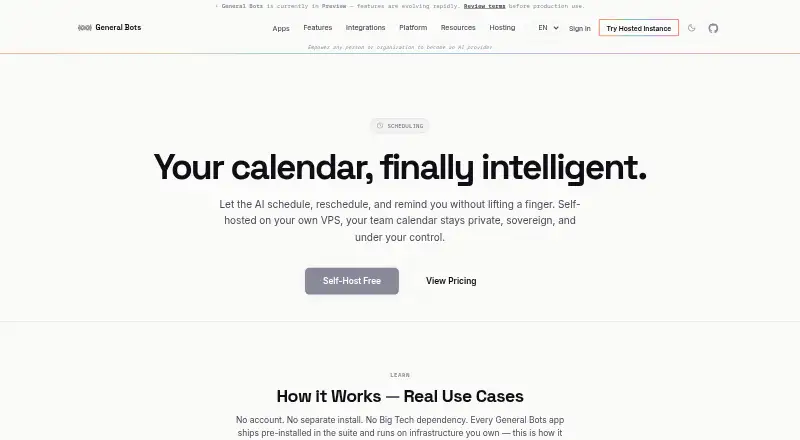
What General Bots Calendar is
General Bots Calendar is a self-hosted team calendar for scheduling, reminders, and task tracking. Users can type natural-language requests to create meetings, calls, and reminders, with invitations sent automatically. An availability endpoint suggests open booking slots, while REST endpoints cover creating, reading, updating, and deleting events and checking free/busy status. The calendar supports day, week, month, and agenda views, plus mini-calendar navigation and keyboard shortcuts. Event types include all-day and recurring events, and personal reminders can include lead time. Tasks with due dates appear on the calendar, and completing a task marks it done there. Multiple calendars are supported, and synchronization lists CalDAV servers as an integration. The software runs on infrastructure owned by the customer, keeping data on the customer's hardware. Its full source is available under AGPLv3. Deployment is described as a self-contained Docker setup on a virtual machine or bare metal, with the suite's apps pre-installed. The Self-Hosted plan costs nothing, with unlimited users and operations and no per-user licensing fees. The app is available from the General Bots desktop launcher without a separate install or signup.
Good
- Natural-language event and reminder creation
- Automatic invitations for scheduled requests
- Availability endpoint suggests open slots
- Day, week, month, and agenda views
- Tasks synchronize with calendar completion
- Unlimited users and operations
Watch out
- Requires customer-owned infrastructure
- Deployment uses Docker on a VM or bare metal
- Self-hosted plan requires managing the supplied environment
Who it suits
General Bots Calendar suits teams that want scheduling, reminders, tasks, and APIs on infrastructure they control. It is useful for organizations needing unlimited self-hosted users and operations under an AGPLv3 source license.
Verdict
Pick General Bots Calendar when self-hosting, source availability, and natural-language scheduling are priorities. Consider another calendar if you do not want to operate the software on your own infrastructure.
Plans and prices
From General Bots Calendar's own pricing page, checked 4 Oct 2026.
| Plan | Price | What it gives you |
|---|---|---|
| Self-Hosted | Free | Unlimited users and operations · No per-user licensing fees · Self-hosted on your infrastructure · AGPLv3 source |
The facts
Each one read from General Bots Calendar's own pages, with the date it was checked.
What it does
- API
- The product page describes REST endpoints for creating, reading, updating, and deleting events and checking free/busy availability.checked 4 Oct 2026
- Availability
- The availability endpoint can suggest open time slots for booking.checked 4 Oct 2026
- Calendar sync
- The documentation says Calendar syncs with other apps and lists CalDAV servers as a calendar service integration.checked 4 Oct 2026
- Calendar views
- It provides day, week, month, and agenda views, with mini-calendar navigation and keyboard shortcuts.checked 4 Oct 2026
- Chat scheduling
- Users can create meetings, calls, and reminders by typing natural-language requests, and invitations are sent automatically.checked 4 Oct 2026
- Deployment
- The product page describes a self-contained Docker deployment on a VM or bare metal, with the suite's apps pre-installed.checked 4 Oct 2026
- Desktop access
- The page says the app is available from the General Bots desktop launcher without a separate install or signup.checked 4 Oct 2026
- Events and reminders
- Supported event types include meetings, calls, all-day events, recurring events, and personal reminders with lead time.checked 4 Oct 2026
- License
- The product page says the full source is available under AGPLv3.checked 4 Oct 2026
- Pricing limits
- The page advertises unlimited users and operations and no per-user licensing fees for self-hosting.checked 4 Oct 2026
- Privacy and hosting
- The calendar runs on infrastructure the customer owns, with data kept on the customer's hardware.checked 4 Oct 2026
- Purpose
- General Bots Calendar is a self-hosted team calendar with AI scheduling, rescheduling, and reminders.checked 4 Oct 2026
- Support contact
- The product page links to a Talk to Us contact option.checked 4 Oct 2026
- Task integration
- Tasks with due dates appear on the calendar, and completing a task marks it done there too.checked 4 Oct 2026
The company
- Founded
- 2017checked 28 Sep 2026
- Headquarters
- Rio de Janeiro, Brazilchecked 28 Sep 2026
The full review of General Bots Calendar
General Bots Calendar is a self-hosted team calendar that combines natural-language scheduling with task deadlines, reminders, and an API. It is best suited to organizations willing to run Docker software on their own infrastructure and wanting control over calendar data. Its strongest case is the combination of open source, unlimited self-hosted usage, and scheduling automation; teams wanting a managed hosted service should look elsewhere.
Overview
The calendar covers day, week, month, and agenda views, with mini-calendar navigation and keyboard shortcuts for moving through dates. Chat requests can create meetings, calls, and reminders, and invitations are sent automatically. That shortens the path from a request to a confirmed event, although the operational responsibility remains with the customer because deployment and maintenance are self-hosted.
Data stays on hardware owned by the customer, and the full source is available under AGPLv3. Deployment is described as a self-contained Docker installation on a virtual machine or bare metal, with the suite's applications pre-installed. The General Bots desktop launcher provides access without a separate installation or signup.
Key features
Natural-language scheduling
Users can type requests in ordinary language to create meetings, calls, and reminders. Supported events also include all-day and recurring entries, while personal reminders can include lead time. Automatic invitations make the chat workflow practical for teams arranging sessions quickly rather than filling out multiple fields manually.
Availability and integrations
An availability endpoint suggests open booking slots, allowing another application or workflow to query when people are free. REST endpoints support creating, reading, updating, and deleting events, plus free/busy checks. Calendar synchronization works with other apps, including CalDAV servers, so it can participate in an existing calendar environment instead of being an isolated schedule.
Tasks and calendar views
Tasks with due dates appear on the calendar, and completing a task marks it done there as well. This is useful when work deadlines need to sit beside appointments, but it is a focused task connection rather than a substitute for a full project-management system. Multiple calendars, keyboard shortcuts, and the four standard views support routine planning at different levels of detail.
Pricing
| Plan | Price | Includes |
|---|---|---|
| Self-Hosted | free | Unlimited users and operations, no per-user licensing fees, self-hosting on your infrastructure, and AGPLv3 source |
The free plan is unusually permissive on licensing: teams do not pay by seat or operation, making it suitable for broad internal deployment or a large user base. The tradeoff is that infrastructure, Docker deployment, updates, and operational support are yours to handle. A Talk to Us contact option is provided for support discussions, but there is no hosted tier or paid service level described.
Platforms
General Bots Calendar is available on the web and through an API, with deployments supported on Linux, macOS, and Windows environments through self-hosting. It can also run on customer-owned infrastructure and is offered from the General Bots desktop launcher. This favors organizations managing their own systems over users seeking a native mobile-first application.
Who it's for
Choose it for teams that need calendar data kept on their own hardware, want source access, or plan to integrate scheduling into internal tools through REST and availability endpoints. It also fits groups that value natural-language event creation and want task due dates visible in the same schedule. It is a poor fit for organizations that do not want to administer a VM or bare-metal Docker deployment, or that expect a vendor-managed calendar with a conventional subscription support model.
Pros and cons
Pros
- Unlimited self-hosted usage: unlimited users and operations with no per-user licensing fees remove seat-growth penalties.
- Strong control of data: customer-owned infrastructure and AGPLv3 source support privacy and inspectability requirements.
- Useful automation: natural-language scheduling, automatic invitations, reminders, and open-slot suggestions reduce manual coordination.
- Integration-ready: REST event and free/busy endpoints plus CalDAV synchronization connect it to other systems.
- Task visibility: due dates and completion status stay aligned between tasks and the calendar.
Cons
- Self-hosting burden: the customer must run and maintain the Docker deployment rather than relying on a hosted operator.
- Limited deployment convenience: the product is centered on web, API, and desktop-launcher access rather than dedicated mobile apps.
- Focused task scope: calendar-linked tasks do not replace a full project-management platform.
Alternatives
Routine is a better choice if you want a freemium service spanning Android, iOS, Linux, macOS, web, and Windows, with a free tier capped at three integrations, three custom databases, and 250 AI credits.
Open Sunsama suits readers seeking a free personal-use option that can be hosted or self-hosted across mobile, desktop, web, and API platforms, with commercial use requiring a separate arrangement.
Amie is the alternative for users who prefer a freemium calendar focused on iOS, macOS, and Windows.
FlowSavvy fits people who want hosted scheduling on Android, iOS, or the web, with its Basic plan limiting scheduling profiles, repeating tasks, lists, and the auto-scheduling range.
Reclaim AI is suited to users wanting a web or extension-based freemium scheduler with a free tier limited to one user, a one-week scheduling range, one calendar sync, one scheduling link, and five AI agents.
DayWise is an Android alternative with a free manual-scheduling tier and a paid option for expanded AI scheduling.
Trevor AI is a web choice whose free plan supports one calendar account, while its paid plan adds multiple accounts and broader intelligence.
Efficio is another calendar-and-task option with a free beta-tester plan.
For more options, browse AI Calendar Assistants.
Verdict
Pick General Bots Calendar when self-hosting, source availability, and natural-language scheduling are priorities. Its unlimited free licensing, API access, task linkage, and customer-controlled data make it compelling for technically capable teams. Look elsewhere if you want the vendor to host and operate the calendar, or need a polished native mobile experience and broader project-management depth.
Getting started
- Open the General Bots Calendar website or desktop launcher
- Deploy the self-contained Docker suite on a VM or bare metal
- Run it on infrastructure your organization owns
- Use the calendar views or natural-language chat to add events
- Connect calendar services such as CalDAV servers
- Use the REST API for event and availability operations
Questions
Is General Bots Calendar free?
Yes. The Self-Hosted plan costs nothing and includes unlimited users and operations without per-user licensing fees.
Where does the calendar run?
It runs on infrastructure the customer owns, with data kept on the customer's hardware. Deployment is described for Docker on a VM or bare metal.
What platforms are supported?
The listed platforms include API, Linux, macOS, self-hosted, web, and Windows. The product page also describes access through the General Bots desktop launcher.
Is General Bots Calendar open source?
Yes. The full source is available under the AGPLv3 license.
Can it schedule meetings from natural language?
Yes. Users can type requests for meetings, calls, or reminders, and invitations are sent automatically. An availability endpoint can suggest open booking slots.
Does it integrate with other calendars?
Calendar synchronization is supported, and CalDAV servers are listed as a calendar service integration.