
Galileo
Galileo is an observability, evaluation, and guardrail platform for generative AI and agentic applications.
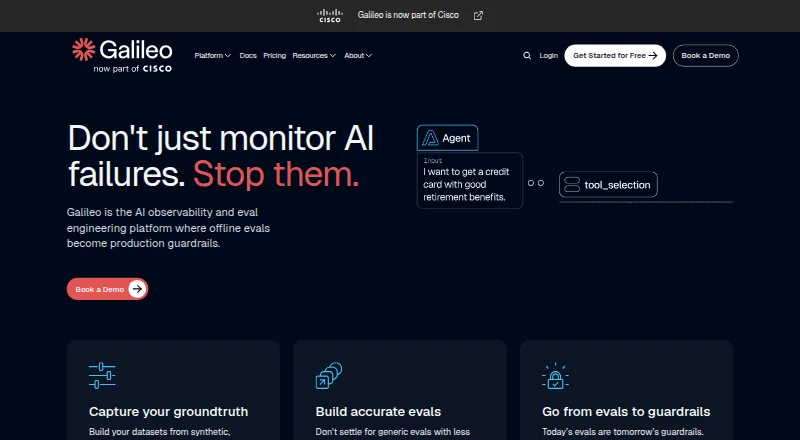
What Galileo is
Galileo is an observability, evaluation, and guardrail platform for generative AI and agentic applications. It evaluates RAG, agents, safety, and security with ready-made and custom evaluators, and analyzes agent behavior to help teams find failure modes and patterns. Galileo Experiments let users assess datasets and prompts systematically and compare results. Evaluation scores can also inform agent actions, tool access, and escalation routes. The platform supports Python and TypeScript SDKs and an API, with integrations including CrewAI, Google ADK, LangChain and LangGraph, OpenAI, Microsoft Agent Framework, Strands Agents, and Vercel AI SDK. Deployment options include SaaS, virtual private cloud, and on-premises. The Free plan includes 5,000 traces per month, unlimited users, and unlimited custom evaluations. Pro costs $100 a month, billed yearly, for 50,000 monthly traces; trace volume affects pricing. SSO supports OIDC and SAML only on a customer's own Galileo cluster, not the free version or hosted app.galileo.ai service.
Good
- Evaluations cover RAG, agents, safety, and security.
- Experiments compare datasets, prompts, and evaluation results.
- Offers Python and TypeScript SDKs plus an API.
- Free plan includes 5,000 traces monthly.
- Supports SaaS, VPC, and on-premises deployment.
Watch out
- Pro costs $100 a month, billed yearly.
- Free plan is limited to 5,000 monthly traces.
- SSO is unavailable on the free plan and hosted app.
- Paid-plan groups are not included on the free plan.
Who it suits
Galileo suits engineers, product managers, and subject matter experts building AI applications who need evaluation, observability, or guardrails. It also fits teams that want SDK or API access and a choice of deployment options.
Verdict
Galileo combines evaluations, behavioral analysis, experiments, and score-driven guardrails for AI applications. Check the trace limits, annual Pro billing, and SSO availability against your deployment needs.
Plans and prices
From Galileo's own pricing page, checked 29 Sep 2026.
| Plan | Price | What it gives you |
|---|---|---|
| Pro | $100 a month | 50,000 traces per month · Standard RBAC · Advanced analytics & insights · Dedicated support: Slack · Pricing scales based on number of traces · Billed yearly |
| Enterprise | Priced on request | Unlimited traces · Custom rate limits · Hosted, VPC, or on-prem deployment · Enterprise-grade security RBAC and SSO · Dedicated CSM · Real-time guardrails · 24/7 Slack, email, or phone support · Low-latency dedicated inference servers · Forward deployed engineering support · Custom billing options |
| Free | — | 5,000 traces per month · Unlimited users · Unlimited custom evals |
The facts
Each one read from Galileo's own pages, with the date it was checked.
What it does
- Access control
- Galileo provides role-based access controls, while groups are available to customers on paid plans.checked 29 Sep 2026
- Audience
- Galileo says it is designed for engineers, product managers, and subject matter experts building safe and reliable AI applications.checked 29 Sep 2026
- Deployment
- The site lists SaaS, Virtual Private Cloud, and on-premises deployment options.checked 29 Sep 2026
- Evaluation
- The platform offers out-of-the-box evaluations for RAG, agents, safety, and security, along with custom evaluators.checked 29 Sep 2026
- Experiments
- Galileo Experiments support systematic evaluation using datasets, prompts, and experiment comparisons.checked 29 Sep 2026
- Guardrails
- Galileo describes a workflow in which evaluation scores can control agent actions, tool access, and escalation paths.checked 29 Sep 2026
- Integrations
- Documented integrations include CrewAI, Google ADK, LangChain and LangGraph, OpenAI, Microsoft Agent Framework, Strands Agents, and Vercel AI SDK.checked 29 Sep 2026
- Observability
- Galileo analyzes agent behavior to identify failure modes, surface patterns, and suggest fixes.checked 29 Sep 2026
- Purpose
- Galileo is an observability, evaluation, and guardrail platform for GenAI and agentic applications.checked 29 Sep 2026
- SDKs and API
- The platform can be used through Python and TypeScript SDKs or its API.checked 29 Sep 2026
- Single sign-on
- SSO supports OIDC and SAML providers, but is available only on a customer's own Galileo cluster and not on the free version or hosted app.galileo.ai service.checked 29 Sep 2026
- Support
- The Pro plan includes dedicated Slack support, and Enterprise includes 24/7 support via Slack, email, or phone.checked 29 Sep 2026
The company
- Company founding
- Galileo says it was founded in 2021.checked 29 Sep 2026
- Founded
- 2021checked 28 Sep 2026
Money
- Free plan limit
- The Free plan includes 5,000 traces per month, unlimited users, and unlimited custom evaluations.checked 29 Sep 2026
The full review of Galileo
Galileo is a GenAI and agentic-application platform that combines evaluation, observability, experimentation, and runtime guardrails. It fits engineering, product, and subject-matter teams responsible for reliable AI behavior, especially those using its supported frameworks and SDKs. The main trade-off is between its unusually broad control surface and practical limits around traces, annual billing, and where SSO can run.
Overview
Galileo brings testing and production oversight into one workflow. Its behavioral analysis looks for agent failure modes and recurring patterns, then helps teams identify potential fixes. Evaluation scores can also influence agent actions, tool permissions, and escalation routes, turning quality and safety checks into operational controls rather than static reports.
Teams can connect through Python or TypeScript SDKs or the API. Documented integrations cover CrewAI, Google ADK, LangChain and LangGraph, OpenAI, Microsoft Agent Framework, Strands Agents, and Vercel AI SDK. Galileo was founded in 2021.
Key features
Evaluation and experiments
Built-in evaluators cover retrieval-augmented generation, agents, safety, and security, while custom evaluators handle application-specific criteria. Experiments provide a structured way to compare datasets, prompts, and runs. Prompt versioning, custom metrics, LLM-as-a-judge scoring, safety evaluations, human review workflows, and CI/CD integration make the platform useful across development, release review, and regression checks.
Observability and guardrails
Observability focuses on agent behavior, failure patterns, and actionable diagnosis. The guardrail workflow can use scores to decide whether an agent proceeds, receives tool access, or escalates. That connection is valuable for teams that need controls during execution, although it requires enough trace capacity to represent real traffic.
Access and deployment
Role-based access control is provided, with groups reserved for paid customers. Deployment choices include Galileo SaaS, Virtual Private Cloud, and on-premises installations. OIDC and SAML single sign-on work only on a customer's own Galileo cluster; SSO is not included with the free version or the hosted app.galileo.ai service. This distinction matters for organizations whose identity policy requires SSO in a hosted environment.
Pricing
Free
The Free plan has no listed price and includes 5,000 traces per month, unlimited users, and unlimited custom evaluations. It is a sensible way to build an evaluation workflow or pilot observability without a seat ceiling, but the monthly trace cap can constrain busy applications and it does not provide the paid access and support features.
Pro
Pro costs $100 a month, billed yearly. It raises the allowance to 50,000 traces per month and adds standard RBAC, advanced analytics and insights, and dedicated Slack support. Pricing scales with the number of traces, so teams should size expected usage rather than treating the headline amount as a fixed ceiling. Pro suits growing teams that need richer analysis and support but can operate within hosted-plan constraints.
Enterprise
Enterprise uses custom billing and removes the standard trace ceiling with unlimited traces and custom rate limits. It adds hosted, VPC, or on-premises deployment; enterprise-grade RBAC and SSO; a dedicated customer success manager; real-time guardrails; 24/7 support by Slack, email, or phone; low-latency dedicated inference servers; and forward deploy. It is the appropriate tier for regulated or high-volume deployments that require infrastructure and support commitments beyond Pro.
Platforms
Galileo is offered through an API, self-hosted deployments, and the web. The deployment menu spans SaaS, Virtual Private Cloud, and on-premises options, while SDK access is available for Python and TypeScript.
Who it's for
Galileo is aimed at engineers, product managers, and subject-matter experts building safe, dependable AI applications. It is particularly well suited to teams that want evaluation results to drive agent behavior and that need one system for experiments, traces, review, and guardrails. Small projects with light traffic may find the Pro commitment and trace model more than they need.
Pros and cons
Pros
- Evaluation connected to runtime controls: Scores can govern tool access, actions, and escalation instead of remaining isolated test output.
- Broad evaluation coverage: RAG, agent, safety, and security evaluators are available alongside custom metrics, human review, and LLM-as-a-judge options.
- Flexible deployment: SaaS, VPC, and on-premises choices support different security and operational requirements.
- Framework reach: Integrations include major agent and model ecosystems, with Python, TypeScript, and API interfaces.
Cons
- Free trace ceiling: 5,000 traces per month limits the free tier for substantial production traffic.
- Annual Pro term: The 100.00 USD monthly price is billed yearly, and the amount scales with trace volume.
- Hosted SSO restriction: OIDC and SAML SSO require the customer's own Galileo cluster, excluding the free tier and hosted app service.
- Some collaboration features are paid: Groups and stronger support arrangements begin above the free plan.
Alternatives
Promptfoo is a better fit when you want a freemium, locally runnable evaluation tool with 10k red-team probes per month, broad provider integrations, and support across desktop, server, API, and web environments.
DeepEval suits teams seeking a free, Apache 2.0-licensed open-source framework that runs locally and in CI/CD.
Giskard is worth choosing for an open-source library with local deployment and basic LLM vulnerability and RAG evaluation reports.
Confident AI fits smaller projects that prefer a freemium service with a two-seat, one-project free tier and capped weekly test runs.
garak is a free open-source option for teams wanting a focused tool without paid plans.
HELM is appropriate when an open-source Python framework with no paid plans is the priority.
Maxim AI is an alternative for teams wanting a freemium platform with a free developer tier, limited seats, workspace, logs, retention, and email support.
For broader category browsing, see LLM Evaluation Tools, Machine Learning Model Monitoring Software, AI LLM Evaluation Tools, AI LLM Observability Tools, LLM Observability Tools, and Model Monitoring Software.
Verdict
Choose Galileo if your team needs evaluations, agent observability, experiments, and guardrails in a single system, particularly with a supported framework and a deployment requirement that may extend to VPC or on-premises. Look elsewhere if you need a fully local open-source workflow, a month-to-month entry plan, or SSO directly on the hosted service.
Alternatives to Galileo
- 1

Opik
Free planOpen sourceWebAPILinuxmacOS8.4From $19 a month - 2

Evidently AI
Free planOpen sourceWebAPILinuxmacOS8.3From $80 a month - 3

Deepchecks
Free planOpen sourceWebAPILinuxmacOS8.1Free plan - 4

NannyML
Free planOpen sourceWebAPILinuxSelf-hosted7.9From $99 a month - 5

SUPERWISE
Free planWebAPIExtensionLinux7.8From $9 a month - 6
Arize AX
Free planWebAPISelf-hosted6.8From $50 a month