
Confident AI
Confident AI is an AI quality platform for evaluating application changes during development and monitoring AI applications in production.
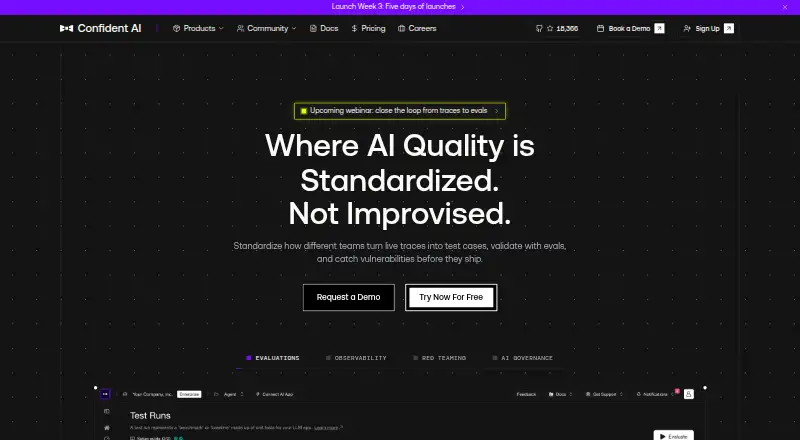
What Confident AI is
Confident AI is an AI quality platform for evaluating application changes during development and monitoring AI applications in production. Teams can compare prompts, models, and parameters, run automated regression evaluations in CI/CD, and use more than 50 metrics. In production, it traces executions with spans and records inputs, outputs, latency, and tokens; live alerts flag declining AI quality. Red-team testing targets safety vulnerabilities and adversarial attacks. Python and TypeScript SDKs, OpenTelemetry, and more than 20 framework and gateway integrations connect it to development and monitoring workflows. APIs cover prompt versioning, dataset building, trace ingestion, project provisioning, and governance policies. The platform is available through web and API, or can be self-hosted in a customer’s AWS, Azure, or GCP cloud using Docker; setup typically takes 1–2 weeks. The free plan includes two user seats, one project, five test runs per week, and 1 GB-month of trace spans. Free-tier test-run and tracing data are retained for 14 days.
Good
- More than 50 evaluation metrics.
- Automated CI/CD regression evaluations.
- Live alerts for declining AI quality.
- Self-hosted deployment is available.
- Python and TypeScript SDKs are supported.
Watch out
- Free tier is limited to five test runs weekly.
- Free-tier data is retained for 14 days.
- Self-hosted setup typically takes 1–2 weeks.
Who it suits
It suits engineers, QA teams, product managers, subject-matter experts, and annotators who need to evaluate or monitor AI applications. Self-hosting and configurable roles may also fit organizations with deployment and access-control requirements.
Verdict
Confident AI combines development evaluation, production tracing, and safety testing in one platform. Its free plan has specific usage limits, while paid plans start at $200 per month.
Plans and prices
From Confident AI's own pricing page, checked 30 Sep 2026.
| Plan | Price | What it gives you |
|---|---|---|
| Free | Free | 2 user seats · 1 project · 5 test runs per week · 1 GB-month of trace spans · Forever $0 |
| Starter | $200 a month | Unlimited user seats · 5 projects · 5 GB-months of trace spans · $1 per additional GB-month · ~$0.05/M input tokens and $0.40/M output tokens · $200 / month |
| Team | $2,000 a month | Unlimited user seats · Unlimited projects · 75 GB-months of trace spans · $1 per additional GB-month · ~$0.05/M input tokens and $0.40/M output tokens · $2,000 / month |
| Enterprise | Priced on request | Unlimited user seats · Unlimited projects · Unlimited GB-months of trace spans · Unlimited online eval metric runs/month · Custom pricing |
The facts
Each one read from Confident AI's own pages, with the date it was checked.
What it does
- Alerting
- The platform provides live alerting when AI quality degrades.checked 30 Sep 2026
- API
- Every part of the platform is exposed through APIs for versioning prompts, building datasets, ingesting traces, provisioning projects, and assigning governance policies.checked 30 Sep 2026
- Authentication
- The Confident API uses API keys with organization-level and project-level authentication.checked 30 Sep 2026
- Data protection
- Confident AI states that data is encrypted at rest, protected by TLS in transit, and covered by SOC II and HIPAA compliance.checked 30 Sep 2026
- Evaluation
- The platform supports prompt, model, and parameter experiments, automated CI/CD regression evaluations, and more than 50 metrics.checked 30 Sep 2026
- Integrations
- Confident AI offers Python and TypeScript SDKs, OpenTelemetry, and more than 20 framework and gateway integrations.checked 30 Sep 2026
- Integrations notifications
- Project integrations can send evaluation-completion notifications to Slack, Discord, Teams, or email.checked 30 Sep 2026
- Observability
- Confident AI traces AI executions with spans and captures inputs, outputs, latency, and tokens for production monitoring.checked 30 Sep 2026
- Product
- Confident AI is an AI Quality platform that provides development evaluations and production observability for reliable AI applications.checked 30 Sep 2026
- Security
- The documentation states that Confident AI is HIPAA compliant, offers SSO and customizable roles and permissions, and supports self-hosted deployment.checked 30 Sep 2026
- Self-hosting
- Confident AI can be deployed in a customer's AWS, Azure, or GCP cloud via Docker and typically takes 1–2 weeks to set up.checked 30 Sep 2026
- Users
- The platform is designed for engineers, QA teams, product managers, subject-matter experts, and annotators.checked 30 Sep 2026
Money
- Free-tier retention
- The data-handling documentation states that free-tier test-run and tracing data are retained for 14 days.checked 30 Sep 2026
The company
- Red teaming
- Confident AI provides red-team testing for safety vulnerabilities and adversarial attacks.checked 30 Sep 2026
The full review of Confident AI
Confident AI is a quality platform for teams that need to evaluate AI systems before release and watch their behavior in production. It suits engineering, QA, product, and domain-expert groups that prefer one API-driven workflow for testing, observability, and safety. The strongest case is breadth; the main constraint is that serious usage quickly moves beyond the limited free tier.
Overview
Confident AI joins prompt, model, and parameter experiments with automated CI/CD regression checks, production tracing, live quality alerts, and red-team exercises. That combination is useful for organizations that would otherwise maintain separate evaluation and monitoring systems. Its APIs support prompt versioning, dataset construction, trace ingestion, project provisioning, and governance-policy assignment, so engineering teams can manage the service programmatically rather than relying only on the web interface.
More than 50 metrics cover evaluation work, with support for custom metrics, LLM-as-a-judge assessments, safety evaluations, and human review workflows. Production traces record execution spans, inputs, outputs, latency, and token consumption. Those capabilities make the product relevant across the development-to-operations lifecycle, although the free plan is too small for sustained, high-volume evaluation.
Key features
Evaluation and regression testing
Prompt, model, and parameter experiments provide a structured way to compare changes. Automated CI/CD regression evaluations can gate releases or identify quality changes during delivery, which is more useful than ad hoc manual checks for teams shipping frequently. Custom metrics and LLM-as-a-judge extend the built-in metric set when a project needs domain-specific scoring.
Observability and alerting
Tracing captures the inputs and outputs associated with AI executions, along with latency and token data. Live alerting when quality degrades gives operations teams a way to respond to production changes instead of discovering them only through customer reports. Slack, Discord, Teams, and email notifications can receive evaluation-completion messages through project integrations.
Safety and review
Red-team testing focuses on safety vulnerabilities and adversarial attacks, making it relevant for teams that must assess failure modes as well as general answer quality. Human review workflows add an avenue for subject-matter experts and annotators to assess results that automated metrics cannot fully capture.
Developer access and governance
Python and TypeScript SDKs, OpenTelemetry support, and more than 20 framework and gateway integrations reduce the need to build custom connectors. API-key authentication works at organization and project level, while versioning and governance functions are exposed through the API. This is a strong fit for engineering-led operations and controlled multi-project environments.
Pricing
The free plan costs nothing, billed Forever at $0. It includes 2 user seats, 1 project, 5 test runs per week, and 1 GB-month of trace spans. Free-tier test-run and tracing data are retained for 14 days. That is enough for a small proof of concept or occasional checks, but not for a team running regular regression suites or retaining a substantial production history.
Starter costs $200 a month, billed $200 / month. It adds unlimited user seats, 5 projects, and 5 GB-months of trace spans. Extra trace storage costs $1 per additional GB-month, with approximate usage charges of $0.05/M input tokens and $0.40/M output tokens. Starter is the practical entry point for a small production team, but the project and included-trace ceilings matter if several applications share the account.
Team costs $2,000 a month, billed $2,000 / month. It provides unlimited user seats and projects, 75 GB-months of trace spans, and the same $1 per additional GB-month and approximate token rates. This tier fits organizations operating multiple AI products or larger evaluation programs; its tenfold price increase over Starter is difficult to justify for a single small application.
Enterprise uses custom pricing and includes unlimited user seats, unlimited projects, unlimited GB-months of trace spans, and unlimited online evaluation metric runs per month. It is the appropriate tier when usage limits or organizational scale make fixed quotas impractical. There is no free trial.
Platforms
Confident AI is available through an API, web interface, and self-hosted deployment. Customers can deploy it in their own AWS, Azure, or GCP cloud using Docker; setup typically takes 1–2 weeks. Documentation states HIPAA compliance, SSO, customizable roles and permissions, encryption at rest, TLS in transit, and SOC II and HIPAA coverage. Self-hosting is therefore a meaningful option for organizations with data-residency or governance requirements, though it brings an implementation project rather than an instant hosted setup.
Who it's for
Engineering teams benefit from SDKs, APIs, CI/CD evaluations, integrations, and trace-level production data. QA groups can formalize regression and safety checks, while product managers can use alerting and evaluation results to track quality over time. Subject-matter experts and annotators have a defined role through human review workflows. Small developers who need only a lightweight local evaluator, or teams unwilling to pay for ongoing observability, will find the free quotas restrictive.
Pros and cons
Pros
- End-to-end coverage: development experiments, CI/CD regression, red teaming, and production observability share one platform.
- Broad evaluation toolkit: more than 50 metrics plus custom metrics, LLM-as-a-judge, safety checks, and human review support varied quality programs.
- Automation-friendly: Python and TypeScript SDKs, OpenTelemetry, extensive integrations, and APIs for versioning and governance suit engineering workflows.
- Deployment and controls: self-hosting, SSO, roles, encryption, and stated HIPAA and SOC II coverage address regulated environments.
Cons
- Restricted free tier: two seats, one project, five weekly test runs, 1 GB-month of traces, and 14-day retention limit ongoing free usage.
- High Team price: the $2,000 monthly tier is a substantial jump for organizations that outgrow Starter.
- Operational overhead for self-hosting: a typical 1–2 week Docker deployment requires customer-side infrastructure work.
- Usage-based additions: Starter and Team can incur extra trace and token charges beyond their included allowances.
Alternatives
Choose Promptfoo instead if you want a freemium tool with a Community plan offering 10,000 red-team probes per month, broad evaluation features, and local or self-hosted execution across more platforms.
DeepEval is the better choice for a free, Apache 2.0-licensed evaluation framework that runs locally and in CI/CD.
Pick Giskard when an open-source library and local deployment with basic adversarial vulnerability scans and RAG evaluation are the priority.
Galileo suits teams seeking hosted observability with a $100-per-month Pro plan, 50,000 traces per month, RBAC, and advanced analytics.
For a free open-source red-team utility, consider garak; HELM is another free open-source Python evaluation framework with no paid plans listed.
Maxim AI is worth considering when a free developer tier, a free trial, and up to 10,000 monthly logs are more important than Confident AI's broader unified scope.
Whisper is a free, MIT-licensed local speech model and codebase rather than a comparable end-to-end AI quality platform.
Verdict
Confident AI is a strong choice for organizations that need evaluation, safety testing, and production tracing connected through APIs, especially where self-hosting and governance controls matter. Start with Free for a limited pilot, move to Starter for a small production team, and reserve Team or Enterprise for multi-project operations. Look elsewhere if you need a permanently free, local-first evaluator or cannot support the $200-per-month entry point and usage-based charges.
Alternatives to Confident AI
- 1
OpenSecureAI Scanner
Free planOpen sourceWebAPILinuxmacOS8.1From $49 a month - 2

AgentSeal
Free planOpen sourceWebAPILinuxmacOS8.0From $19 a month - 3

Promptfoo
Free planOpen sourceWebAPILinuxmacOS7.8Free plan - 4

Giskard
Free planOpen sourceWebAPILinuxSelf-hosted7.6Free plan - 5
NVADER
Free planWeb6.7From $49 a month - 6
RedLens AI
Free planWebAPISelf-hosted6.7From $199 a month