
DeepEval
DeepEval is a free, open-source framework for creating evaluation pipelines that test AI systems.
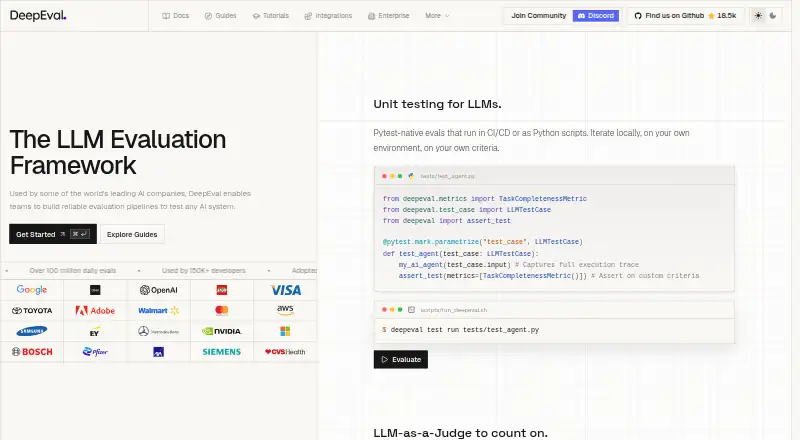
What DeepEval is
DeepEval is a free, open-source framework for creating evaluation pipelines that test AI systems. Its Pytest-native evaluations can run in CI/CD or as Python scripts, and it lists more than 50 metrics, including checks for hallucination, faithfulness, answer relevancy, summarization, toxicity, and bias. The framework evaluates text, images, and audio, including conversational and voice interactions, using methods such as G-Eval, DAG, QAG, and JevEval. It can generate synthetic goldens from a knowledge base and simulate conversations with different user personas. For agent applications, DeepEval traces steps that can be graded and inspected in the terminal or test runner. Integrations cover agent frameworks and a broad set of model providers. By default, it sends basic telemetry to PostHog; the maker says this excludes personally identifiable information and stored results, and users can opt out through an environment variable. The maker describes DeepEval OS as intended for pre-production testing, with results in local files and an engineer-owned test runner. Enterprise capabilities are offered through Confident AI Evals.
Good
- Free, open-source framework
- Pytest-native evaluations for CI/CD
- Supports text, images, and audio
- Traces agent steps for inspection
Watch out
- DeepEval OS is limited to pre-production testing
- Results are stored in local files
- Basic telemetry is enabled by default
Who it suits
DeepEval suits developers building repeatable AI evaluations in Python or CI/CD, especially those testing multiple modalities or agent workflows. Its free OS offering is for pre-production testing rather than production evaluation.
Verdict
DeepEval offers a free framework with a broad set of evaluation metrics and testing methods. Keep its pre-production scope and default telemetry behavior in mind when deciding whether it fits your workflow.
Plans and prices
From DeepEval's own pricing page, checked 28 Sep 2026.
| Plan | Price | What it gives you |
|---|---|---|
| DeepEval | Free | Open-source LLM evaluation framework · Apache 2.0 licensed · local and CI/CD test runner |
| Free | Free | 2 user seats · 1 project · 5 test runs per week · 1 GB-month trace spans · Forever $0 |
| Starter | $200 a month | Unlimited seats · 5 projects · 5 GB-month trace spans · $1 per additional GB-month · $200 / month per organization |
| Team | $2,000 a month | Unlimited seats · unlimited projects · 75 GB-month trace spans · $1 per additional GB-month · $2,000 / month per organization |
| Enterprise | Priced on request | Unlimited seats · unlimited projects · unlimited GB-month trace spans · unlimited online-evaluation metric runs · Custom pricing |
The facts
Each one read from DeepEval's own pages, with the date it was checked.
What it does
- API and SDKs
- Confident AI exposes APIs, a TypeScript SDK and OpenTelemetry support alongside DeepEval's Python framework.checked 15 Oct 2026
- CLI
- The `deepeval test run` command is built on Pytest, while `evaluate()` provides a Python-programmatic interface.checked 15 Oct 2026
- Cloud data
- The maker says data sent to Confident AI is stored in databases in its private AWS cloud, except for organizations on the VIP plan.checked 28 Sep 2026
- Component evaluation
- Teams can evaluate individual spans such as tools, planners, retrievers and generators.checked 15 Oct 2026
- Customization
- Metrics, prompts, judge models and evaluation templates can be customized.checked 15 Oct 2026
- Documentation
- The documentation contains installation, quickstarts, metric references, integrations, tracing, datasets, CLI, environment-variable and troubleshooting sections.checked 15 Oct 2026
- Enterprise deployment
- The enterprise offering is available on Confident AI Evals and can be self-hosted on a customer's infrastructure or run in the maker's cloud.checked 28 Sep 2026
- Enterprise security
- The hosted enterprise offering states SOC 2 Type II, GDPR compliance, SSO, RBAC, audit logs and custom retention.checked 15 Oct 2026
- Evaluation methods
- Its evaluation techniques include G-Eval, DAG, QAG, and JevEval.checked 28 Sep 2026
- Founders
- Y Combinator identifies Jeffrey Ip and Kritin Vongthongsri as Confident AI's founders.checked 15 Oct 2026
- Framework integrations
- Official integrations include LangChain, LlamaIndex, CrewAI, OpenAI Agents, LangGraph, PydanticAI, Google ADK, AgentCore, Strands and OpenTelemetry.checked 15 Oct 2026
- Install package
- PyPI provides a platform-independent Python wheel and source distribution for DeepEval.checked 15 Oct 2026
- Integrations
- Listed integrations include LangChain, Pydantic AI, OpenAI Agents, LangGraph, AWS AgentCore, Strands, Google ADK, LlamaIndex, and CrewAI.checked 28 Sep 2026
- License
- The repository and package identify DeepEval as Apache Software License 2.0.checked 15 Oct 2026
- Limit: reported defect
- A GitHub issue reports the introductory tutorial failing with a `ModuleNotFoundError` when running `deepeval test run`.checked 15 Oct 2026
- Limit: runtime
- AI Tools Atlas reports that large or multi-turn evaluations can be computationally slow and expensive.checked 15 Oct 2026
- Local operation
- DeepEval can run entirely locally without Confident AI or an account.checked 15 Oct 2026
- Local telemetry
- By default, DeepEval sends basic telemetry to PostHog, excludes personally identifiable information and stored results, and supports opting out with DEEPEVAL_TELEMETRY_OPT_OUT=1.checked 28 Sep 2026
- Metrics
- The project advertises more than 50 metrics spanning quality, agents, RAG, conversations, safety, voice and multimodal use cases.checked 15 Oct 2026
The company
- Company relationship
- Confident AI created and maintains DeepEval and describes it as one of its open-source testing packages.checked 15 Oct 2026
- Company size
- LinkedIn lists Confident AI as a privately held software company with 11–50 employees and San Francisco headquarters.checked 15 Oct 2026
- Headquarters
- San Francisco, California, United Stateschecked 23 Sep 2026
- Limit: team features
- AI Tools Atlas says collaboration, dataset management, monitoring and dashboards require the hosted Confident AI service.checked 15 Oct 2026
Money
- Limit: evaluator cost
- AI Tools Atlas notes that LLM-judge metrics require provider API calls, so cost rises with dataset size and metric count.checked 15 Oct 2026
The full review of DeepEval
DeepEval is a free, open-source framework for engineers building repeatable LLM and agent checks into Python workflows. Its broad metrics and multimodal evaluations make it a strong fit for pre-production quality gates; teams that need production monitoring or centralized collaboration should look elsewhere.
Overview
Pytest-native evaluations run in CI/CD or as Python scripts, giving engineering teams a way to make model checks part of their development process. DeepEval OS keeps results in local files and relies on an engineer-owned test runner, a sensible fit for pre-release regression testing but a poor standalone choice for production oversight. The maker explicitly describes its scope as pre-production testing.
Key features
DeepEval’s 50+ research-backed metrics cover hallucination, faithfulness, answer relevancy, summarization, toxicity, and bias. Teams can evaluate text, images, and audio, including conversational and voice use cases, and choose among G-Eval, DAG, QAG, and JevEval techniques. That breadth suits teams testing varied AI systems; it also means users must decide which checks fit their own evaluation goals.
Synthetic goldens generated from a knowledge base and simulated conversations across user personas can help teams develop test cases. Agent-step tracing supports grading and inspection in the terminal and test runner, which is useful for debugging pre-production behavior without moving evaluation into a separate workflow.
Integrations include LangChain, Pydantic AI, OpenAI Agents, LangGraph, AWS AgentCore, Strands, Google ADK, LlamaIndex, and CrewAI. Evaluation models can come from providers including OpenAI, Azure OpenAI, Ollama, OpenRouter, Anthropic, Amazon Bedrock, Gemini, DeepSeek, Vertex AI, Grok, Moonshot, Portkey, vLLM, LM Studio, and LiteLLM. This range can accommodate varied stacks, while the framework’s value remains centered on developer-run testing.
By default, DeepEval sends basic telemetry to PostHog; it excludes personally identifiable information and stored results. Teams that prefer not to send this telemetry can opt out with DEEPEVAL_TELEMETRY_OPT_OUT=1. Data sent to Confident AI is stored in databases in the maker’s private AWS cloud, except for organizations on the VIP plan.
Pricing
DeepEval is free: its plan costs free and provides an open-source LLM evaluation framework under the Apache 2.0 license, with a local and CI/CD test runner. The plan includes tool-call checks, trace ingestion, safety evaluations, regression runs, custom metrics, LLM-as-a-judge, human review workflows, prompt versioning, and CI/CD integration. It is a compelling option for engineers who want evaluation capabilities in their own development workflow without a paid plan; its pre-production scope is the important trade-off.
For organizations seeking a managed collaboration layer, the separate enterprise offering is available on Confident AI Evals with custom pricing. It can be self-hosted on a customer’s infrastructure or run in the maker’s cloud. Enterprise features include SSO, role-based access control, granular permissions, audit logs, SOC 2 Type II, GDPR compliance, and custom data retention. Shared workspaces, no-code evaluation workflows, and annotation queues address needs that the engineer-owned open-source runner does not.
Platforms
DeepEval supports Linux, macOS, and Windows, as well as self-hosted deployment. Its SDK language support and deployment options are both described as broad, which fits teams working across development environments, though the core workflow remains oriented around Python and CI/CD.
Who it's for
DeepEval is best for engineering teams that want to build repeatable pre-production tests for LLMs, agents, or multimodal systems, especially when they need a wide choice of metrics, evaluation methods, and model-provider integrations. Teams that require production monitoring, shared workspaces, or no-code collaboration should consider a platform layer instead.
Pros and cons
- Pros: More than 50 metrics, multiple evaluation techniques, and text, image, and audio support provide substantial testing range in one framework.
- Pros: Pytest-native checks, regression runs, and CI/CD integration make evaluations suitable for repeatable development gates.
- Pros: Synthetic test-case generation and agent-step tracing help teams build and inspect evaluations.
- Cons: DeepEval OS is limited to pre-production testing, with local results and an engineer-owned runner, so it is not a production-monitoring or centralized collaboration solution.
- Cons: Default telemetry requires an opt-out setting for teams that do not want basic PostHog telemetry sent.
Alternatives
Promptfoo is worth considering for teams that want a free community plan with 10k red-team probes per month, all LLM evaluation features, and local or self-hosted runs.
Giskard may suit teams looking for an open-source library with local deployment and a basic adversarial LLM vulnerability scan and RAG evaluation report.
Braintrust is another freemium option; its Starter plan includes 1 GB processed data, 10,000 scores, 14-day retention, and unlimited users, projects, and datasets.
Confident AI is a related choice for teams seeking a hosted collaboration layer: its free plan has 2 user seats, 1 project, 5 test runs per week, and 1 GB-month of trace spans.
Galileo may be a better fit for teams prioritizing a paid Pro plan with 50,000 traces per month, standard RBAC, advanced analytics, and dedicated Slack support.
Maxim AI offers a free Developer plan with up to 3 seats, 1 workspace, 10k logs per month, 3-day data retention, and email support.
Parea AI is an alternative for small teams wanting a free plan with 2 team members, 3k logs per month with one-month retention, 10 deployed prompts, and Discord community support.
LiveBench is another free option.
For category comparisons, see LLM Evaluation Tools, AI Agent Evaluation Tools, and AI LLM Evaluation Tools.
Verdict
Choose DeepEval if your engineers want a free, flexible framework for repeatable pre-production evaluation across LLMs, agents, and multimodal systems. Its breadth of metrics and developer-owned CI/CD workflow are the main reasons to pick it; look elsewhere when production monitoring or centralized collaboration is essential.
Getting started
- Visit deepeval.com to access the framework.
- Install the Python package and use its Pytest-native evaluations or Python scripts.
- Run evaluations locally or in CI/CD.
- Connect a listed agent framework or model provider as needed.
- Set DEEPEVAL_TELEMETRY_OPT_OUT=1 to opt out of basic telemetry.
Limits worth knowing
DeepEval OS is described as limited to pre-production testing, with results stored in local files and an engineer-owned test runner. Enterprise capabilities are offered through Confident AI Evals.
Questions
Is DeepEval free?
Yes. The DeepEval plan is free and open source under Apache 2.0.
Which platforms does it support?
The listed platforms are Linux, macOS, Windows, and self-hosted deployment.
What does DeepEval evaluate?
It supports text, images, and audio, including conversational and voice evaluations.
Does it integrate with agent frameworks and model providers?
Yes. Listed agent integrations include LangChain, LangGraph, and OpenAI Agents. Listed model providers include OpenAI, Anthropic, Gemini, and Amazon Bedrock.
Does DeepEval send telemetry?
Basic telemetry is sent to PostHog by default, excluding personally identifiable information and stored results. You can opt out with DEEPEVAL_TELEMETRY_OPT_OUT=1.
What does the enterprise offering include?
Confident AI Evals offers shared workspaces, no-code evaluation workflows, annotation queues, and listed security features. It can be self-hosted on a customer's infrastructure or run in the maker's cloud.
Alternatives to DeepEval
- 1

Promptfoo
Free planOpen sourceWebAPILinuxmacOS7.8Free plan - 2

Braintrust
Free planWebAPISelf-hosted7.7From $249 a month - 3

Giskard
Free planOpen sourceWebAPILinuxSelf-hosted7.6Free plan - 4
TruLens
Free planOpen sourceAPISelf-hosted7.2Free plan - 5

Arena (formerly Chatbot Arena)
Free planOpen sourceWebAPISelf-hosted7.1Free plan - 6

Maxim AI
Free planWebAPISelf-hosted7.0From $29 a month