
Fulfil
Fulfil is an agentic ERP for Shopify Plus and direct-to-consumer brands, bringing together order, inventory, and warehouse management with purchasing, manufa…
What Fulfil is
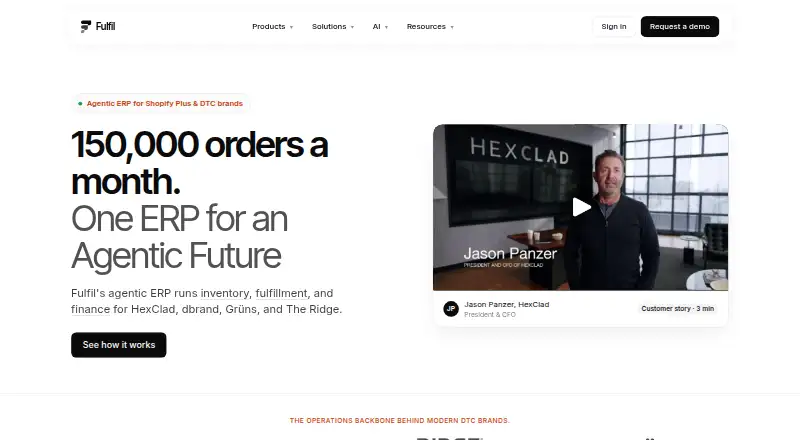
Fulfil is an agentic ERP for Shopify Plus and direct-to-consumer brands, bringing together order, inventory, and warehouse management with purchasing, manufacturing, and accounting. It also lists fulfillment routing and returns management. Users can describe products and workflows in plain English and query orders, inventory, and margins through AI tools such as Claude and ChatGPT. Integrations cover ecommerce channels, marketplaces, 3PLs, shipping carriers, financial tools, and more than 500 EDI retailers. Each plan includes an open REST API without per-call fees. Pricing is custom and tailored to order volume, channels, and operational complexity. Fulfil says the service runs on Google Cloud across multiple US data centers and encrypts data at rest and in transit using AES-256 and TLS. Listed access controls include enforced two-factor authentication, Google or Microsoft single sign-on, and role-based permissions. Customers can export their complete dataset through BigQuery if they leave. The company targets Shopify Plus brands doing $15M to $1B with operational complexity such as multiple warehouses, 3PLs, subscriptions, or international entities, and says customers receive named success managers and around-the-clock support.
Good
- Combines inventory, order, and warehouse management.
- Includes purchasing, manufacturing, and accounting.
- REST API has no per-call fees.
- Supports two-factor authentication and role-based permissions.
- Customers can export their complete dataset through BigQuery.
Watch out
- Pricing is available on request.
- Target customers are Shopify Plus brands doing $15M to $1B.
Who it suits
It is aimed at Shopify Plus and direct-to-consumer brands with complex operations, such as multiple warehouses, 3PLs, or international entities. The stated target range is $15M to $1B.
Verdict
Fulfil combines ERP capabilities with AI tools, integrations, and an included REST API. Its custom pricing and stated target market make operational fit important to consider.
Plans and prices
From Fulfil's own pricing page, checked 21 Oct 2026.
| Plan | Price | What it gives you |
|---|---|---|
| Starting price listed by GetApp | $100,000 a year | Starting price shown by GetApp · per year |
| Custom pricing | Priced on request | Tailored to order volume, channels, and operational complexity |
| Custom quote | Priced on request | Demo required · tailored quote · Quote tailored to order volume, channels, and operational complexity |
The facts
Each one read from Fulfil's own pages, with the date it was checked.
What it does
- 3PL API documentation
- The public 3PL API documentation specifies a workspace base URL, JWT bearer tokens per warehouse, pagination, batch writes, multi-status responses, and structured errors.checked 21 Oct 2026
- Access controls
- The platform supports enforced two-factor authentication, single sign-on via Google or Microsoft, and role-based permissions.checked 3 Oct 2026
- Accounting
- Accounting includes a general ledger, AP, AR, accrual revenue recognition, fixed assets, budgets, multi-entity books, intercompany entries, and consolidated statements.checked 21 Oct 2026
- AI extensibility
- The CLI connects Claude Code, Cursor, Windsurf, OpenClaw, Codex, and other agents to query or modify ERP data using existing API permissions and logged operations.checked 21 Oct 2026
- AI features
- Fulfil says users can describe products and workflows in plain English and query orders, inventory, and margins through AI tools such as Claude and ChatGPT.checked 3 Oct 2026
- API
- The company says its open REST API is included with every plan and has no per-call fees.checked 3 Oct 2026
- API authentication and webhooks
- API access supports OAuth 2.0 and scoped personal tokens, while channel, 3PL, and carrier APIs use JWT or carrier-specific authentication and webhooks provide event notifications.checked 21 Oct 2026
- API coverage
- The Admin REST API exposes CRUD, searches, bulk operations, reports, actions, wizards, orders, inventory, fulfillment, manufacturing, accounting, payments, and files.checked 21 Oct 2026
- Chrome extension
- Fulfil's Chrome extension has version 3.2, about 2,000 users, and is intended to expose Fulfil features in commonly used sites.checked 21 Oct 2026
- Data export
- Fulfil says customers can export their complete dataset through BigQuery if they leave the service.checked 3 Oct 2026
- Data portability
- Customers can request a complete BigQuery dataset export when leaving the service rather than only a CSV extract.checked 21 Oct 2026
- Data warehouse
- Each instance includes a managed Google BigQuery warehouse with near-real-time synchronization and connections for Looker, Tableau, Power BI, Metabase, and Google Sheets.checked 21 Oct 2026
- Funding and investor
- Crunchbase lists Fulfil as a private seed company funded by 500 Global, with one seed round whose amount is not displayed.checked 21 Oct 2026
- Hosting
- Fulfil says it runs on Google Cloud across multiple US data centers.checked 3 Oct 2026
- Hosting and deployment
- TrustRadius lists Fulfil as SaaS, and the maker describes it as cloud-based on Google Cloud infrastructure.checked 21 Oct 2026
- Integrations
- Fulfil lists integrations for ecommerce channels, marketplaces, 3PLs, shipping carriers, financial tools, and more than 500 EDI retailers.checked 3 Oct 2026
- Inventory management
- Inventory supports real-time multi-channel stock, bin locations, lot and batch traceability, serial numbers, RFID, cycle counts, reservations, FIFO/FEFO, bundles, kits, and replenishment.checked 21 Oct 2026
- Licence
- Fulfil is proprietary commercial software; its terms prohibit reverse engineering, modification, and derivative works except where explicitly allowed.checked 21 Oct 2026
The company
- Company
- Fulfil says it was started in 2015 by its founders, who had worked as ERP consultants.checked 3 Oct 2026
- Company founding and size
- LinkedIn lists Fulfil as privately held, founded in 2015, headquartered in Miami, Florida, with 51–200 employees.checked 21 Oct 2026
- Company legal name
- Crunchbase identifies the legal entity as Fulfil.IO Inc.checked 21 Oct 2026
- Founded
- 2015checked 28 Sep 2026
- Headquarters
- Toronto, Miami, and Bangalorechecked 28 Sep 2026
Where it runs
- GetApp integrations and support
- GetApp lists 32 integrations including Shopify, BigCommerce, Shopify POS, Amazon MCF, Stripe, Slack, Claude, and Ramp, plus knowledge-base and email support.checked 21 Oct 2026
The full review of Fulfil
Fulfil is an ERP for Shopify Plus and direct-to-consumer brands, combining commerce operations with accounting and AI tools. It is best suited to high-volume businesses managing several warehouses, 3PLs, subscriptions, or international entities. Its broad operational scope and included API make it a serious option, but custom pricing means it is not an obvious fit for smaller or simpler sellers.
Overview
Order, inventory, warehouse, purchasing, manufacturing, and accounting capabilities sit in one platform. That breadth may suit brands trying to coordinate complex operations rather than assemble separate tools for each function. Fulfil also supports fulfillment routing and returns management.
Fulfil says customers can describe products and workflows in plain English and use AI tools such as Claude and ChatGPT to query orders, inventory, and margins. That offers a conversational route to operational information, alongside standard platform workflows.
Key features
Integrations cover ecommerce channels, marketplaces, 3PLs, shipping carriers, financial tools, and more than 500 EDI retailers. That reach is relevant to brands selling across channels and working with outside logistics providers; the fit still depends on the systems a business needs to connect.
Every plan includes an open REST API with no per-call fees, a useful distinction for companies building custom connections or workflows. Fulfil also supports enforced two-factor authentication, Google or Microsoft single sign-on, and role-based permissions. It states that it is SOC 2 Type II compliant, encrypts data at rest and in transit using AES-256 and TLS, and runs on Google Cloud across multiple US data centers. Customers can export their complete dataset through BigQuery if they leave.
Fulfil says customers receive named success managers and around-the-clock support. That service model may matter for operations where order and inventory systems are central to day-to-day work.
Pricing
Fulfil is paid, with custom pricing tailored to order volume, channels, and operational complexity. That structure aligns the quote with the scale and shape of a business, but gives smaller teams no published entry price to assess before engaging. The available plan includes fulfillment routing, returns management, API access, and customer notifications; no seat, quota, trial, or renewal terms are provided.
Platforms
Fulfil supports web access and an API. The API is included in every plan without per-call fees, making it usable as part of a broader integration setup rather than a metered add-on.
Who it's for
Fulfil targets Shopify Plus brands doing $15M to $1B, particularly those with multiple warehouses, 3PLs, subscriptions, or international entities. Its combination of commerce operations and accounting is most compelling when those moving parts need to work together. A smaller seller with straightforward fulfillment may find the breadth and custom-priced sales process more than it needs.
Pros and cons
- Pros: Order, inventory, warehouse, purchasing, manufacturing, and accounting capabilities bring a wide operational scope into one platform.
- Pros: The included REST API has no per-call fees, supporting custom integrations without call-based charges.
- Pros: BigQuery data export gives customers a route to take their complete dataset if they leave.
- Cons: Custom pricing tied to operational complexity makes costs harder to compare in advance.
- Cons: Its stated target market is high-volume Shopify Plus brands, so simpler businesses may not benefit from its full scope.
Alternatives
For broader order-management comparisons, see Order Management Software; for tools focused on commerce accounting, see Ecommerce Accounting Software.
- Fluent Order Management is worth comparing for teams whose requirements fit its stated 500k annual orders, 10 fulfillment nodes, and 20k SKUs on Fluent Light, or its volume-based Enterprise plan.
- Sellbrite is a more approachable starting point for sellers who want a freemium option: its Forever Free plan allows up to 30 orders per month, with unlimited integrated sales channels, SKUs, and users.
- Linnworks is another paid option with custom pricing based on order volume and required features.
- Salesforce Order Management may suit teams looking for native Service Cloud integration, B2C and B2B Commerce preintegration, or a Growth plan supporting up to 500 inventory locations.
- ChannelEngine uses tailored pricing based on GMV and integration requirements, with a monthly license fee and a success-based fee on incremental marketplace GMV growth.
- Brightpearl offers bespoke pricing with unlimited users included.
- IBM Sterling Order Management is another paid order-management option.
- Descartes Sellercloud has a listed annual subscription of $1,349 a year.
Verdict
Choose Fulfil if you run a high-volume Shopify Plus brand with complex fulfillment and want operations, accounting, integrations, and an unmetered API in one system. Its strongest case is the breadth of tools aimed at that kind of business; the main reason to look elsewhere is custom pricing and a target market that leaves simpler sellers with little reason to take on an ERP of this scope.
Alternatives to Fulfil
- 1
SalesWarp Labor Management
Free planAndroidiOSWebAPI8.1From $499 a month - 2

Openship
Free planOpen sourceWebAPISelf-hosted7.7From $49 a month - 3
Microsoft Dynamics 365 Sales
AndroidiOSWebAPI7.6 - 4

Ordoro
Free planWebAPI7.5From $59 a month - 5
Orderwerks
AndroidiOSWebAPI7.0From $60 a month - 6
EMERGE
Free planWeb6.9Free plan