Frida
Frida is a dynamic instrumentation toolkit for developers, reverse-engineers, and security researchers.
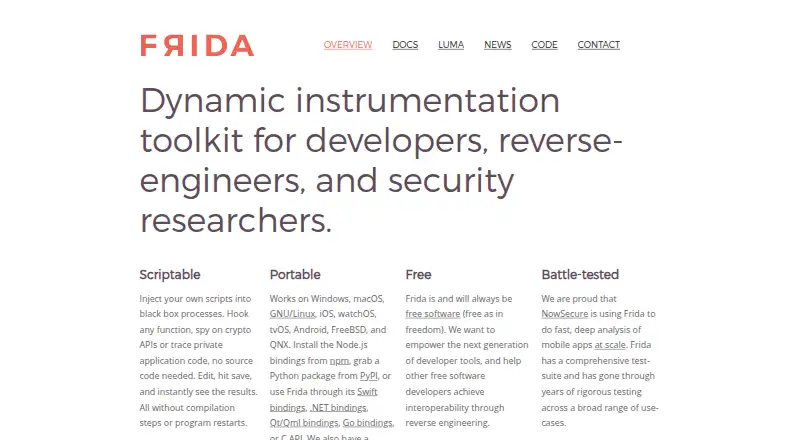
What Frida is
Frida is a dynamic instrumentation toolkit for developers, reverse-engineers, and security researchers. It lets you place scripts in running processes to hook functions, inspect APIs, and trace application code without source code. Uses described for Frida include API tracing, diagnostics, encrypted-protocol analysis, and black-box testing. It supports injected, embedded, and preloaded instrumentation; Frida Gadget can be embedded in a program when injection is unavailable, including on jailed iOS and Android systems.
Frida supports Windows, macOS, GNU/Linux, iOS, watchOS, tvOS, Android, FreeBSD, and QNX. It provides bindings for Node.js, Python, Swift, .NET, Qt/Qml, and Go, plus a C API. Its CLI tools require Python and run on Windows, macOS, or GNU/Linux; the documented installation command is `pip install frida-tools`. Frida describes itself as free software and says it will always be free. Its official native GUI, Luma, offers persistent sessions, a live REPL, pluggable instruments, and real-time collaboration.
Good
- Hooks functions and inspects APIs in running processes
- Works without application source code
- Supports injected, embedded, and preloaded modes
- Bindings cover six languages plus a C API
- Free software with no paid plans listed
Watch out
- CLI tools require Python
- CLI runs only on Windows, macOS, or GNU/Linux
Who it suits
Frida suits developers and security researchers who need to inspect or trace running applications without source code. It also fits reverse-engineers working across its supported platforms and scripting languages.
Verdict
Frida provides a broad set of instrumentation modes and target platforms for dynamic analysis. Its free-software model may suit users comfortable with Python-based CLI setup or its Luma GUI.
Plans and prices
From Frida's own pricing page, checked 15 Oct 2026.
| Plan | Price | What it gives you |
|---|---|---|
| Free software | Free | dynamic instrumentation toolkit · CLI, libraries and bindings · no paid tiers listed |
The facts
Each one read from Frida's own pages, with the date it was checked.
What it does
- Build options
- The project supports prebuilt binaries or building from source with make and optional configure settings.checked 15 Oct 2026
- CLI REPL
- The Frida CLI provides an interactive REPL modeled after IPython or Cycript, with objects such as Process, Memory, Module, ObjC and Stalker.checked 15 Oct 2026
- Collaboration
- Luma syncs sessions, REPL transcripts, instruments, captures, notebook entries, and presence in real time, and uses GitHub authentication.checked 2 Oct 2026
- Core library
- frida-core injects JavaScript into processes, maintains two-way communication, enumerates apps and processes, and is written mainly in Vala with C, Objective-C and assembly glue.checked 15 Oct 2026
- Documentation depth
- The documentation includes tutorials, troubleshooting, building, footprint guidance, platform guides, tool references and JavaScript, C, Gum, Core, Swift and Go API sections.checked 15 Oct 2026
- Function inspection
- The documentation demonstrates observing calls, changing arguments and invoking native functions inside a target process.checked 15 Oct 2026
- Funding record
- Crunchbase shows four funding rounds for NowSecure, including debt financing involving CIBC Innovation Banking, while the total amount is not publicly displayed.checked 15 Oct 2026
- Gadget
- Frida Gadget can be embedded in a program when injected mode is unavailable, including on jailed iOS and Android systems.checked 2 Oct 2026
- GUI
- Luma is presented as the official Frida app with persistent sessions, a live REPL, an integrated frida-trace handler editor and real-time collaboration.checked 15 Oct 2026
- History
- Frida grew from Ole André Vadla Ravnås's frida-gum instrumentation library and later added frida-core, QuickJS scripting, Stalker tracing and Python bindings.checked 15 Oct 2026
- Independent comparison
- Cyberly characterizes Frida as strongest for live runtime interaction and behavioral manipulation, complementing static tools such as Ghidra and IDA Pro.checked 15 Oct 2026
- Installation
- CLI installation requires a recent Python 3.x release and Windows, macOS or GNU/Linux; the documented command is pip install frida-tools.checked 15 Oct 2026
- Instrumentation modes
- Frida supports injected, embedded, and preloaded instrumentation modes.checked 2 Oct 2026
- Integrations
- Luma can browse and import scripts from CodeShare and add npm packages through its built-in package manager.checked 2 Oct 2026
- Language bindings
- Bindings are available for Python, Node.js, Swift, .NET, Qt/Qml and Go, alongside a C API.checked 15 Oct 2026
- Languages
- Frida offers bindings for Node.js, Python, Swift, .NET, Qt/Qml, and Go, as well as a C API.checked 2 Oct 2026
- Licence
- The main repository uses the wxWindows Library Licence 3.1, based on LGPL terms with an exception allowing binary works to be distributed under the distributor's terms.checked 15 Oct 2026
The company
- Company facts
- LinkedIn lists NowSecure as privately held, founded in 2009, headquartered in Chicago and employing 51–200 people.checked 15 Oct 2026
- Company legal name
- Crunchbase lists the supporting company’s legal name as NowSecure, Inc., formerly known as viaForensics.checked 15 Oct 2026
Money
- Free software
- Frida describes itself as free software and says it will always be free.checked 2 Oct 2026
Where it runs
- GUI app
- Luma is Frida’s official native GUI and includes persistent sessions, a live REPL, pluggable instruments, and real-time collaboration.checked 2 Oct 2026
- iOS modes
- iOS operation differs for jailbroken and non-jailbroken devices; non-jailbroken use requires a debuggable app, mounted Developer Disk Image and a cached Gadget.checked 15 Oct 2026
- iOS version guidance
- The iOS guide recommends iOS 13 or newer and treats older versions as experimental.checked 15 Oct 2026
- Limit: Android detection
- AppSec Santa notes that Android applications may detect frida-server and terminate before hooks are installed.checked 15 Oct 2026
The full review of Frida
Overview
Frida is a dynamic instrumentation toolkit for examining software while it runs, without needing access to its source code. It is best suited to developers, reverse-engineers, and security researchers who are comfortable working with scripts and command-line tools. Its breadth of targets and instrumentation modes makes it a strong fit for runtime investigation; it is less suitable for readers seeking a conventional, ready-made desktop analysis suite.
Key features
Runtime scripting
Frida injects scripts into running processes so users can hook functions, inspect APIs, and trace application code. That makes it useful for investigating behavior that static inspection cannot reveal, including the documented tasks of diagnostics, encrypted-protocol analysis, and black-box testing. The trade-off is that this is an instrumentation toolkit, not a turnkey analysis workflow: its scripting approach favors users prepared to build and direct their own investigations.
Bindings for Node.js, Python, Swift, .NET, Qt/Qml, and Go, plus a C API, provide several ways to integrate Frida into existing development work. That flexibility is valuable across varied toolchains, though users still need to choose and work in a supported interface.
Modes and target access
Injected, embedded, and preloaded modes give users different ways to instrument a target. Frida Gadget can be embedded in a program when injection is unavailable, including on jailed iOS and Android systems. This broadens Frida's usefulness on constrained devices, but embedded instrumentation requires a different setup from simply injecting into a running process.
The official Luma GUI offers persistent sessions, a live REPL, pluggable instruments, and real-time collaboration. It can browse and import CodeShare scripts and add npm packages through its built-in package manager. Luma syncs sessions, REPL transcripts, instruments, captures, notebook entries, and presence, using GitHub authentication. These features offer a more visual and collaborative route into Frida, although the command-line tools remain an important option for users who prefer direct scripting.
Pricing
Frida's Free software plan costs nothing, and the project says it will always be free. There is no free trial because the toolkit is free software, and no paid plans are listed. This is a clear fit for individuals and teams who want a free instrumentation toolkit rather than a commercial tier with differentiated entitlements.
The command-line tools are installed with Python on Windows, macOS, or GNU/Linux; the documented pip command is pip install frida-tools. Luma is also available at no charge as Frida's official GUI. The free model removes a license cost, but users should expect to handle the setup and scripting work that come with a developer-oriented toolkit.
Platforms
Frida supports Windows, macOS, GNU/Linux, iOS, watchOS, tvOS, Android, FreeBSD, and QNX, across ia32, x64, arm, and arm64 architectures. That range suits work spanning desktop, mobile, and other supported targets. Frida's CLI setup is documented for Windows, macOS, and GNU/Linux; Luma downloads are listed for macOS, iOS, Linux, and Windows, with minimums of macOS 15+ and iOS 26+.
Who it's for
Frida is a strong choice for security researchers and reverse-engineers who need to observe runtime behavior across different operating systems, or developers diagnosing a program without its source. Its language bindings and multiple instrumentation modes also suit teams integrating analysis into existing workflows. Users who want an out-of-the-box disassembler or decompiler, rather than script-driven runtime instrumentation, should consider a different tool.
Pros and cons
- Pro: Supports multiple instrumentation modes and a wide range of operating systems, making it adaptable to different targets and access constraints.
- Pro: Broad language bindings and a C API let users work with existing development languages.
- Pro: Luma adds persistent sessions, a live REPL, script and package access, and real-time collaboration.
- Con: The CLI requires Python and a supported desktop operating system, so getting started involves setup rather than simply opening an application.
- Con: The script-based model expects users to direct their own analysis; it is not a ready-made static analysis interface.
- Con: Luma's stated macOS 15+ and iOS 26+ minimums may rule out older devices for the GUI.
Alternatives
For a related option, browse Reverse Engineering Tools. radare2 is another free reversing toolkit with broad platform support, including self-hosted use; consider it when a reversing toolkit is a better fit than Frida's runtime instrumentation focus. rev.ng may suit readers focused on its free-software decompilation pipeline, with the UI offered commercially in cloud and standalone versions.
Rizin is a free binary analysis framework for readers looking for that kind of analysis tool instead. Binary Ninja is worth considering when decompilation is the priority: its free tier covers evaluation and education, with five decompilation architectures but no API or plugin access. IDA Pro offers a free tier for x86-32 and x86-64 disassembly with two cloud-based decompilers, while its paid Essential plan is 1099.00 USD.
angr is a free, open-source option for users working with Python 3.10+ on Windows, macOS, or Linux. JEB may suit researchers, students, hobbyists, and nonprofit reverse-engineers seeking its free Community Edition for x86 and x86-64 decompilation. Cutter is another free and open-source option, under GPLv3, for readers who want to compare a different tool.
Verdict
Choose Frida if you need free, scriptable access to software at runtime across a wide set of targets, especially when source code is unavailable or ordinary injection is not possible. Its depth, language options, and Luma collaboration features are compelling; look elsewhere if your priority is a more packaged disassembly or decompilation workflow.
Getting started
- Visit https://frida.re/ for Frida information.
- Install Python on Windows, macOS, or GNU/Linux for the CLI tools.
- Run `pip install frida-tools` to install the CLI tools.
- Use Frida's bindings or C API in a supported language, or use the official Luma GUI.
- For Luma, choose a listed build for macOS, iOS, Linux, or Windows.
Questions
How much does Frida cost?
Frida is free software. The listed plan is Free software at no cost, with no paid plans listed.
Which systems can Frida target?
Frida supports Windows, macOS, GNU/Linux, iOS, watchOS, tvOS, Android, FreeBSD, and QNX. Listed architectures are ia32, x64, arm, and arm64.
What languages does Frida support?
It offers bindings for Node.js, Python, Swift, .NET, Qt/Qml, and Go, as well as a C API.
What does Frida do?
It injects scripts into running processes to hook functions, inspect APIs, or trace application code without source code. Documented uses include API tracing, diagnostics, encrypted-protocol analysis, and black-box testing.
Is there a graphical interface?
Yes. Luma is Frida's official native GUI, with persistent sessions, a live REPL, pluggable instruments, and real-time collaboration.
How do I install the CLI tools?
The CLI tools require Python and Windows, macOS, or GNU/Linux. The documented command is `pip install frida-tools`.
Alternatives to Frida
- 1

Binary Ninja
Free planWebAPILinuxmacOS7.8$199 one-time - 2

rev.ng
Free planOpen sourceWebAPILinuxmacOS7.7Free plan - 3

JEB
Free planAPILinuxmacOSSelf-hosted7.6From $1,200 a year - 4
Ghidra
Free planOpen sourceAPIExtensionLinuxmacOS7.3Free plan - 5

IDA Pro
Free planLinuxmacOSWindows7.0From $1,099 a year - 6
Boomerang
Free planLinuxmacOSWindows6.7Free plan