
rev.ng
rev.ng is a decompiler for reverse engineering that produces syntactically valid, standard-compliant C from supported binaries.
What rev.ng is
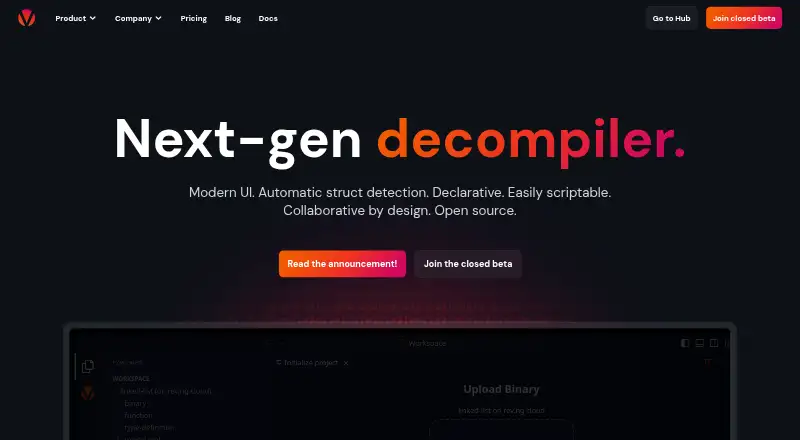
rev.ng is a decompiler for reverse engineering that produces syntactically valid, standard-compliant C from supported binaries. It can identify data structures such as linked lists, structs, and arrays by using information across functions. Listed architectures available by default include x86, x86-64, ARM, AArch64, MIPS, and S390X; supported imports include ELF, PE/COFF, Mach-O, DWARF, PDB, and IDB. Users can define functions, revise prototypes, and rename items using YAML files. Its client-server design supports interaction through an HTTP API, and debugger integration and a scripting API are listed. The interface is described as usable in a browser or standalone app, with cloud and standalone versions offering the same experience; the site invites users to join a closed beta for the UI. Collaborators can share project URLs, with public projects allowing two collaborators. The company says its decompilation pipeline is Free Software, while the UI is intended for commercial cloud and standalone versions. rev.ng is free and lists API, Linux, macOS, web, and Windows platforms.
Good
- Produces standard-compliant C code
- Recognizes several data structures across functions
- Lists six default architecture families
- Supports HTTP API interaction
- Decompilation pipeline is Free Software
Watch out
- UI is in a closed beta
- Public projects allow two collaborators
- Private and standalone plan terms are TBD
Who it suits
rev.ng may suit reverse-engineering users who need C output, structure recovery, and API or YAML-based workflow options. Its listed platforms cover desktop operating systems as well as browser and API access.
Verdict
rev.ng combines binary decompilation with structure recovery and configurable project workflows. The UI’s closed-beta status and TBD terms for private or standalone options are important considerations.
Plans and prices
From rev.ng's own pricing page, checked 14 Oct 2026.
| Plan | Price | What it gives you |
|---|---|---|
| Open source | Free | available anywhere · no UI · private projects · no collaborators · emits C, disassembly and CFG · imports ELF, PE/COFF, Mach-O, DWARF, PDB and IDB · detects functions, arguments and data structures · Free as in Freedom |
| Public project | Free | cloud hosted · public visibility · 2 collaborators per project · closed beta access · emits C, disassembly and CFG · imports ELF, PE/COFF, Mach-O, DWARF, PDB and IDB · detects functions, arguments and data structures · Free as in Free Beer |
| Private project | Priced on request | cloud hosted · private visibility · unlimited collaborators · availability TBD · emits C, disassembly and CFG · imports ELF, PE/COFF, Mach-O, DWARF, PDB and IDB · detects functions, arguments and data structures · TBD |
| Standalone | Priced on request | fully standalone and offline · runs anywhere · private projects · unlimited collaborators · availability TBD · emits C, disassembly and CFG · imports ELF, PE/COFF, Mach-O, DWARF, PDB and IDB · detects functions, arguments and data structures · TBD |
The facts
Each one read from rev.ng's own pages, with the date it was checked.
What it does
- Access
- The UI is described as available in a browser or as a standalone app, with cloud or standalone use offering the same experience.checked 2 Oct 2026
- Architecture coverage
- The product site says its QEMU-based approach can support more than 20 architectures.checked 14 Oct 2026
- Architecture foundation
- LLVM supplies analysis and optimization passes while QEMU lifts machine code to an architecture-independent representation.checked 14 Oct 2026
- Architecture support
- The features page lists x86, x86-64, ARM, AArch64, MIPS, and S390X as included by default.checked 2 Oct 2026
- Automatic data structures
- Interprocedural analysis can infer linked lists, structs, arrays and arrays of structs.checked 14 Oct 2026
- Automation
- A client-server architecture allows users to interact through an HTTP API.checked 2 Oct 2026
- Availability
- The site invites users to join a closed beta for the UI.checked 2 Oct 2026
- Beta status
- The public-project cloud UI is described as a closed beta with invitations handled on a FIFO basis.checked 14 Oct 2026
- Binary formats
- Import support includes IDA IDB/I64 databases, DWARF debug information and Windows PDB information.checked 14 Oct 2026
- Cloud collaboration
- Hub lets users create projects in the browser and collaborate by sharing a URL.checked 14 Oct 2026
- Collaboration
- The product page says collaborators can work on the same project by sharing a URL; public projects include two collaborators per project.checked 2 Oct 2026
- Commercial boundary
- The decompilation pipeline is Free Software, while the UI is planned as commercial cloud and standalone software.checked 14 Oct 2026
- C output
- The decompiler emits syntactically valid, standard-compliant C code.checked 2 Oct 2026
- C output validity
- The decompiler emits syntactically valid, standard-compliant C that the feature page demonstrates compiling with GCC.checked 14 Oct 2026
- Crunchbase founder
- Crunchbase identifies Pietro Fezzardi as a co-founder and compiler engineer.checked 14 Oct 2026
- Crunchbase funding
- Crunchbase lists rev.ng as privately held, shows one grant funding round with EISMEA as investor, and does not disclose the amount.checked 14 Oct 2026
- Data structure recovery
- It automatically detects data structures such as linked lists, structs, arrays, and arrays of structs using interprocedural information.checked 2 Oct 2026
- Decompilation
- The decompiler produces C code intended to be valid and recompilable without significant warnings.checked 14 Oct 2026
- Developer documentation
- A separate developer manual is provided alongside the user manual and CLI reference.checked 14 Oct 2026
- Docker install
- A rev.ng Docker image is documented, with an amd64 platform option for Apple Silicon Macs.checked 14 Oct 2026
The company
- Company headquarters
- rev.ng says it is based in Milan, Italy, with part of the team working remotely.checked 14 Oct 2026
- Company history
- The founders describe the project as originating from binary-analysis and compiler research connected with Politecnico di Milano.checked 14 Oct 2026
- Company legal name
- The website footer identifies the maker as rev.ng Labs S.r.l.checked 14 Oct 2026
- Company size
- LinkedIn lists rev.ng Labs as a privately held computer and network security company with 2–10 employees.checked 14 Oct 2026
The full review of rev.ng
rev.ng is a reverse-engineering decompiler for analysts who want to turn binaries into C and recover clues about their data structures. It is best suited to users comfortable with a developing UI and project-based workflows. Its broad architecture support and open-source pipeline are appealing, but the closed beta and unclear project-plan pricing make it a qualified choice.
Overview
rev.ng pairs decompilation with structure recovery and workflow controls. It emits syntactically valid, standards-compliant C and can identify structures across functions, giving analysts more to work with when tracing how a program handles data. The pipeline is Free Software, but the UI is intended as a commercial cloud or standalone product; this is a mixed-license offering, not an entirely open-source application.
The UI is described as available in a browser or standalone app, with the same experience in either mode. The closed beta is the main adoption hurdle: users should not plan around a broadly available interface until they can join and use it. For questions and problem reports, rev.ng points users to Discourse, Discord, and email.
Key features
- Data-structure recovery: Automatic detection covers linked lists, structs, arrays, and arrays of structs, using information gathered across functions. This can help analysts form a clearer picture of a binary’s data model, though the detections are clues to interpret rather than a substitute for analysis.
- C output: Syntactically valid, standard-compliant C provides a readable starting point for understanding program behavior. It does not, by itself, establish that the recovered code matches the original source.
- Architecture and import coverage: Included architectures are x86, x86-64, ARM, AArch64, MIPS, and S390X. Imports include ELF, PE/COFF, Mach-O, DWARF, PDB, and IDB, making rev.ng relevant across several common binary and debugging formats.
- Automation and workflow: A client-server design exposes an HTTP API, while YAML files let users define functions, edit prototypes, and rename items. These controls suit repeatable or scripted analysis better than a workflow limited to manual interaction.
- Shared projects: Collaborators can work on a project through a shared URL. Public projects allow two collaborators per project; users needing private visibility or more collaborators must consider a different plan.
Pricing
rev.ng is presented as free, and its open-source core is the clearest no-cost route. The project plans distinguish public collaboration from private cloud or offline use, but prices for the paid options are not settled, so teams should confirm terms before making a procurement decision.
| Plan | What it includes | Best fit |
|---|---|---|
| Open source | Open-source core, runs anywhere, private projects, all architectures; price not listed. | Users who want the core pipeline and private projects without relying on the commercial UI. |
| Public project | Two collaborators per project; price not listed. | Small teams willing to use public project visibility. |
| Private project | Cloud, all architectures, unlimited collaborators, and private visibility; custom pricing, billed TBD. | Teams that need private cloud projects and room for larger collaboration. |
| Standalone | Fully standalone and offline, all architectures, unlimited collaborators, and private visibility; custom pricing, billed TBD. | Teams that require offline deployment and private projects. |
The public-project plan caps collaboration at two people and requires accepting public visibility. Private cloud and standalone plans remove that collaborator cap and add private visibility, but their TBD billing terms leave costs uncertain. The open-source plan provides private projects and all architectures, though the plan description does not promise the commercial UI experience.
Platforms
rev.ng lists API, Linux, macOS, web, and Windows support. Browser and standalone UI options cover different deployment preferences, while the standalone plan specifically offers offline use. The site invites users to join a closed beta for the UI, which may affect whether those options are accessible to a prospective user now.
Who it's for
rev.ng is a strong candidate for reverse engineers who need C output, structure recovery, and scripting across multiple architectures. The API and YAML-based controls will matter most to analysts building repeatable workflows, while shared URLs can suit small groups working on public projects. It is less suitable for teams that need a mature, generally accessible UI, fixed commercial terms, or private collaboration without confirming the relevant plan.
Pros and cons
Pros
- Structure recovery spans linked lists, structs, and array forms, adding useful context to decompiled output.
- Six listed architectures and imports spanning executable and debugging formats support varied analysis work.
- An HTTP API and YAML workflow controls provide options for automation and repeatability.
- The open-source core runs anywhere and includes private projects and all architectures.
Cons
- The UI is in closed beta, making access a practical uncertainty for users who need a graphical workflow.
- Public projects are limited to two collaborators and public visibility.
- Private cloud and standalone plans have custom pricing with billing marked TBD, complicating budgeting.
- The UI is commercial even though the decompilation pipeline is Free Software, so the product is not wholly open source.
Alternatives
Decompiler Software and Reverse Engineering Tools are useful starting points for comparing products across those categories.
- Binary Ninja is worth considering for users who want a freemium alternative with a free evaluation and education plan, while its free tier limits decompilation to five architectures and excludes API or plugin access.
- IDA Pro suits readers seeking a paid alternative with a free tier for x86-32 and x86-64 disassembly and two cloud-based decompilers; its listed platforms are Linux, macOS, and Windows.
- JEB offers a free Community Edition for x86 and x86-64 decompilation, aimed at researchers, students, hobbyists, and nonprofit reverse engineers.
- Bytecode Viewer is a free, open-source GPL v3 option for users who prioritize a fully free tool.
- Ghidra is a free alternative for users seeking software with no stated price or usage limits.
- ILSpy is a free, MIT-licensed alternative.
- JADX is a free, Apache 2.0-licensed option for readers who can accept that decompilation may not recover all code.
- Relyze is another Windows alternative.
Verdict
Choose rev.ng if you need multi-architecture decompilation with structure recovery and want an open-source pipeline that can support scripted workflows. Its strongest case is the combination of C output, interprocedural recovery, and API access. Look elsewhere if your project depends on immediate UI access, guaranteed private collaboration at a known cost, or an entirely open-source product.
Getting started
- Visit https://rev.ng/.
- Choose among the listed API, Linux, macOS, web, or Windows platforms.
- Join the closed beta for access to the UI.
- Use the browser or standalone app when available.
- For collaboration, share a project URL; public projects allow two collaborators.
Limits worth knowing
The UI is offered through a closed beta. Public projects include two collaborators per project; private project and standalone plans are marked billed TBD.
Questions
Is rev.ng free?
Yes. The pricing model is free, and a free plan is listed.
Which platforms are listed?
API, Linux, macOS, web, and Windows.
Is rev.ng open source?
The company says its decompilation pipeline is Free Software. The UI will be offered commercially in cloud and standalone versions.
Which architectures and imports are supported?
Default architectures listed are x86, x86-64, ARM, AArch64, MIPS, and S390X. Imports listed include ELF, PE/COFF, Mach-O, DWARF, PDB, and IDB.
Who makes rev.ng?
rev.ng Labs develops it and says it is based in Milan, Italy.
Alternatives to rev.ng
- 1

Binary Ninja
Free planWebAPILinuxmacOS7.8$199 one-time - 2
Frida
Free planOpen sourceAndroidiOSAPILinux7.7Free plan - 3

JEB
Free planAPILinuxmacOSSelf-hosted7.6From $1,200 a year - 4
Ghidra
Free planOpen sourceAPIExtensionLinuxmacOS7.3Free plan - 5

IDA Pro
Free planLinuxmacOSWindows7.0From $1,099 a year - 6
Boomerang
Free planLinuxmacOSWindows6.7Free plan